Microscopy Calculations: Magnification and Actual Size
FREE BIOLOGY REVISION · UNIT 1 · A1.5
Pearson BTEC Level 3 AAQ Applied Science · Issue 7, May 2026
Revision notes
The central relationship
Magnification = image size ÷ actual size. Rearrange to actual size = image size ÷ magnification, or image size = actual size × magnification. Magnification is a ratio with no physical unit, written for example ×400. Use the same length unit for image and actual size before dividing.
1 mm = 1000 µm; 1 µm = 1000 nm. Thus 1 mm = 1 000 000 nm. Convert before substituting and show working so that the direction of the conversion is clear. A cell diameter is normally a length, not an area or volume.
Scale bars survive resizing
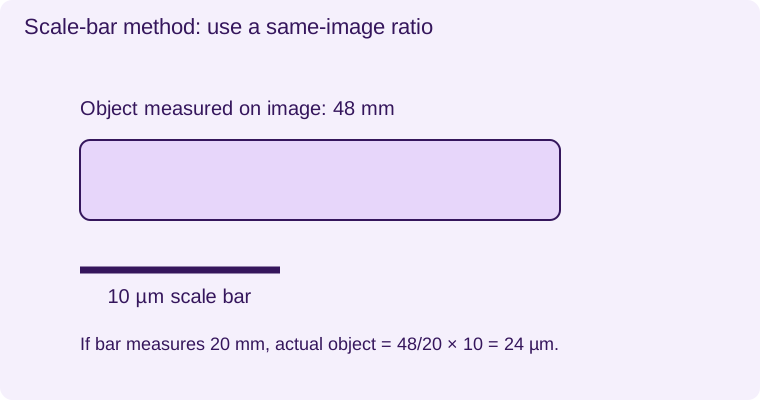
A labelled scale bar represents an actual length in the specimen. If an image is resized together with its bar, the ratio of measured object length to measured bar length remains valid. Actual object size = measured object ÷ measured scale bar × stated actual bar length. A printed magnification label becomes invalid when the image is resized without updating the label.
Measure between the specified boundaries. A fuzzy edge, slanted cell or thick printed line introduces uncertainty. Repeat measurements when appropriate and quote sensible precision. Do not give six significant figures from a ruler measurement to the nearest millimetre.
Two-dimensional evidence
An image may show a section through a cell rather than its largest diameter. Your calculated length is the represented section length unless the question supplies more information. A larger image does not necessarily represent a larger organism: compare scale bars.
For an optical microscope, total magnification is eyepiece magnification × objective magnification. A ×10 eyepiece and ×40 objective give ×400. This does not mean that every displayed digital image is at ×400; later display enlargement can change the final image size.
Enlarge diagram
Swipe the larger view, or focus it and use the arrow keys.
Worked application and data skills
Example 1: an image is 48 mm long at ×1200. Actual length = 48 ÷ 1200 = 0.040 mm = 40 µm.
Example 2: a cell is 8 µm wide and magnification is ×2500. Image width = 8 × 2500 = 20 000 µm = 20 mm.
Example 3: a 10 µm scale bar measures 20 mm on screen; an organelle measures 8 mm. Actual length = 8/20 × 10 = 4 µm.
Example 4: a bacterium is 2500 nm long. In micrometres this is 2500/1000 = 2.5 µm. A 25 mm image therefore has magnification 25 000/2.5 = ×10 000.
Common misconceptions
Magnification is unitless. Divide image size by magnification to find actual size. A scale bar must be measured on the same displayed image as the object.
Examination tips
Write the rearranged equation, substitute compatible units and include the final size unit.
Check your understanding
Five original questions. Use Tab to move between controls, arrow keys within a radio group, and Enter or Space on buttons. Feedback appears after Check Answer. Try Again clears the question. Attempts are not saved.
Sources and scope
Scope: Unit 1 A1.5. Original BTECRevision notes, schematics and questions. Independent resource; not endorsed by Pearson.
Official Pearson specification. Scientific review references are listed in the accompanying QA report.
EXAM RESOURCES
Biology exam resources
Apply your knowledge with written practice.
Browse exam resources