Bacterial Cell Ultrastructure
FREE BIOLOGY REVISION · UNIT 1 · A1.1.1
Pearson BTEC Level 3 AAQ Applied Science · Issue 7, May 2026
Learning objectives · A1.1.1
By the end of this topic you should be able to:
Identify the nucleoid, plasmids, 70S ribosomes, capsule, cell wall, cytoplasm, plasma membrane, flagella and pili; link structures to their functions and explain the historical mesosome term.
Revision notes
A small cell with a complete working system
A prokaryotic cell has no membrane-bound nucleus. Its main chromosome occupies a nucleoid region in the cytoplasm. Many bacteria also contain plasmids: smaller DNA molecules that replicate separately and can carry useful genes, including some antibiotic-resistance genes. These are not essential features of every bacterium. The nucleoid stores genetic information; it is not a miniature nucleus.
The cytoplasm contains enzymes for metabolic reactions. 70S ribosomes translate messenger RNA into proteins. The S describes sedimentation behaviour, not a count of components. A plasma membrane forms a selectively permeable boundary. Bacteria have no mitochondria: in aerobic bacteria, respiratory electron transport takes place at the plasma membrane.
Protective and external structures
Most bacterial cell walls contain peptidoglycan, which helps maintain shape and prevents osmotic lysis. The wall is outside the plasma membrane. Some bacteria have a capsule outside the wall; it can assist attachment and protect against drying or host defences. Capsules are not present in all species.
Flagella provide movement through rotation. Pili are shorter protein appendages used in attachment; specialised conjugation pili participate in DNA transfer between cells. Do not assume all pili have identical functions or that every bacterium has flagella.
Mesosomes: a specification term requiring care
Pearson lists mesosomes. Historically these were described as plasma-membrane infoldings with functions in respiration or cell division. Modern evidence identifies the classic mesosome as an artefact caused by chemical fixation for electron microscopy. Recognise the term in historical images, but do not present a mesosome as an established functional organelle in a living bacterium.
Apply structure to function
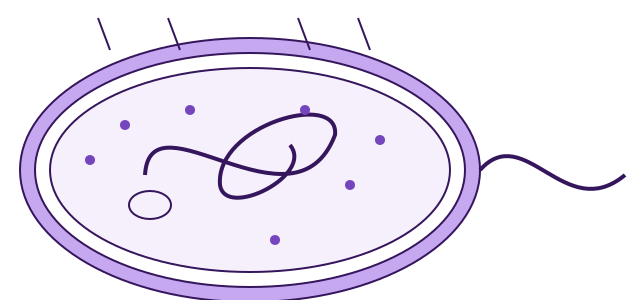
A protein-secreting bacterium needs ribosomes to make the protein, cytoplasmic enzymes to support metabolism and a membrane transport system to export it. A labelled drawing should distinguish the outer capsule, the supporting cell wall and the inner plasma membrane. Their positions and roles differ.
Worked application and data skills
A cell lacks a nucleus, contains 70S ribosomes and has peptidoglycan outside its membrane. These combined observations support identification as a bacterium. A tail alone is insufficient evidence because some eukaryotic cells also have flagella. If a plasmid carries a resistance gene, gaining it may change antibiotic susceptibility without changing the identity of the organism.
Common misconceptions
Bacteria contain DNA despite having no nucleus. A capsule, wall and membrane are different structures. Mesosomes are not accepted as normal respiratory organelles.
Examination tips
Use several identifying features together. Link each named structure to a specific function.
Check your understanding
Five original questions. Use Tab to move between controls, arrow keys within a radio group, and Enter or Space on buttons. Feedback appears after Check Answer. Try Again clears the question. Attempts are not saved.
Sources and scope
Scope: Unit 1 A1.1.1. Original BTECRevision notes, schematics and questions. Independent resource; not endorsed by Pearson.
Official Pearson specification. Scientific review references are listed in the accompanying QA report.
Take Your Learning Further
Practise
Build Your Confidence
Reinforce your understanding with our topic-based workbook. Every workbook page links back to its matching online lesson, so you can revisit explanations whenever you need support.
Explore Workbook – BiologyMaster
Get Exam Ready
Apply your knowledge with exam-style practice papers and detailed mark schemes. Identify what you’ve mastered and what to revise next.
Practice Papers – BiologyEXAM RESOURCES
Biology exam resources
Apply your knowledge with written practice.
Browse exam resources