Nucleotides, DNA and RNA Structure
FREE BIOLOGY REVISION · UNIT 1 · B4.1
Pearson BTEC Level 3 AAQ Applied Science · Issue 7, May 2026
Learning objectives
By the end of this topic you should be able to:
- Identify the components of nucleotides and distinguish DNA from RNA.
- Explain how nucleotides form polynucleotide chains and complementary base pairs.
- Relate nucleic-acid structure to the storage and use of genetic information.
Revision notes
The nucleotide building block
A nucleotide contains a pentose sugar, a phosphate group and a nitrogenous base. DNA uses deoxyribose; RNA uses ribose. Adenine and guanine are purines with two rings; cytosine, thymine and uracil are pyrimidines with one ring. DNA normally uses A, T, C and G; RNA normally uses A, U, C and G.
Forming a polynucleotide
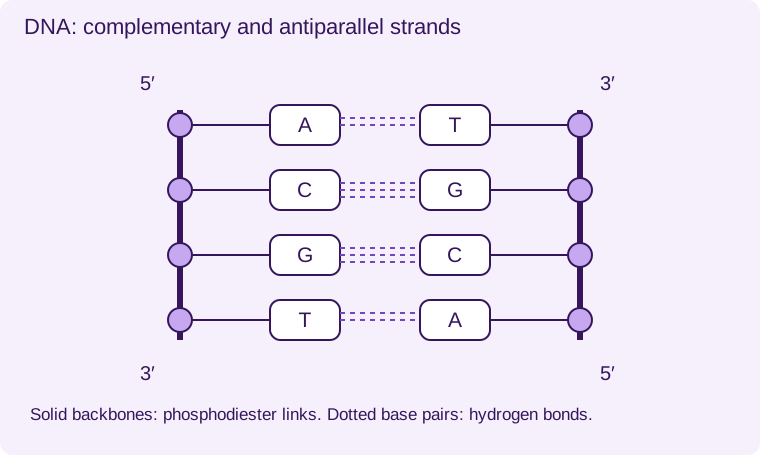
Condensation links nucleotides through phosphodiester bonds between sugar and phosphate groups, producing a sugar–phosphate backbone. Water is released in the simplified condensation model. The base projects from the sugar. A nucleic-acid strand has direction, described as 5′ to 3′. The covalent backbone is not held together by hydrogen bonds between adjacent bases.
An RNA nucleotide is formed from ribose, phosphate and an appropriate base; DNA nucleotides contain deoxyribose instead. Uracil replaces thymine in the usual RNA base set. RNA is usually single-stranded but can fold back and form complementary internal regions.
The DNA double helix
Two antiparallel polynucleotide strands associate through complementary base pairing: A with T and C with G. Hydrogen bonds between bases hold the paired strands together, with two in an A–T pair and three in a C–G pair. A purine pairs with a pyrimidine, helping maintain a consistent helix width. The backbones remain on the outside; bases point inward.
Antiparallel means one strand runs 5′→3′ while the paired strand runs 3′→5′. The base sequence stores information; the number of hydrogen bonds does not itself encode an amino-acid sequence. Complementarity permits a template relationship between strands.
Read and construct a sequence
When asked for a complementary sequence, pair each base and pay attention to direction. DNA pairing uses T; an RNA complement uses U opposite A. If both sequences must be written 5′→3′, the complementary strand must be reversed after pairing. This is a common source of errors in otherwise correct answers.
Enlarge diagram
Swipe the larger view, or focus it and use the arrow keys.
Enlarge diagram
Swipe the larger view, or focus it and use the arrow keys.
Worked application and data skills
For DNA 5′-ATGC-3′, the paired DNA strand is 3′-TACG-5′. Written in its own 5′→3′ direction it is 5′-GCAT-3′. In a double-stranded DNA sample with 30% A, T is also 30%; the remaining 40% is shared equally between G and C, giving 20% each. This percentage rule is not automatic for a single RNA strand.
Common misconceptions
Phosphodiester bonds form the backbone; hydrogen bonds connect complementary DNA bases. DNA strands are antiparallel. RNA uses uracil rather than thymine in its usual base set.
Examination tips
Label sugar, phosphate and base, and mark strand directions before complementing sequences.
Check your understanding
Five original questions. Use Tab to move between controls, arrow keys within a radio group, and Enter or Space on buttons. Feedback appears after Check Answer. Try Again clears the question. Attempts are not saved.
Sources and scope
Scope: Unit 1 B4.1. Original BTECRevision notes, schematics and questions. Independent resource; not endorsed by Pearson.
Official Pearson specification. Scientific review references are listed in the accompanying QA report.
Take Your Learning Further
Practise
Build Your Confidence
Reinforce your understanding with our topic-based workbook. Every workbook page links back to its matching online lesson, so you can revisit explanations whenever you need support.
Explore Workbook – BiologyMaster
Get Exam Ready
Apply your knowledge with exam-style practice papers and detailed mark schemes. Identify what you’ve mastered and what to revise next.
Practice Papers – BiologyEXAM RESOURCES
Biology exam resources
Apply your knowledge with written practice.
Browse exam resources