Specialised Plant, Blood, Reproductive and Nerve Cells
FREE BIOLOGY REVISION · UNIT 1 · A2.1
Pearson BTEC Level 3 AAQ Applied Science · Issue 7, May 2026
Revision notes
Plant cells adapted to transport and photosynthesis
Palisade mesophyll cells are elongated, closely packed beneath the upper leaf surface and contain many chloroplasts. Their position and organelle content support light absorption and photosynthesis. A large vacuole leaves a thin peripheral layer of cytoplasm, helping shorten diffusion paths.
Root hair cells have a long extension increasing surface area for water and mineral-ion uptake. A thin wall gives a short path; membrane transport proteins support selective ion uptake, including active transport. Mitochondria supply ATP. Water enters according to water-potential gradients; root hairs do not actively pump water itself.
Mature xylem vessel elements are dead, hollow and joined end to end, with end walls lost or perforated. Lignified walls resist collapse under tension and provide support. Pits permit lateral water movement. They carry water and mineral ions. Phloem sieve tube elements are living but lack a nucleus at maturity. Sieve plates allow sap flow. Companion cells have nuclei and many mitochondria, supporting loading and maintenance. Phloem translocates assimilates from sources to sinks; different tubes may carry material in opposite directions.
Reproduction
Sperm cells have a haploid nucleus, a flagellum for movement, mitochondria to support ATP supply and an acrosome containing enzymes involved in penetrating egg coverings. An egg cell also has a haploid nucleus; it is much larger, with cytoplasm and reserves supporting early development. Its membrane changes after fertilisation to help prevent polyspermy. Haploid gametes restore the diploid chromosome number when their nuclei fuse.
Blood cells and fragments
Mammalian erythrocytes have a biconcave shape, providing high surface area and a short diffusion distance. They contain haemoglobin and lack nuclei and mitochondria when mature, maximising space and avoiding consumption of transported oxygen by aerobic respiration. Their flexibility permits passage through capillaries.
Leucocytes have nuclei and defend the body. Phagocytes engulf pathogens; lymphocytes include cells producing antibodies and cells participating in other immune responses. Do not assign antibody secretion to every white cell. Thrombocytes, or platelets in mammals, are fragments derived from megakaryocytes. They adhere at damaged vessels and contribute to clot formation; they are not complete nucleated human cells.
Neurones
Neurones receive and transmit electrical signals. Dendrites receive inputs, the cell body maintains the cell, and a long axon carries impulses towards terminals. Myelin insulates many axons and nodes permit rapid saltatory conduction. Synaptic terminals communicate with other cells through neurotransmitters. The exact shape varies with sensory, relay and motor roles.
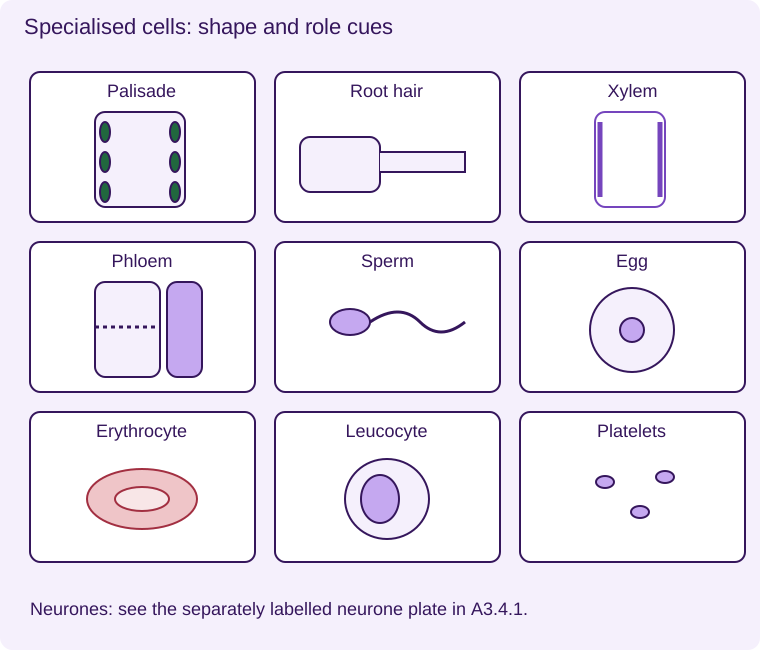
Palisade
Chloroplast-rich leaf cell
Root hair
Long projection increases absorption surface
Xylem
Hollow conducting vessel with strengthened walls
Phloem
Sieve tube beside a companion cell
Sperm
Head, midpiece and flagellum
Egg
Large cytoplasm and haploid nucleus
Erythrocyte
Biconcave red blood cell; no nucleus in maturity
Leucocyte
A nucleated white blood cell; forms vary
Platelets
Small cell fragments involved in clotting
Shape and role cues. Neurones have a separate labelled illustration in A3.4.1. The cells are not shown at a common scale.
- 1
- Acrosome
- 2
- Haploid nucleus
- 3
- Midpiece: mitochondria
- 4
- Flagellum
Sperm is specialised for fertilisation. The egg has a large cytoplasm and haploid nucleus; fertilisation restores diploidy. Not to scale.
- 1
- Dendrites
- 2
- Cell body and nucleus
- 3
- Axon
- 4
- Myelin segment
- 5
- Node of Ranvier: exposed axon
- 6
- Axon terminals
Action potentials regenerate at nodes; local current spreads under myelin. Schematic, not to scale.
Worked application and data skills
A cell in a plant transport tube has no nucleus but is still living and lies beside a mitochondria-rich companion cell. Identify a phloem sieve tube element, not a xylem vessel. A mature xylem vessel element is dead and has lignified walls. In a blood film, a biconcave cell without a nucleus suggests an erythrocyte; a nucleated cell is more consistent with a leucocyte.
Common misconceptions
Platelets are cell fragments in humans. Mature phloem sieve tubes are living despite lacking a nucleus. Root hairs actively transport ions, not water.
Examination tips
Always write adaptation → effect → function. Include every named cell group in your revision.
Check your understanding
Five original questions. Use Tab to move between controls, arrow keys within a radio group, and Enter or Space on buttons. Feedback appears after Check Answer. Try Again clears the question. Attempts are not saved.
Sources and scope
Scope: Unit 1 A2.1. Original BTECRevision notes, schematics and questions. Independent resource; not endorsed by Pearson.
Official Pearson specification. Scientific review references are listed in the accompanying QA report.
EXAM RESOURCES
Biology exam resources
Apply your knowledge with written practice.
Browse exam resources