Water Molecules, Polarity and Hydrogen Bonding
FREE BIOLOGY REVISION · UNIT 1 · B1.1
Pearson BTEC Level 3 AAQ Applied Science · Issue 7, May 2026
Revision notes
Formula and internal bonds
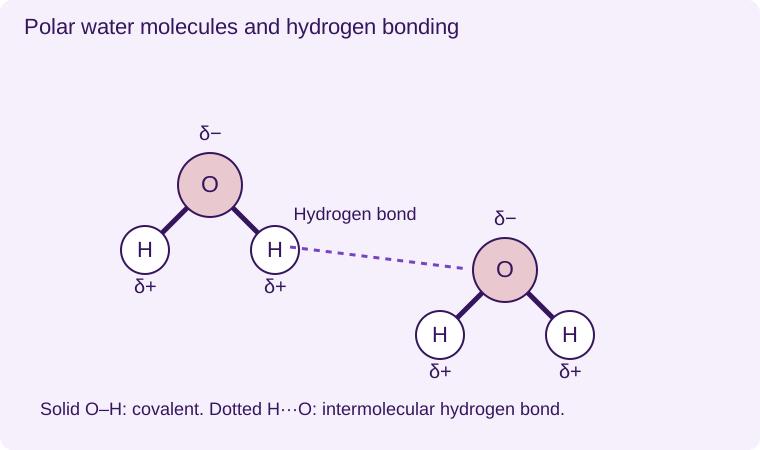
Water has molecular formula H₂O: two hydrogen atoms and one oxygen atom in each molecule. A structural formula can be written H–O–H, but the real molecule is bent rather than linear. Each O–H bond is covalent, formed by a shared pair of electrons. The shared electrons are attracted more strongly towards oxygen, making the bonds polar.
Oxygen carries a partial negative charge, δ−, and hydrogens carry partial positive charges, δ+. These are partial charges within a molecule, not full charges created by complete electron transfer. A water molecule is electrically neutral overall. Its bent arrangement means the bond polarities do not cancel, so it is a polar molecule.
Between molecules
A hydrogen bond forms between a partially positive hydrogen attached to an electronegative atom and an appropriate partially negative atom on a neighbouring molecule. In liquid water, attractions form and break continually. Use a solid line for a covalent O–H bond and a dotted line for a hydrogen bond between molecules; confusing these destroys the structure–property explanation.
Hydrogen bonds are individually much weaker than covalent O–H bonds, but large numbers have major effects on bulk properties. Energy is needed to disrupt enough intermolecular attractions for molecules to move apart. This helps explain water’s relatively high specific heat capacity and high latent heat of vaporisation.
From molecular structure to biology
Polarity supports interactions with ions and other polar molecules. It helps water act as a solvent and supports transport in blood and cell fluids. Cohesion between water molecules contributes to a continuous water column in xylem. The molecular basis must be stated before using these functions as evidence.
Melting or boiling water does not normally split every H₂O molecule into hydrogen and oxygen. The major changes involve arrangement and intermolecular interactions. Breaking the covalent bonds within water requires a different process, such as electrolysis under suitable conditions. Distinguish a physical state change from chemical decomposition.
Enlarge diagram
Swipe the larger view, or focus it and use the arrow keys.
Worked application and data skills
Consider two adjacent water molecules. Draw oxygen with δ− and each hydrogen with δ+. The O–H bond inside either molecule is covalent. A dotted link from one molecule’s Hδ+ to the other’s Oδ− represents a hydrogen bond. If asked why water is cohesive, cite these intermolecular attractions rather than claiming that separate molecules share one giant covalent bond.
Common misconceptions
Hydrogen bonds are between molecules in this example; O–H bonds are within a molecule. Water is neutral overall despite polarity. Boiling is not electrolysis.
Examination tips
Use correctly labelled bond types and partial charges in a molecular diagram.
Check your understanding
Five original questions. Use Tab to move between controls, arrow keys within a radio group, and Enter or Space on buttons. Feedback appears after Check Answer. Try Again clears the question. Attempts are not saved.
Sources and scope
Scope: Unit 1 B1.1. Original BTECRevision notes, schematics and questions. Independent resource; not endorsed by Pearson.
Official Pearson specification. Scientific review references are listed in the accompanying QA report.
EXAM RESOURCES
Biology exam resources
Apply your knowledge with written practice.
Browse exam resources