Comparing Plant and Animal Cells
FREE BIOLOGY REVISION · UNIT 1 · A1.3
Pearson BTEC Level 3 AAQ Applied Science · Issue 7, May 2026
Learning objectives
By the end of this topic you should be able to:
- Compare the shared organelles of plant and animal cells.
- Explain the functions of the plant cell wall, vacuole and chloroplasts.
- Use cell structure and function to justify comparisons.
Revision notes
Shared eukaryotic organisation
Typical plant and animal cells have a nucleus, cytoplasm, plasma membrane, mitochondria, ribosomes, ER, Golgi apparatus and vesicles. Both carry out respiration and need ATP. A plant cell does not replace mitochondria with chloroplasts: photosynthesis and respiration serve different functions. Their shared organelles support the same broad tasks of gene expression, protein synthesis, transport and metabolism.
Differences with functional consequences
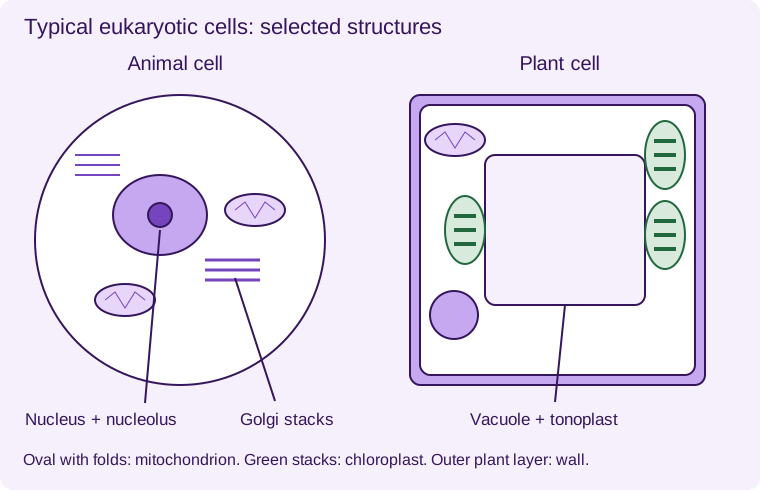
Plant cells have a cellulose wall outside the plasma membrane. This gives mechanical support and resists the internal pressure generated when water enters. Animal cells lack this wall and their shapes are often more flexible. A large permanent central vacuole commonly holds cell sap in a mature plant cell. Its tonoplast is a selective membrane. Water entering the vacuole contributes to turgor, helping support non-woody tissues.
Photosynthetic plant cells contain chloroplasts. Most animal cells have none, and many plant cells, including root hairs, also lack them. Amyloplasts in storage tissues store starch. Plants commonly store carbohydrate as starch; animals commonly use glycogen. Plasmodesmata connect neighbouring plant cells across walls.
Centrioles are common in animal cells; most higher plant cells lack them. Lysosomal digestion is typically associated with lysosomes in animals, while plant lytic vacuoles perform many equivalent functions. Avoid claiming that every specialised animal cell contains every textbook organelle: mature mammalian erythrocytes, for example, lack a nucleus and mitochondria.
Compare rather than list
A good comparison pairs the same criterion across both cell types. For example: plant cells have a cellulose wall providing support, whereas animal cells lack a cellulose wall. A statement about chloroplasts in one cell followed by a statement about the nucleus in another does not establish a matched comparison.
In dilute external solution, water can enter both cell types by osmosis. A plant wall limits further expansion and the cell becomes turgid. An animal cell has no rigid wall and can swell and lyse if conditions are sufficiently hypotonic. The wall is freely permeable to many small solutes; selective permeability belongs primarily to the membrane.
Animal cell
- 1
- Nucleus and nucleolus
- 2
- Golgi apparatus
- 3
- Mitochondrion
- 4
- Rough endoplasmic reticulum
- 5
- Plasma membrane
Plant cell
- 1
- Nucleus and nucleolus
- 2
- Vacuole containing cell sap
- 3
- Tonoplast
- 4
- Chloroplast
- 5
- Cell wall
- 6
- Plasma membrane
Selected structures shown. Schematic cells; not to scale.
Worked application and data skills
A leaf palisade cell and a liver cell both contain mitochondria. Only the palisade cell normally contains chloroplasts. Explain the difference: both need aerobic ATP production, while the palisade cell also absorbs light for photosynthesis. Do not claim that a liver cell obtains energy directly from light.
Common misconceptions
A root hair is a plant cell even without chloroplasts. Cell walls do not replace plasma membranes. Plants respire day and night.
Examination tips
Use paired comparisons and qualify typical features when specialised cells are exceptions.
Check your understanding
Five original questions. Use Tab to move between controls, arrow keys within a radio group, and Enter or Space on buttons. Feedback appears after Check Answer. Try Again clears the question. Attempts are not saved.
Sources and scope
Scope: Unit 1 A1.3. Original BTECRevision notes, schematics and questions. Independent resource; not endorsed by Pearson.
Official Pearson specification. Scientific review references are listed in the accompanying QA report.
Take Your Learning Further
Practise
Build Your Confidence
Reinforce your understanding with our topic-based workbook. Every workbook page links back to its matching online lesson, so you can revisit explanations whenever you need support.
Explore Workbook – BiologyMaster
Get Exam Ready
Apply your knowledge with exam-style practice papers and detailed mark schemes. Identify what you’ve mastered and what to revise next.
Practice Papers – BiologyEXAM RESOURCES
Biology exam resources
Apply your knowledge with written practice.
Browse exam resources