Endothelium, Risk Factors and Atherosclerosis
FREE BIOLOGY REVISION · UNIT 1 · A3.2.1
Pearson BTEC Level 3 AAQ Applied Science · Issue 7, May 2026
Revision notes
The vessel lining
Endothelium is a thin layer of specialised squamous cells lining blood vessels. It provides a smooth interface with blood, regulates exchange and releases signals affecting vessel diameter, inflammation and clotting. Healthy endothelium helps maintain controlled flow; it is not just an inert lining. Arteries also contain smooth muscle and elastic tissue, but these are not endothelial cells.
Formation of an atheroma
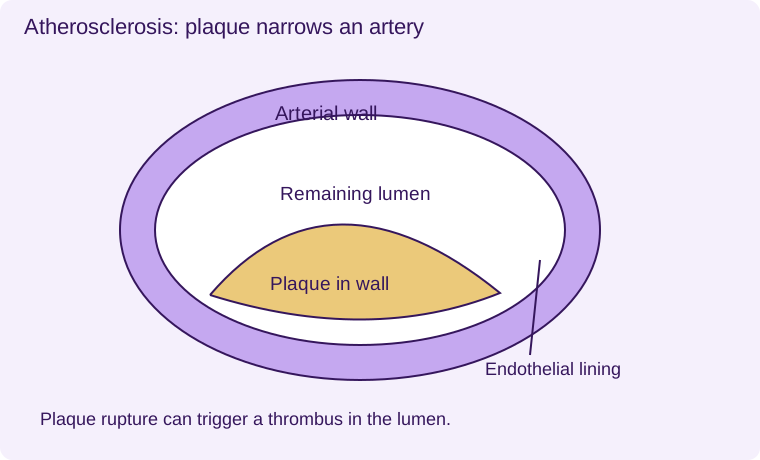
Endothelial dysfunction promotes retention of LDL-containing particles within the arterial wall and inflammatory-cell entry. Macrophages take up modified lipids and become foam cells, contributing to a fatty lesion. Smooth muscle cells and connective material help form a fibrous cap over the plaque. As the plaque develops, it can narrow the lumen and reduce blood supply.
A plaque can rupture or erode, exposing material that triggers platelet activation and coagulation. A thrombus may obstruct the artery. In coronary arteries this can deprive heart muscle of oxygen; in arteries supplying the brain it can contribute to ischaemic stroke. Atherosclerosis develops in arterial walls, not as droplets of dietary fat simply sticking inside any blood vessel.
Risk factors and mechanism
Smoking promotes endothelial injury, inflammation and thrombosis. Hypertension increases stress on vessel walls. High LDL concentrations increase the opportunity for lipid retention. Diabetes and persistently raised glucose can damage vessels and promote dysfunction. Physical inactivity, diet and excess adiposity can affect several of these pathways. Age and family history also influence risk.
Risk factors alter probability; they do not make the outcome inevitable. Multiple factors can interact, so avoid adding percentage risks from unrelated studies. Changes in vessel diameter and plaque stability both matter: the most dangerous event is not always caused by the plaque producing the greatest chronic narrowing.
Evaluate evidence
An association between smoking and disease does not, by itself, reveal every causal step. Mechanistic evidence, repeated observational findings and intervention evidence together strengthen an explanation. When interpreting a study, consider age, blood pressure, medication and other possible confounding factors.
- 1
- Arterial wall
- 2
- Endothelial lining
- 3
- Plaque within the wall narrows the lumen
Plaque rupture can trigger a thrombus in the lumen. Simplified artery cross-section; not to scale.
Worked application and data skills
In a fictional cohort, 24 of 200 people in one group and 10 of 200 in another experience an event. Risks are 12% and 5%; the absolute difference is 7 percentage points. The relative risk is 12/5 = 2.4. Without allocation and confounder information, do not assume that one measured lifestyle factor caused the entire difference.
Common misconceptions
A plaque is a lesion in an artery wall. A thrombus is a blood clot. Risk is not certainty, and relative change is not the same as percentage-point change.
Examination tips
Describe the chain from endothelial dysfunction to inflammation, plaque and possible thrombosis. Link risk factors to that chain.
Check your understanding
Five original questions. Use Tab to move between controls, arrow keys within a radio group, and Enter or Space on buttons. Feedback appears after Check Answer. Try Again clears the question. Attempts are not saved.
Sources and scope
Scope: Unit 1 A3.2.1. Original BTECRevision notes, schematics and questions. Independent resource; not endorsed by Pearson.
Official Pearson specification. Scientific review references are listed in the accompanying QA report.
EXAM RESOURCES
Biology exam resources
Apply your knowledge with written practice.
Browse exam resources