Carbohydrate Functions and ATP Supply
FREE BIOLOGY REVISION · UNIT 1 · B2.2
Pearson BTEC Level 3 AAQ Applied Science · Issue 7, May 2026
Learning objectives
By the end of this topic you should be able to:
- Explain how carbohydrates support energy supply and storage.
- Describe ATP as an immediate transfer molecule rather than a long-term energy store.
- Link carbohydrate use to the lesson’s cellular examples and calculations.
Revision notes
Fuel and ATP
Glucose can be broken down through respiration. Energy released is transferred to ATP, which couples energy-releasing reactions to cellular work such as active transport and biosynthesis. ATP is an immediate energy-transfer molecule, not the same substance as glucose. Aerobic respiration allows more complete oxidation than anaerobic glycolysis, but exact ATP yield depends on conditions and should not be treated as one universal number.
In the overall aerobic equation, glucose reacts with oxygen to form carbon dioxide and water: C₆H₁₂O₆ + 6O₂ → 6CO₂ + 6H₂O. The equation summarises many enzyme-controlled stages, not one explosive event inside a cell. Carbohydrate can support ATP supply in tissues including muscle and the nervous system.
Storage
Plants store starch; animals commonly store glycogen in liver and skeletal muscle. Both are compact and relatively insoluble, so large reserves can be held without the osmotic effect of an equivalent number of separate dissolved glucose molecules. Hydrolysis releases smaller sugars for metabolism. Branching creates many accessible ends, helping rapid mobilisation.
Liver glycogen supports regulation of blood glucose, while muscle glycogen mainly supplies the muscle’s own activity. These stores are not interchangeable in every physiological role. Do not claim that glycogen is a hormone or that insulin is a storage carbohydrate.
Structural and molecular roles
Cellulose microfibrils resist stretching in plant walls. Their strength results from straight chains and many interchain hydrogen bonds. This is different from the coiled or branched storage arrangement of starch and glycogen. Ribose and deoxyribose contribute to nucleotide structures, connecting carbohydrate chemistry to RNA, DNA and ATP.
Interpret an unfamiliar example
If a substance is a highly branched α-glucose polymer, a storage function is plausible. If it consists of parallel β-glucose chains assembled into fibres, a structural function is more plausible. Use evidence from structure to justify the answer. Insolubility is useful for both storage and strength, so it alone cannot identify the polymer.
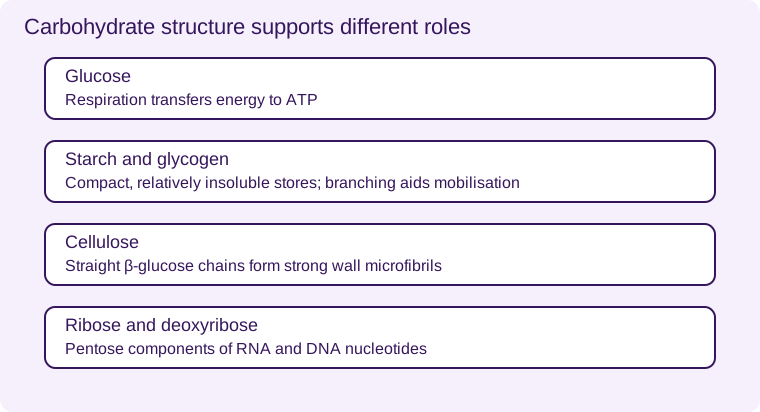
Respiration transfers energy to ATP
Compact, relatively insoluble stores; branching aids mobilisation
Straight β-glucose chains form strong wall microfibrils
Pentose components of RNA and DNA nucleotides
Worked application and data skills
A fictional muscle glycogen reserve falls from 80 to 50 arbitrary units during exercise. Use = 30 units; percentage decrease = 30/80 × 100 = 37.5%. This shows mobilisation of stored carbohydrate. It does not measure ATP yield directly because ATP production and use require separate measurements.
Common misconceptions
ATP transfers energy; it is not a long-term carbohydrate store. Muscle and liver glycogen have different physiological roles. Cellulose is not an α-glucose storage polymer.
Examination tips
Explain why a property is useful: insolubility reduces osmotic effects, while branching supports rapid mobilisation.
Check your understanding
Five original questions. Use Tab to move between controls, arrow keys within a radio group, and Enter or Space on buttons. Feedback appears after Check Answer. Try Again clears the question. Attempts are not saved.
Sources and scope
Scope: Unit 1 B2.2. Original BTECRevision notes, schematics and questions. Independent resource; not endorsed by Pearson.
Official Pearson specification. Scientific review references are listed in the accompanying QA report.
Take Your Learning Further
Practise
Build Your Confidence
Reinforce your understanding with our topic-based workbook. Every workbook page links back to its matching online lesson, so you can revisit explanations whenever you need support.
Explore Workbook – BiologyMaster
Get Exam Ready
Apply your knowledge with exam-style practice papers and detailed mark schemes. Identify what you’ve mastered and what to revise next.
Practice Papers – BiologyEXAM RESOURCES
Biology exam resources
Apply your knowledge with written practice.
Browse exam resources