Diffusion, Osmosis, Active Transport and Bulk Transport
FREE BIOLOGY REVISION · UNIT 1 · C1.2
Pearson BTEC Level 3 AAQ Applied Science · Issue 7, May 2026
Learning objectives
By the end of this topic you should be able to:
- Compare simple diffusion, facilitated diffusion, osmosis and active transport.
- Explain the roles of gradients, membrane proteins and ATP.
- Describe bulk transport and interpret percentage mass-change data.
Revision notes
Passive movement
Diffusion is net movement of particles down a concentration gradient as a result of random motion. Small non-polar molecules can diffuse through the lipid bilayer. Facilitated diffusion uses channels or carriers to move substances down their electrochemical or concentration gradient without direct ATP expenditure. Carrier-mediated rates can saturate when the available proteins are occupied.
Osmosis is net water movement across a selectively permeable membrane from higher water potential to lower water potential. In simple comparable solutions, this is from the more dilute side to the more concentrated side. Water can pass through aquaporins. At equilibrium water molecules still move both ways; net movement is zero. Pressure also affects water potential, especially in plant cells.
Active transport
Active transport moves substances against their concentration or electrochemical gradient using an energy source. Primary active transport directly couples movement to ATP hydrolysis, as in the sodium–potassium pump. Secondary active transport uses an ion gradient established by other energy-dependent processes. Thus not every active carrier directly hydrolyses ATP at the moment the solute moves.
Root cells can accumulate mineral ions against a gradient. An inhibitor of respiration may reduce ATP supply and impair active uptake. This is evidence about energy dependence, not proof that diffusion itself consumes ATP.
Bulk transport
Endocytosis brings material into a cell by membrane invagination and vesicle formation. Phagocytosis engulfs large particles; pinocytosis takes in extracellular fluid, and receptor-mediated pathways select cargo. Exocytosis exports material when a vesicle fuses with the plasma membrane. These membrane-remodelling processes require energy and are suitable for cargo that cannot simply pass through a small channel.
Predict cell responses
An animal cell in a sufficiently hypotonic environment gains water and may lyse. In a hypertonic environment it loses water and shrinks. A plant cell gains turgor in dilute solution; in a sufficiently concentrated solution, water loss can pull the membrane away from the wall, causing plasmolysis. The wall does not prevent water movement.
Experimental reasoning
In tissue osmosis experiments, control sample size, time, temperature and blotting. Percentage mass change permits comparison of pieces with different starting masses. A zero-change estimate is conditional on the method and does not prove that no individual water molecules moved.
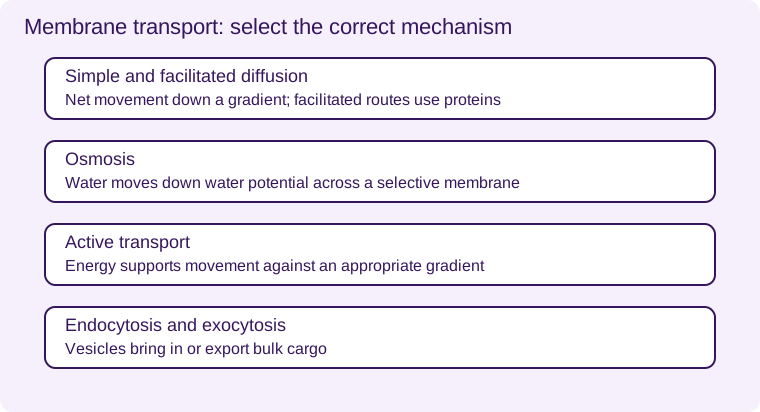
Net movement down a gradient; facilitated routes use proteins
Water moves down water potential across a selective membrane
Energy supports movement against an appropriate gradient
Vesicles bring in or export bulk cargo
1. Cargo outside
2. Invagination
3. Vesicle inside
Cell interior is shaded. Endocytosis encloses extracellular cargo; exocytosis uses vesicle fusion for export.
Worked application and data skills
A plant tissue sample rises from 2.0 to 2.3 g. Percentage mass change = (2.3 − 2.0)/2.0 × 100 = +15%. A sample falling from 2.0 to 1.7 g gives −15%. A plot of percentage change against external concentration can estimate the zero-change concentration by interpolation. Use a best-fit trend and do not label that point as zero molecular movement.
Common misconceptions
Facilitated diffusion is passive. Osmosis refers to water. Equilibrium means no net movement. Exocytosis is not diffusion through a carrier.
Examination tips
Name the transported material, direction relative to gradient, membrane mechanism and energy requirement.
Check your understanding
Five original questions. Use Tab to move between controls, arrow keys within a radio group, and Enter or Space on buttons. Feedback appears after Check Answer. Try Again clears the question. Attempts are not saved.
Sources and scope
Scope: Unit 1 C1.2. Original BTECRevision notes, schematics and questions. Independent resource; not endorsed by Pearson.
Official Pearson specification. Scientific review references are listed in the accompanying QA report.
Take Your Learning Further
Practise
Build Your Confidence
Reinforce your understanding with our topic-based workbook. Every workbook page links back to its matching online lesson, so you can revisit explanations whenever you need support.
Explore Workbook – BiologyMaster
Get Exam Ready
Apply your knowledge with exam-style practice papers and detailed mark schemes. Identify what you’ve mastered and what to revise next.
Practice Papers – BiologyEXAM RESOURCES
Biology exam resources
Apply your knowledge with written practice.
Browse exam resources