Squamous Epithelium and Alveolar Gas Exchange
FREE BIOLOGY REVISION · UNIT 1 · A3.1.1
Pearson BTEC Level 3 AAQ Applied Science · Issue 7, May 2026
Revision notes
A thin exchange surface
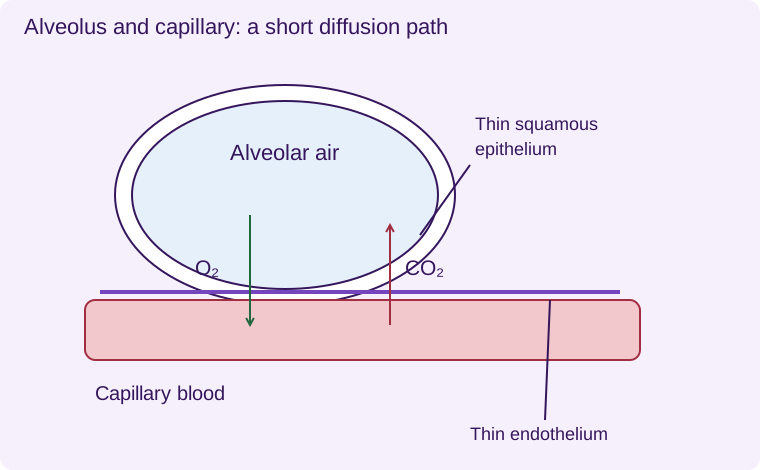
Epithelium is tissue covering a surface or lining a space. Simple squamous epithelium consists of a single layer of flattened cells. In lung alveoli, thin type I epithelial cells provide a short diffusion path between air and blood. A nearby capillary endothelium is also thin. Together with their closely associated basement membranes, these layers form the air–blood barrier.
Oxygen dissolves in the moist surface and diffuses from alveolar air towards blood down a partial-pressure gradient. Carbon dioxide moves in the opposite direction. For a school-level concentration model, describe net movement from higher to lower concentration, but do not imply that gases must be actively pumped across the epithelium.
Maintain the gradient
Millions of alveoli supply a large total surface area. Ventilation renews alveolar air; blood flow brings blood relatively low in oxygen and removes oxygenated blood. These processes maintain gradients. Haemoglobin binding helps transport oxygen away from the exchange surface. A thin epithelium alone is insufficient without a supply of fresh air and blood.
Type II alveolar cells produce surfactant, reducing surface tension and helping prevent alveolar collapse. They are not the main thin squamous exchange cells. Macrophages provide defence. Alveoli are not lined by a thick mucus layer and beating cilia: those features belong primarily to conducting airways.
Predict consequences of damage
Diffusion is faster when surface area and the driving gradient are larger and the diffusion path is shorter. Fibrosis thickens the barrier; fluid accumulation can increase the path; emphysema reduces available surface area. Each can impair gas exchange for a different structural reason. Link a named change to its consequence, rather than merely saying the lungs become less efficient.
- 1
- Thin squamous alveolar epithelium
- 2
- Capillary endothelium
- 3
- Red blood cell in capillary blood
- 4
- Short diffusion path between air and blood
O₂ diffuses into blood; CO₂ diffuses towards alveolar air. Barrier thickness is exaggerated for clarity.
Worked application and data skills
In a fictional model with unchanged gradient, doubling barrier thickness halves diffusion rate if other variables remain constant. If relative rate was 12 units, it becomes 6 units. This illustrates a proportional model, not a clinical prediction. Reduced blood oxygen can then limit aerobic ATP production in tissues.
Common misconceptions
Gas exchange is passive diffusion. Ciliated columnar cells do not form the main alveolar exchange barrier. Ventilation and diffusion are distinct processes.
Examination tips
Use structure → diffusion distance or area → gas-exchange rate → effect on tissues.
Check your understanding
Five original questions. Use Tab to move between controls, arrow keys within a radio group, and Enter or Space on buttons. Feedback appears after Check Answer. Try Again clears the question. Attempts are not saved.
Sources and scope
Scope: Unit 1 A3.1.1. Original BTECRevision notes, schematics and questions. Independent resource; not endorsed by Pearson.
Official Pearson specification. Scientific review references are listed in the accompanying QA report.
EXAM RESOURCES
Biology exam resources
Apply your knowledge with written practice.
Browse exam resources