COPD: Changes to Airways and Alveoli
FREE BIOLOGY REVISION · UNIT 1 · A3.1.3
Pearson BTEC Level 3 AAQ Applied Science · Issue 7, May 2026
Learning objectives
By the end of this topic you should be able to:
- Compare the airway and alveolar changes associated with chronic bronchitis and emphysema.
- Explain how these changes affect airflow and gas exchange.
- Calculate and interpret FEV1/FVC values within the limits of the teaching example.
Revision notes
Persistent airflow limitation
Chronic obstructive pulmonary disease (COPD) involves persistent limitation of airflow, commonly associated with chronic bronchitis and emphysema. Tobacco smoke is a major risk factor; occupational exposures, air pollution and inherited factors can also contribute. COPD is not simply another name for a short-lived chest infection.
In chronic bronchitis, persistent inflammation and excess mucus narrow airways. Ciliary clearance is impaired, so mucus and pathogens can accumulate. Airflow resistance increases and recurrent infections can worsen symptoms. The structural problem is mainly in the conducting airways, although effects extend throughout the respiratory system.
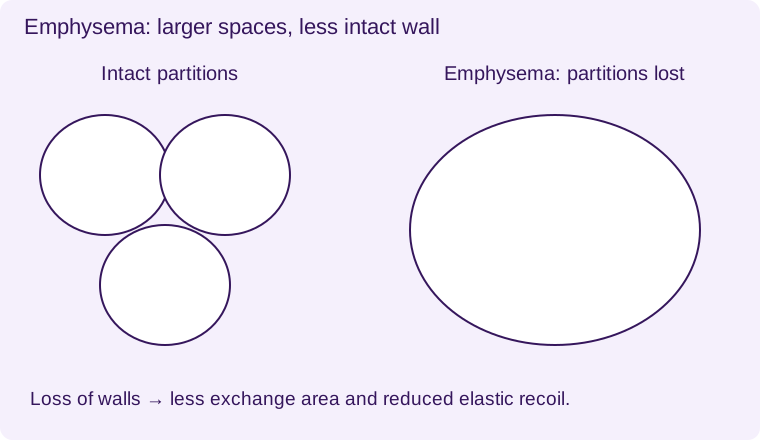
In emphysema, alveolar walls and elastic tissue are damaged. Neighbouring air spaces merge, reducing total gas-exchange surface area. Loss of elastic recoil makes expiration less effective and promotes air trapping. Larger air spaces therefore do not mean improved exchange: available wall area has been lost.
Consequences across scales
Reduced ventilation and exchange can lower oxygen delivery. During exercise, muscle demand for oxygen rises, so a reduced reserve becomes especially apparent. Fatigue and breathlessness can result. State these as physiological consequences rather than using a single symptom to diagnose someone. Oxygen and carbon dioxide changes vary with disease severity and are not identical in every patient.
Interpret lung-function data
FEV1 is the volume forcibly exhaled in the first second; FVC is the total forced vital capacity. Their ratio helps describe airflow obstruction. In a simplified example, reduced first-second emptying relative to total exhaled volume suggests obstructed flow. Formal diagnosis uses clinical evaluation and appropriate reference criteria; a revision calculation is not a diagnostic tool.
When comparing data, use matched conditions and reference values appropriate to the person. Age, height, technique and effort influence spirometry. A graph of volume exhaled against time should show slower early emptying for an obstructed example, not claim that the person has stopped breathing altogether.
Intact alveolar partitions
Many small air spaces separated by thin walls
Emphysema: partitions lost
Larger air spaces and less intact exchange wall
Loss of walls reduces exchange area and elastic recoil.
Worked application and data skills
Fictional results: FEV1 = 1.5 L and FVC = 3.0 L. FEV1/FVC = 1.5/3.0 = 0.50, or 50%. A comparison sample has 3.2/4.0 = 0.80, or 80%. The first sample expels a smaller fraction in the first second. This supports an obstructive pattern in this teaching example; it is not enough by itself to diagnose an individual.
Common misconceptions
Larger emphysematous spaces mean less intact exchange area. COPD has multiple contributing mechanisms. A ratio and a percentage express the same comparison differently.
Examination tips
Separate chronic bronchitis mechanisms from emphysema mechanisms, then connect both to reduced respiratory performance.
Check your understanding
Five original questions. Use Tab to move between controls, arrow keys within a radio group, and Enter or Space on buttons. Feedback appears after Check Answer. Try Again clears the question. Attempts are not saved.
Sources and scope
Scope: Unit 1 A3.1.3. Original BTECRevision notes, schematics and questions. Independent resource; not endorsed by Pearson.
Official Pearson specification. Scientific review references are listed in the accompanying QA report.
Take Your Learning Further
Practise
Build Your Confidence
Reinforce your understanding with our topic-based workbook. Every workbook page links back to its matching online lesson, so you can revisit explanations whenever you need support.
Explore Workbook – BiologyMaster
Get Exam Ready
Apply your knowledge with exam-style practice papers and detailed mark schemes. Identify what you’ve mastered and what to revise next.
Practice Papers – BiologyEXAM RESOURCES
Biology exam resources
Apply your knowledge with written practice.
Browse exam resources