Enzyme Structure and Active-Site Specificity
FREE BIOLOGY REVISION · UNIT 1 · C2.1
Pearson BTEC Level 3 AAQ Applied Science · Issue 7, May 2026
Revision notes
A protein with a specialised binding region
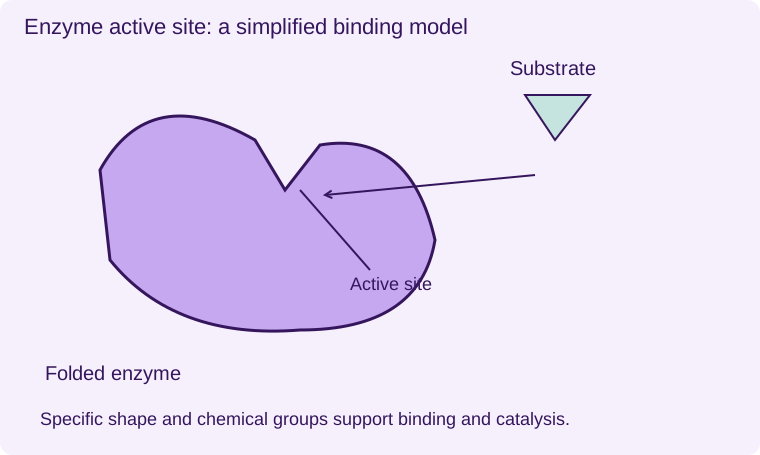
The enzymes considered in this unit are proteins folded into specific three-dimensional shapes. Their amino-acid sequence determines the interactions supporting that shape. An active site is a region where substrate binds and catalysis occurs. Amino acids distant in the primary sequence can lie together in the folded active site.
Specificity depends on both shape and chemical properties: charge, polarity and suitable interactions affect binding and reaction. It is not enough to say the substrate fits a hole of the right size. A substrate with a complementary shape but incompatible chemistry may not be a suitable reactant.
Structure enables catalysis
Binding can orient substrates, strain bonds or provide chemical groups that help a reaction follow a lower-activation-energy pathway. The enzyme is not consumed overall and can act again. The product differs from the substrate and is released. Enzymes do not create energy or change the equilibrium position merely by being present.
The lock-and-key model represents complementary shapes. The induced-fit model recognises that substrate binding can change enzyme conformation, helping create an effective catalytic arrangement. The required lock-and-key account is a useful starting model, but real proteins are dynamic rather than rigid blocks.
Shape can change
Temperature, pH and other conditions affect interactions maintaining tertiary structure. A sufficiently large change can alter the active site and reduce activity: denaturation. A small reversible change in conditions is not automatically permanent denaturation. Ordinary denaturation does not usually break the peptide backbone into amino acids.
Different enzymes have different active sites and optima. An enzyme adapted to an acidic compartment need not work best at pH 7. Some require cofactors or coenzymes, useful background illustrating that the protein shape can act with other components. Exceptions such as catalytic RNA exist in biology; this lesson focuses on the protein enzymes specified by Pearson.
Apply to a mutation
Changing an amino acid can alter folding, charge or a catalytic group. The effect may be large, small or negligible depending on position and role. Do not assume that every sequence change destroys the enzyme or that unchanged chain length guarantees unchanged activity.
- 1
- Folded enzyme
- 2
- Active site
- 3
- Substrate
A simplified binding model: specific shape and chemical groups support binding and catalysis. Not a molecular-scale structure.
Worked application and data skills
A substrate binds strongly to enzyme X, but a molecule with a different charged group binds poorly despite a similar outline. Explain the difference using chemical complementarity in the active site. If heating disrupts the active-site arrangement, the normal substrate may no longer bind effectively or be positioned correctly for catalysis.
Common misconceptions
An active site is a three-dimensional chemical region, not merely a gap. Denaturation usually leaves primary structure intact. Catalysts do not supply the reaction’s energy.
Examination tips
Link primary sequence, folding, active-site properties and substrate specificity.
Check your understanding
Five original questions. Use Tab to move between controls, arrow keys within a radio group, and Enter or Space on buttons. Feedback appears after Check Answer. Try Again clears the question. Attempts are not saved.
Sources and scope
Scope: Unit 1 C2.1. Original BTECRevision notes, schematics and questions. Independent resource; not endorsed by Pearson.
Official Pearson specification. Scientific review references are listed in the accompanying QA report.
Take Your Learning Further
Practise
Build Your Confidence
Reinforce what you’ve learned with our topic-based workbook. Every workbook page links back to its matching online lesson, so help is always at hand.
Explore Workbooks – BiologyMaster
Get Exam Ready
Challenge yourself with exam-style practice papers and detailed mark schemes. Apply your knowledge, identify areas to improve and build exam confidence.
Practice Papers – BiologyEXAM RESOURCES
Biology exam resources
Apply your knowledge with written practice.
Browse exam resources