Carbohydrate Structures: Sugars, Starch, Cellulose and Glycogen
FREE BIOLOGY REVISION · UNIT 1 · B2.1
Pearson BTEC Level 3 AAQ Applied Science · Issue 7, May 2026
Learning objectives
By the end of this topic you should be able to:
- Compare monosaccharides, disaccharides and polysaccharides.
- Explain the formation and hydrolysis of glycosidic bonds.
- Relate the structures of starch, glycogen and cellulose to their functions.
Revision notes
Monosaccharides
Carbohydrates contain carbon, hydrogen and oxygen. Monosaccharides are single sugar units. Glucose, galactose and fructose are hexoses with six carbon atoms and formula C₆H₁₂O₆, but their atom arrangements differ. Ribose is a pentose, C₅H₁₀O₅; deoxyribose is C₅H₁₀O₄ and has one fewer oxygen atom. Ribose occurs in RNA nucleotides, while deoxyribose occurs in DNA nucleotides.
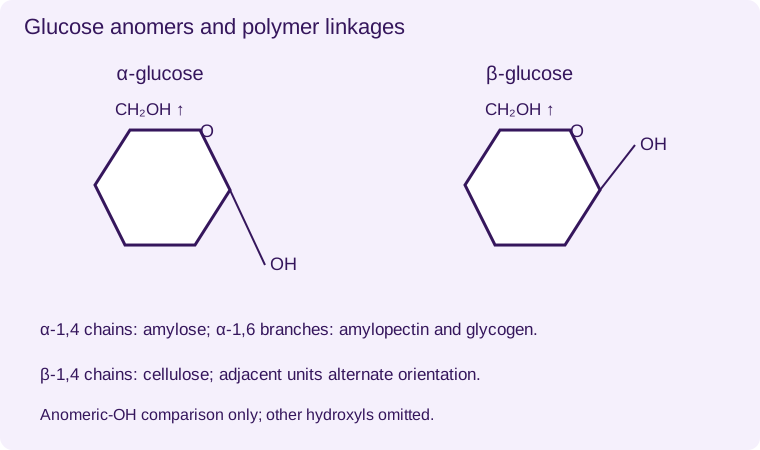
In conventional glucose ring drawings, α-glucose has the carbon-1 hydroxyl below the ring plane, opposite the CH₂OH group; β-glucose has it above, on the same side. This small structural difference has major consequences when glucose units form polymers. Ring orientation matters, so identify the anomeric carbon rather than memorising an unlabelled shape.
Disaccharides and bonds
Two monosaccharides join by condensation, forming a glycosidic bond and releasing water. Hydrolysis uses water to split the bond. Maltose contains two glucose units; lactose contains glucose and galactose; sucrose contains glucose and fructose. They are all disaccharides, but their bonds and chemical test responses differ. Sucrose is non-reducing under the standard Benedict’s test conditions.
Polysaccharides
Starch is a plant storage polysaccharide made from α-glucose. Amylose is mainly unbranched, with α-1,4 links producing a coiled chain. Amylopectin has α-1,4 chains with α-1,6 branch points. Glycogen is an animal and fungal storage polymer with similar link types but more frequent branching. Branch ends allow rapid addition and removal of glucose units.
Cellulose contains β-glucose joined by β-1,4 links. Alternate glucose units are inverted, producing straight chains. Many hydrogen bonds between adjacent chains form strong microfibrils in plant walls. Humans lack cellulase and cannot digest cellulose into glucose using their own enzymes.
Compare structure, not just names
Starch and cellulose are both glucose polymers, yet their different monomers’ orientations and bonds produce different shapes and functions. Storage polysaccharides are relatively insoluble and compact, reducing their osmotic effect compared with many free glucose molecules. Cellulose is suited to tensile strength rather than rapid glucose storage mobilisation.
Enlarge diagram
Swipe the larger view, or focus it and use the arrow keys.
Worked application and data skills
A chain of 100 glucose units linked into one unbranched molecule has 99 joining bonds and releases 99 water molecules during its assembly by condensation. Joining just two glucose molecules gives maltose and one water molecule: C₆H₁₂O₆ + C₆H₁₂O₆ → C₁₂H₂₂O₁₁ + H₂O. This counting example assumes each connection is made by one condensation.
Common misconceptions
Starch contains α-glucose; cellulose contains β-glucose. Sucrose is not a reducing sugar in the standard direct test. A glycosidic bond is not a peptide bond.
Examination tips
Compare monomer, linkage, branching and function. Label the carbon-1 hydroxyl correctly in glucose diagrams.
Check your understanding
Five original questions. Use Tab to move between controls, arrow keys within a radio group, and Enter or Space on buttons. Feedback appears after Check Answer. Try Again clears the question. Attempts are not saved.
Sources and scope
Scope: Unit 1 B2.1. Original BTECRevision notes, schematics and questions. Independent resource; not endorsed by Pearson.
Official Pearson specification. Scientific review references are listed in the accompanying QA report.
Take Your Learning Further
Practise
Build Your Confidence
Reinforce your understanding with our topic-based workbook. Every workbook page links back to its matching online lesson, so you can revisit explanations whenever you need support.
Explore Workbook – BiologyMaster
Get Exam Ready
Apply your knowledge with exam-style practice papers and detailed mark schemes. Identify what you’ve mastered and what to revise next.
Practice Papers – BiologyEXAM RESOURCES
Biology exam resources
Apply your knowledge with written practice.
Browse exam resources