Drug Effects at Synapses: Agonists, Antagonists and Precursors
FREE BIOLOGY REVISION · UNIT 1 · A3.4.6
Pearson BTEC Level 3 AAQ Applied Science · Issue 7, May 2026
Revision notes
Three different mechanisms
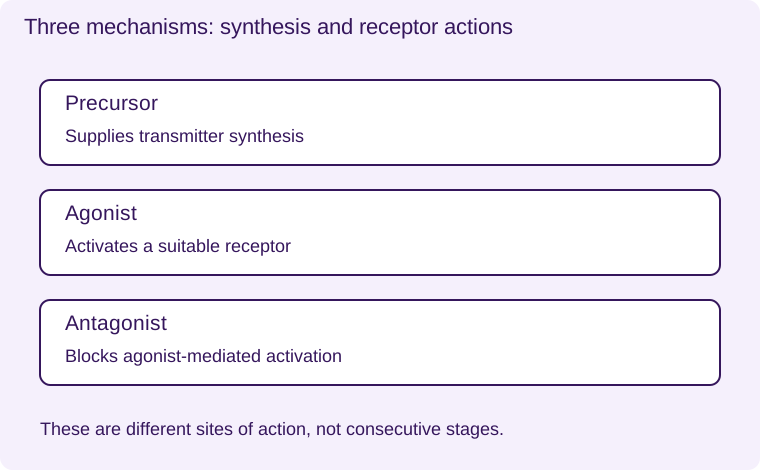
An agonist binds to a receptor and activates it, mimicking or supporting the action of an endogenous signalling molecule. An antagonist binds without producing the same activation and reduces the effect of an agonist at that receptor. A precursor is a substance used to synthesise a transmitter; it need not bind to that transmitter’s receptor.
For the specified dopamine example, L-DOPA supplies a precursor, whereas a dopamine-receptor agonist acts at a receptor. A dopamine antagonist blocks relevant receptor activation. These are distinct positions in the signalling pathway. A drug can have multiple receptor targets, so the overall effect depends on dose, receptor distribution and tissue context.
Other ways to alter transmission
Reuptake inhibitors can increase transmitter persistence in the cleft. Enzyme inhibitors can slow transmitter breakdown. Drugs can also affect ion channels, synthesis, storage or vesicle release. These mechanisms should not all be labelled receptor agonism simply because the final response becomes larger.
If a transmitter normally excites a target, blocking its receptor can reduce excitation. If it normally inhibits a target through that receptor, blocking it can remove inhibition. Therefore antagonist does not universally mean that the whole nervous system slows down. The physiological outcome depends on the circuit and receptor.
Interpret experimental curves
A concentration–response curve plots measured response against drug concentration, often using a logarithmic concentration axis. A higher concentration may increase response until a maximum is approached. A competitive antagonist can shift an agonist curve to the right; under appropriate assumptions a sufficiently high agonist concentration can overcome the competition. Other antagonism patterns differ, so do not apply that prediction to every drug.
Compare an experimental treatment with a vehicle control and repeat measurements. Distinguish the size of a response from the amount of transmitter present: a receptor drug can alter response without changing transmitter synthesis. These examples are for mechanism analysis, not instructions for using medicines or other substances.
Supplies transmitter synthesis
Activates a suitable receptor
Blocks agonist-mediated activation
These are different sites of action, not consecutive stages.
Worked application and data skills
A receptor assay gives a response of 20 units with transmitter alone and 5 units when a receptor blocker is added. This supports reduced receptor-mediated signalling. It does not prove that transmitter concentration fell. If another substance increases response by blocking reuptake, identify prolonged transmitter availability rather than automatically calling it a direct agonist.
Common misconceptions
A precursor is not necessarily an agonist. An antagonist may remove inhibition. A larger response does not prove more transmitter synthesis.
Examination tips
State the site of action, the immediate molecular effect and the resulting change in transmission.
Check your understanding
Five original questions. Use Tab to move between controls, arrow keys within a radio group, and Enter or Space on buttons. Feedback appears after Check Answer. Try Again clears the question. Attempts are not saved.
Sources and scope
Scope: Unit 1 A3.4.6. Original BTECRevision notes, schematics and questions. Independent resource; not endorsed by Pearson.
Official Pearson specification. Scientific review references are listed in the accompanying QA report.
EXAM RESOURCES
Biology exam resources
Apply your knowledge with written practice.
Browse exam resources