Benedict’s and Iodine Tests for Carbohydrates
FREE BIOLOGY REVISION · UNIT 1 · B2.3
Pearson BTEC Level 3 AAQ Applied Science · Issue 7, May 2026
Revision notes
Test reducing sugars
Add Benedict’s reagent to a sample and heat in a hot-water bath using the appropriate supervised laboratory procedure. A negative result remains blue. Increasing reducing-sugar content can give green, yellow, orange or brick-red precipitate as copper(II) is reduced to copper(I) oxide. Glucose, fructose, galactose, maltose and lactose can give positive results; do not limit the test to glucose.
The colour series is only semi-quantitative unless conditions and calibration are controlled. Keep sample volume, reagent volume, heating time and temperature consistent. Turbid or coloured samples can obscure results. Use a known reducing-sugar positive control and a water negative control.
Test starch
Add iodine solution to a sample. A blue-black colour supports the presence of starch; a negative test retains the reagent’s yellow-brown colour. The interaction with the helical amylose component accounts for the familiar colour. Iodine does not test for every carbohydrate. A glucose solution can be Benedict’s-positive and iodine-negative.
Non-reducing sugars
Sucrose is negative in the direct Benedict’s test. As an extension useful for interpreting mixed results, hydrolyse a separate sample using a suitable dilute acid procedure, allow it to cool and neutralise before repeating Benedict’s. A positive result after hydrolysis, when the direct test was negative, supports a non-reducing sugar such as sucrose. The inference depends on valid controls and no contamination.
Investigate digestion
During amylase digestion of starch, an iodine test may become negative as starch is broken down; a reducing-sugar test may become positive as smaller reducing sugars are produced. These tests identify chemical changes, not enzyme identity on their own. Use separate samples so one reagent does not alter the next test.
Practical safety matters: wear eye protection, use a water bath rather than direct flame, handle hot tubes with holders, and follow local chemical risk assessment. Benedict’s contains copper compounds; iodine and acid/alkali require appropriate handling and disposal.
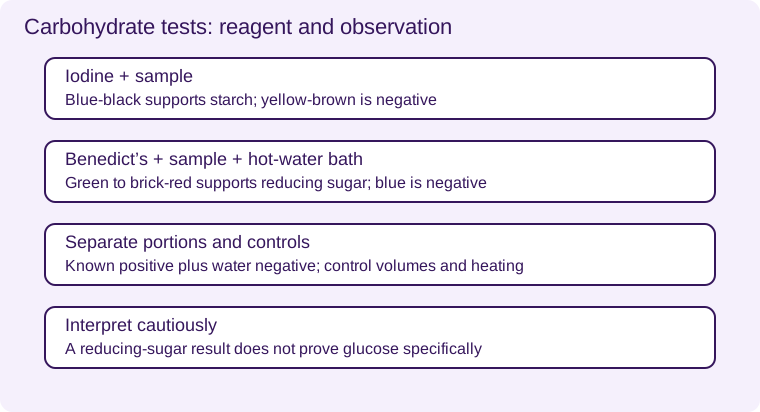
Blue-black supports starch; yellow-brown is negative
Green to brick-red supports reducing sugar; blue is negative
Known positive plus water negative; control volumes and heating
A reducing-sugar result does not prove glucose specifically
Worked application and data skills
Fictional samples: X is iodine-positive and Benedict’s-negative; Y is iodine-negative and Benedict’s-positive. X contains detectable starch and Y contains a detectable reducing sugar under the test conditions. Do not conclude Y must be glucose: several sugars can produce the same result. A negative test means not detected, not proof of absolute absence.
Common misconceptions
Benedict’s is not glucose-specific. Iodine is not a test for all sugars. Do not use one contaminated test mixture for every subsequent test.
Examination tips
State reagent, condition, observation and conclusion separately. Use controls and avoid over-identifying the molecule.
Check your understanding
Five original questions. Use Tab to move between controls, arrow keys within a radio group, and Enter or Space on buttons. Feedback appears after Check Answer. Try Again clears the question. Attempts are not saved.
Sources and scope
Scope: Unit 1 B2.3. Original BTECRevision notes, schematics and questions. Independent resource; not endorsed by Pearson.
Official Pearson specification. Scientific review references are listed in the accompanying QA report.
EXAM RESOURCES
Biology exam resources
Apply your knowledge with written practice.
Browse exam resources