Eukaryotic Organelles and Plant Cell Structures
FREE BIOLOGY REVISION · UNIT 1 · A1.1.2
Pearson BTEC Level 3 AAQ Applied Science · Issue 7, May 2026
Revision notes
Compartmentalisation
Eukaryotic cells contain membrane-bound compartments with specialised conditions and reactions. The plasma membrane controls exchange and cell signalling. Cytoplasm includes cytosol and suspended organelles; many metabolic reactions occur in the cytosol. The nucleus contains chromosomes and is surrounded by a nuclear envelope with pores. The nucleolus makes ribosomal RNA and assembles ribosomal subunits.
Free 80S ribosomes make proteins used within the cell. Ribosomes on rough endoplasmic reticulum (RER) make many proteins destined for secretion or membranes. RER helps process and transport these proteins. Smooth ER synthesises lipids and participates in detoxification and calcium storage. The Golgi apparatus modifies and sorts products into vesicles. Vesicles transport materials or fuse with membranes; lysosomes contain hydrolytic enzymes for intracellular digestion.
Mitochondria have a double membrane; folds of the inner membrane, called cristae, provide surface for aerobic ATP production. The matrix contains enzymes for stages of respiration. Centrioles are microtubule structures associated with organisation of the spindle in many animal cells. Cilia contain microtubules and move material over a surface, for example mucus in airways.
Plant structures
A cellulose cell wall supports the cell and resists expansion. Chloroplasts contain chlorophyll in thylakoid membranes, arranged in grana, and carry out photosynthesis. The large permanent vacuole stores cell sap and contributes to turgor. Its membrane, the tonoplast, controls exchange with the cytoplasm. Amyloplasts are plastids that synthesise and store starch, common in storage tissues such as potato.
Plasmodesmata are cytoplasmic connections through cell walls, allowing exchange and communication between neighbouring cells. Pits are areas where secondary wall deposition is reduced; pit membranes retain primary wall material and middle lamella. They permit lateral water movement between adjacent xylem elements. Pits are not simply unbounded holes through every cell boundary.
Follow a secreted protein
DNA is transcribed in the nucleus. mRNA reaches ribosomes on RER, where translation occurs. Transport vesicles carry the protein to Golgi stacks; processing and sorting follow. A secretory vesicle fuses with the plasma membrane by exocytosis. Each step requires the correct compartment: the Golgi does not translate mRNA.
Organelle recognition checklist
RER has ribosome-bearing cisternae; smooth ER lacks attached ribosomes. Golgi stacks have nearby transport vesicles. Lysosomes are membrane-bounded digestive compartments and cannot be identified reliably from darkness alone. A centriole is a microtubule cylinder; motile cilia contain an organised microtubule core. In a plant wall, plasmodesmata connect cytoplasm across primary walls, whereas xylem pits are regions with reduced secondary wall. Use the supplementary labelled organelle plate to distinguish these structures.
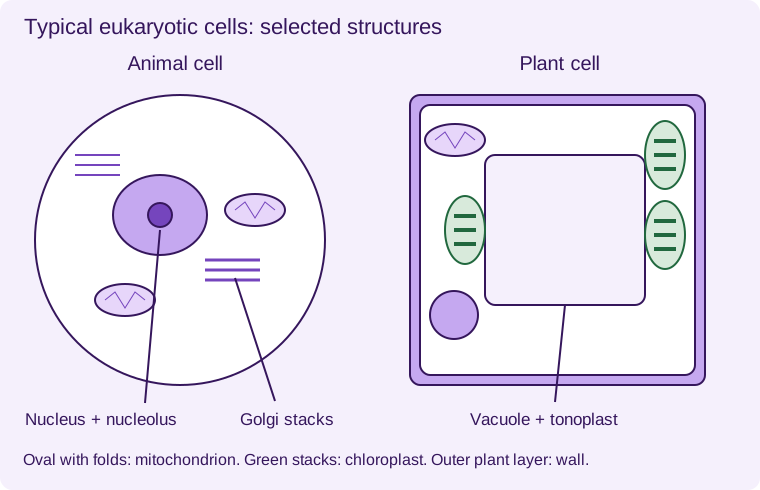
Animal cell
- 1
- Nucleus and nucleolus
- 2
- Golgi apparatus
- 3
- Mitochondrion
- 4
- Rough endoplasmic reticulum
- 5
- Plasma membrane
Plant cell
- 1
- Nucleus and nucleolus
- 2
- Vacuole containing cell sap
- 3
- Tonoplast
- 4
- Chloroplast
- 5
- Cell wall
- 6
- Plasma membrane
Selected structures shown. Schematic cells; not to scale.
Nucleus
- 1
- Nucleolus
- 2
- Double nuclear envelope with pores
Rough ER
- 1
- Membrane cisternae
- 2
- Attached 80S ribosomes
Golgi and vesicles
- 1
- Golgi stacks
- 2
- Transport vesicle
- 3
- Lysosome: digestive enzymes
Smooth ER lacks attached ribosomes. Membrane-bound vesicles transport material between compartments.
Cell wall
Cellulose support
Vacuole / tonoplast
Cell sap / selective membrane
Chloroplast
Grana for photosynthesis
Amyloplast
Starch storage
Plasmodesmata
Cytoplasmic connections through the cell wall
Xylem pits
Reduced secondary wall; pit membrane remains
Boundaries and organelles are shown separately to distinguish their roles.
Centriole: cross-section
Nine outer triplets; dashed guide is not a membrane
Motile cilium: cross-section
Nine outer doublets + central pair
Simplified cross-sections; associated proteins are omitted. The common motile-cilium arrangement is shown.
Worked application and data skills
A pancreatic cell releases a protein enzyme. Predict abundant RER, Golgi apparatus and secretory vesicles because protein synthesis, processing and export are high. A root storage cell may instead contain many amyloplasts. It need not contain chloroplasts because it is not exposed to light for photosynthesis.
Common misconceptions
Not every plant cell contains chloroplasts. The tonoplast surrounds the vacuole. Ribosomes are not membrane-bound organelles.
Examination tips
Explain an organelle prediction using the work the cell performs, rather than simply saying it needs energy.
Check your understanding
Five original questions. Use Tab to move between controls, arrow keys within a radio group, and Enter or Space on buttons. Feedback appears after Check Answer. Try Again clears the question. Attempts are not saved.
Sources and scope
Scope: Unit 1 A1.1.2. Original BTECRevision notes, schematics and questions. Independent resource; not endorsed by Pearson.
Official Pearson specification. Scientific review references are listed in the accompanying QA report.
EXAM RESOURCES
Biology exam resources
Apply your knowledge with written practice.
Browse exam resources