Biological Functions of Water
FREE BIOLOGY REVISION · UNIT 1 · B1.2
Pearson BTEC Level 3 AAQ Applied Science · Issue 7, May 2026
Revision notes
Solvent, reaction medium and transport
Water surrounds many ions and polar molecules, allowing them to dissolve. Dissolved substances can move in cytoplasm, tissue fluid, blood plasma and plant transport fluids. Non-polar substances such as many lipids dissolve poorly, so water is not a universal solvent. Reactions can occur in an aqueous medium; water can also be a reactant in hydrolysis and a product of condensation.
pH and electrolytes
Acids and bases affect hydrogen-ion concentration in aqueous solutions. Pure water is approximately neutral at room temperature, but water alone is a poor buffer. Biological pH regulation depends on buffer systems and physiological regulation, such as bicarbonate, breathing and kidney function. Do not claim that simply adding water automatically restores the correct blood pH.
Electrolytes are dissolved ions, including sodium, potassium, chloride and calcium. Their concentrations and distributions influence membrane potentials, osmotic movement and enzyme function. Water balance and electrolyte balance are linked: changing water volume can alter ion concentrations, while ion movement changes osmotic gradients.
Temperature regulation
Water has a high specific heat capacity: relatively much energy is required to change its temperature. This buffers rapid temperature fluctuations in cells and organisms. Its high latent heat of vaporisation allows evaporating sweat to remove substantial energy. Sweat only produces evaporative cooling when it evaporates; dripping sweat is less effective in that respect. Hydrogen bonding helps explain both properties.
Cohesion–tension and mass flow
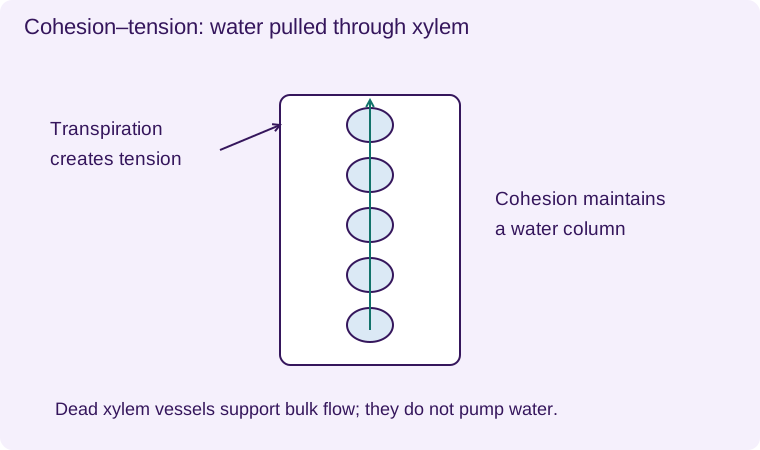
Transpiration from leaves lowers water potential and produces tension in xylem. Cohesion between water molecules helps maintain continuous columns; adhesion to vessel walls also assists. Water is pulled through the xylem by a pressure gradient rather than being pumped up by each dead vessel element. This is mass flow: bulk movement, distinct from individual molecules diffusing over short distances.
In blood, water supplies the liquid transport medium; the heart provides the pressure driving flow. The same solvent therefore supports transport in different systems with different driving mechanisms. Link each use to a physical or chemical property, rather than memorising a disconnected list.
- 1
- Transpiration creates tension
- 2
- Cohesion maintains a water column
- 3
- Xylem vessel wall
The vessel continues above and below this view. Dead xylem vessels support bulk flow; they do not pump water. Symbols represent a continuous water column, not compartments.
Worked application and data skills
Illustrative thermal calculation: warming 0.20 kg of water by 2 °C with c = 4200 J kg⁻¹ °C⁻¹ requires Q = mcΔT = 0.20 × 4200 × 2 = 1680 J. This demonstrates thermal buffering. If 2 g of water evaporates using 2400 J g⁻¹, it transfers 4800 J from its surroundings under that simplified assumption.
Common misconceptions
Water alone is not an effective biological buffer. Electrolytes are ions, not energy particles. Xylem flow is driven largely by transpiration-generated tension.
Examination tips
Write property → mechanism → biological benefit, and distinguish heat capacity from latent heat.
Check your understanding
Five original questions. Use Tab to move between controls, arrow keys within a radio group, and Enter or Space on buttons. Feedback appears after Check Answer. Try Again clears the question. Attempts are not saved.
Sources and scope
Scope: Unit 1 B1.2. Original BTECRevision notes, schematics and questions. Independent resource; not endorsed by Pearson.
Official Pearson specification. Scientific review references are listed in the accompanying QA report.
EXAM RESOURCES
Biology exam resources
Apply your knowledge with written practice.
Browse exam resources