Synapses and Neurotransmitter Signalling
FREE BIOLOGY REVISION · UNIT 1 · A3.4.4
Pearson BTEC Level 3 AAQ Applied Science · Issue 7, May 2026
Learning objectives
By the end of this topic you should be able to:
- Identify the main structures of a chemical synapse.
- Explain the sequence from an arriving action potential to a postsynaptic response.
- Explain how transmitter removal allows signalling to remain controlled.
Revision notes
Structure of a chemical synapse
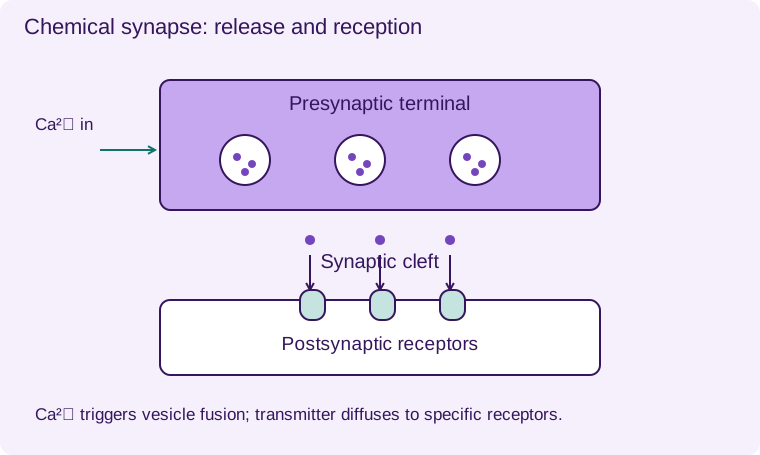
A chemical synapse connects a presynaptic terminal to a postsynaptic cell across a narrow synaptic cleft. The terminal contains neurotransmitter-filled vesicles, mitochondria and voltage-gated calcium channels. The postsynaptic membrane has receptors that respond selectively to particular transmitters. Some receptors are ion channels; others act through intracellular signalling pathways.
Transmission step by step
1. An action potential reaches the presynaptic terminal and depolarises its membrane.
2. Voltage-gated calcium channels open. Calcium enters down its electrochemical gradient.
3. Calcium promotes fusion of synaptic vesicles with the membrane. Neurotransmitter is released by exocytosis.
4. Transmitter diffuses across the cleft and binds postsynaptic receptors.
5. Receptor activation changes postsynaptic activity. An excitatory effect may depolarise the cell; an inhibitory effect may reduce the probability of firing.
6. Transmitter is removed by reuptake, enzymatic breakdown or diffusion, depending on the synapse. This limits signal duration and permits further signalling.
From local response to a new impulse
One excitatory synaptic event does not necessarily produce an action potential. Inputs can summate over time or across different synapses. If the combined effect reaches threshold at the trigger region, a new action potential begins. Inhibitory and excitatory inputs interact, so a transmitter should not be described as always causing the next neurone to fire.
Chemical synapses usually transmit in one anatomical direction because release machinery is presynaptic and the relevant receptors are postsynaptic. A synaptic delay arises because release, diffusion and receptor activation take time. This differs from electrical propagation along an axon.
Specificity and control
The effect depends on the receptor and target cell as well as the transmitter. Acetylcholine can stimulate skeletal muscle at the neuromuscular junction but has different effects at other receptor types. Enzyme inhibition or reuptake blockade can prolong signalling; depletion of vesicles or receptor blockade can reduce it.
- 1
- Presynaptic terminal
- 2
- Vesicle containing neurotransmitter
- 3
- Synaptic cleft
- 4
- Postsynaptic receptors
- 5
- Mitochondrion
Ca²⁺ triggers vesicle fusion; transmitter diffuses to specific receptors. Membranes and molecules are not drawn to scale.
Worked application and data skills
In a model synapse, blocking presynaptic calcium channels prevents normal transmitter release even when an action potential reaches the terminal. Applying transmitter directly to intact postsynaptic receptors may still produce a response. This separates a presynaptic release problem from failure of the postsynaptic membrane.
Common misconceptions
Calcium entry triggers vesicle fusion; sodium entry drives the axonal upstroke. Neurotransmitters do not cross the cleft as action potentials. Not every postsynaptic event reaches threshold.
Examination tips
Present the sequence in order and distinguish presynaptic release from postsynaptic receptor activation.
Check your understanding
Five original questions. Use Tab to move between controls, arrow keys within a radio group, and Enter or Space on buttons. Feedback appears after Check Answer. Try Again clears the question. Attempts are not saved.
Sources and scope
Scope: Unit 1 A3.4.4. Original BTECRevision notes, schematics and questions. Independent resource; not endorsed by Pearson.
Official Pearson specification. Scientific review references are listed in the accompanying QA report.
Take Your Learning Further
Practise
Build Your Confidence
Reinforce your understanding with our topic-based workbook. Every workbook page links back to its matching online lesson, so you can revisit explanations whenever you need support.
Explore Workbook – BiologyMaster
Get Exam Ready
Apply your knowledge with exam-style practice papers and detailed mark schemes. Identify what you’ve mastered and what to revise next.
Practice Papers – BiologyEXAM RESOURCES
Biology exam resources
Apply your knowledge with written practice.
Browse exam resources