Fast- and Slow-Twitch Muscle Fibres
FREE BIOLOGY REVISION · UNIT 1 · A3.3.2
Pearson BTEC Level 3 AAQ Applied Science · Issue 7, May 2026
Revision notes
Different specialisations
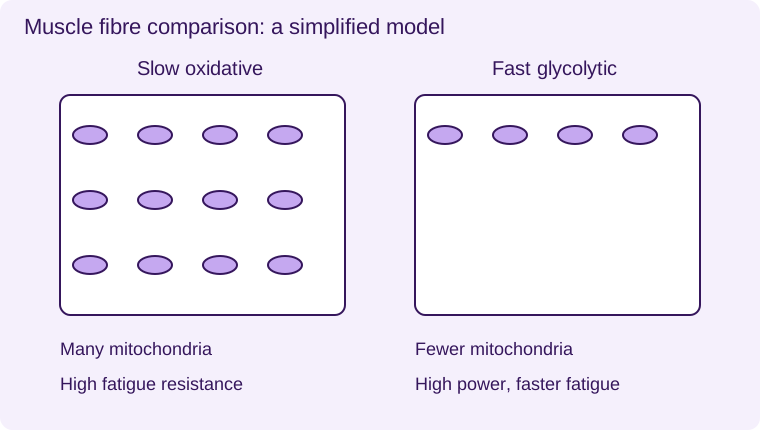
Slow-twitch, or type I, fibres contract relatively slowly and resist fatigue. They contain many mitochondria, a dense capillary supply and abundant myoglobin, an oxygen-binding protein within muscle. Their high oxidative capacity supports sustained ATP production by aerobic respiration. They are well suited to posture and endurance activities.
Fast-twitch fibres contract more rapidly and can generate high power. The fast glycolytic end of the range has larger fibres, substantial glycogen reserves, high glycolytic enzyme activity and lower myoglobin and mitochondrial density than slow oxidative fibres. Rapid ATP production supports brief intense efforts, but fatigue develops sooner.
Fast fibres are not all identical. Type IIa fibres have both oxidative and glycolytic capacities and are more fatigue resistant than the most glycolytic fast fibres. A simple fast-versus-slow comparison is useful, but do not claim that all fast fibres lack mitochondria or can never respire aerobically.
ATP supply and performance
Stored ATP is limited. Phosphocreatine can rapidly regenerate ATP at the start of intense activity; glycolysis and aerobic pathways contribute according to intensity and duration. At high demand, glycolysis can supply ATP quickly but produces a lower yield per glucose than complete aerobic breakdown. Lactate formation helps sustain glycolysis; fatigue has multiple causes and should not be reduced to a single claim that lactate poisons the muscle.
Match evidence to activity
A sprinter benefits from rapid force development and high power. A distance runner benefits from fatigue resistance and sustained oxygen use. Both still use mixtures of fibres and energy pathways. Training changes capacities, capillary supply and enzyme content; inherited variation also matters. A sample of one muscle does not reveal every muscle in the body.
In data questions, compare contraction time, force, mitochondrial density and fatigue rate using values. A darker red appearance can reflect myoglobin, not a different type of blood cell. Explain an advantage within the specified activity rather than calling one fibre universally better.
Slow oxidative
Many mitochondria · high fatigue resistance
Fast glycolytic
Fewer mitochondria · high power, faster fatigue
Simplified comparison of fibre types. Mitochondrial abundance is qualitative.
Worked application and data skills
Fictional fibres retain 85% and 30% of starting force after repeated stimulation for the same duration. The 85% sample is more fatigue resistant. If it also has more mitochondria and myoglobin, the combined evidence supports a slow oxidative profile. Force retention alone does not prove a particular fibre subtype.
Common misconceptions
Fast-twitch does not mean no mitochondria. Myoglobin is in muscle, while haemoglobin is in erythrocytes. All fibres need ATP.
Examination tips
Pair each structural difference with its physiological consequence and the named activity.
Check your understanding
Five original questions. Use Tab to move between controls, arrow keys within a radio group, and Enter or Space on buttons. Feedback appears after Check Answer. Try Again clears the question. Attempts are not saved.
Sources and scope
Scope: Unit 1 A3.3.2. Original BTECRevision notes, schematics and questions. Independent resource; not endorsed by Pearson.
Official Pearson specification. Scientific review references are listed in the accompanying QA report.
EXAM RESOURCES
Biology exam resources
Apply your knowledge with written practice.
Browse exam resources