Dopamine and Parkinson’s Disease
FREE BIOLOGY REVISION · UNIT 1 · A3.4.5
Pearson BTEC Level 3 AAQ Applied Science · Issue 7, May 2026
Revision notes
A signalling-system disorder
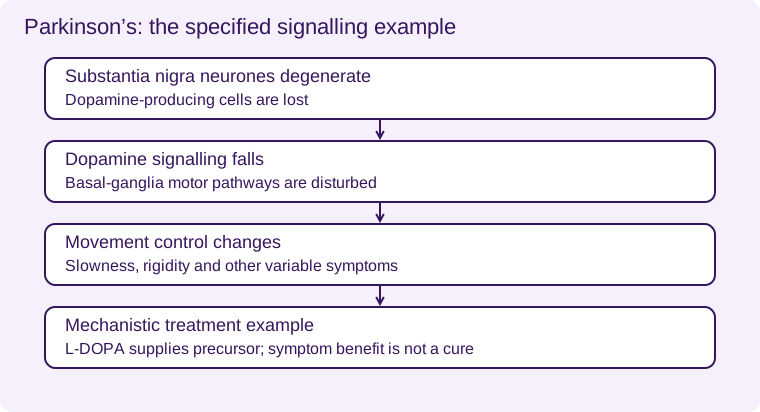
Parkinson’s disease is a progressive neurological disorder. Degeneration of dopamine-producing neurones in the substantia nigra reduces dopamine signalling in motor-control circuits involving the basal ganglia. This disturbs the balance of pathways regulating initiation and smooth control of movement. The problem is not that skeletal muscle loses all ability to contract.
Common motor features include slowness of movement, rigidity and often a resting tremor. Postural and gait difficulties can occur. Non-motor features are also important, including sleep, mood and autonomic symptoms. Presentation varies: the absence of a tremor alone does not exclude the disease, and a tremor alone does not establish it.
Explain chemical imbalance precisely
Dopamine is a neurotransmitter, not a digestive enzyme or a muscle fuel. Reduced dopamine in particular circuits changes signalling between neurones. It is inaccurate to describe the condition simply as a uniform shortage of every brain chemical. Different disorders can involve different transmitter systems, receptors and networks; many have multiple interacting causes.
The term imbalance is a useful introduction, but should not imply that a single blood test can reveal the dopamine concentration at every synapse or explain a complex mental-health condition. Use the specified Parkinson’s example to connect a known neuronal change with altered signalling and function.
Treatment as an application of synaptic principles
Levodopa, or L-DOPA, is a precursor that can cross the blood–brain barrier and be converted to dopamine. Dopamine itself crosses poorly. It is commonly combined with a peripheral decarboxylase inhibitor to reduce conversion outside the brain. Dopamine agonists stimulate relevant receptors, while other medicines alter transmitter breakdown. These mechanisms can improve symptoms but do not imply a cure or complete replacement of lost neurones.
These notes explain biology rather than giving individual treatment guidance. In an examination, identify whether an example increases precursor supply, receptor activation or signal duration. Connect the mechanism to dopamine signalling and recognise that effects and limitations depend on the system.
Dopamine-producing cells are lost
Basal-ganglia motor pathways are disturbed
Slowness, rigidity and other variable symptoms
L-DOPA supplies precursor; symptom benefit is not a cure
Worked application and data skills
A fictional before-and-after study reports a motor score falling from 40 to 28 after a treatment, where a lower score indicates fewer symptoms. Reduction = 12 points, or 12/40 × 100 = 30%. This indicates improvement on that scale, not proof that 30% of lost neurones were restored. A control group and repeated follow-up would strengthen evaluation.
Common misconceptions
Parkinson’s is not diagnosed from tremor alone. Dopamine is a transmitter. Symptom improvement is not evidence of neuronal regeneration or cure.
Examination tips
Link substantia nigra degeneration → reduced dopamine signalling → altered motor-circuit control.
Check your understanding
Five original questions. Use Tab to move between controls, arrow keys within a radio group, and Enter or Space on buttons. Feedback appears after Check Answer. Try Again clears the question. Attempts are not saved.
Sources and scope
Scope: Unit 1 A3.4.5. Original BTECRevision notes, schematics and questions. Independent resource; not endorsed by Pearson.
Official Pearson specification. Scientific review references are listed in the accompanying QA report.
EXAM RESOURCES
Biology exam resources
Apply your knowledge with written practice.
Browse exam resources