Protein Functions in Transport, Defence, Signalling and Repair
FREE BIOLOGY REVISION · UNIT 1 · B3.2
Pearson BTEC Level 3 AAQ Applied Science · Issue 7, May 2026
Revision notes
Movement and catalysis
Actin and myosin interact to generate muscle force. Their organised shapes and binding regions support repeated cross-bridge cycles. Enzymes catalyse metabolic reactions through specific active sites. A protein’s function therefore depends on its folded structure, not simply on containing nitrogen.
Defence and recognition
Antibodies are immunoglobulin proteins with variable regions that bind specific antigens. Binding can neutralise a target or mark it for other immune actions; an antibody does not necessarily digest a pathogen itself. Antigens are structures recognised by immune receptors. Many antigens are proteins or glycoproteins, but not all antigens are proteins, so do not turn the specification’s protein examples into a universal chemical definition.
Transport and signalling
Haemoglobin carries oxygen; plasma proteins can transport poorly water-soluble substances. Membrane carrier proteins bind specific solutes and change shape to move them across membranes. Some work in facilitated diffusion and some in active transport, so a carrier is not automatically an ATP-driven pump.
Some hormones, such as insulin, are proteins or peptides and bind cell-surface receptors. Other hormones are steroids or other chemical types. Receptor proteins and signalling proteins translate an external signal into a cellular response. Specific shape and chemical interactions support selective binding.
Growth, repair and clotting
Dietary proteins are digested to amino acids that can be used to synthesise new body proteins. Collagen contributes tensile strength to connective tissues; other proteins build membranes, cells and extracellular structures. Growth and repair require regulated synthesis, not insertion of whole food proteins unchanged into injured tissue.
In clotting, soluble fibrinogen is converted to insoluble fibrin, forming a mesh that stabilises the platelet plug. Enzymes and other protein factors participate in a regulated cascade. The clot should remain local to the damage; uncontrolled clotting in intact vessels can be harmful.
Shape as the common principle
Transport binding sites, antibody variable regions and enzyme active sites illustrate selective interactions. A mutation or denaturation can alter these sites. However, not every protein binds the same kind of molecule or performs one of these tasks in the same way. Use a named example and explain the relevant feature.
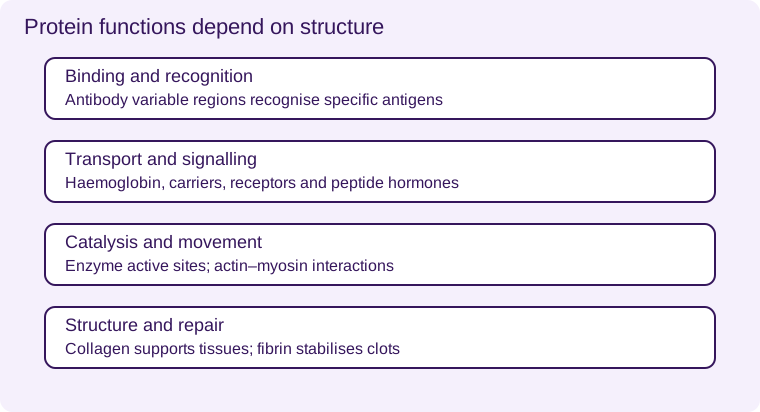
Antibody variable regions recognise specific antigens
Haemoglobin, carriers, receptors and peptide hormones
Enzyme active sites; actin–myosin interactions
Collagen supports tissues; fibrin stabilises clots
Worked application and data skills
A membrane protein moves glucose down its concentration gradient without direct ATP use. Identify carrier-mediated facilitated diffusion, not active transport. An antibody binding a viral surface protein illustrates specific recognition. Insulin binding its receptor illustrates signalling. The same broad molecular class supports different functions because sequence and folding differ.
Common misconceptions
Not all hormones are proteins. Not all antigens are proteins. A carrier can mediate passive transport. Antibodies bind targets rather than universally digesting them.
Examination tips
For each named function, provide a protein example and a structural reason it can perform the role.
Check your understanding
Five original questions. Use Tab to move between controls, arrow keys within a radio group, and Enter or Space on buttons. Feedback appears after Check Answer. Try Again clears the question. Attempts are not saved.
Sources and scope
Scope: Unit 1 B3.2. Original BTECRevision notes, schematics and questions. Independent resource; not endorsed by Pearson.
Official Pearson specification. Scientific review references are listed in the accompanying QA report.
EXAM RESOURCES
Biology exam resources
Apply your knowledge with written practice.
Browse exam resources