DNA, RNA, Protein Synthesis and Gene Expression
FREE BIOLOGY REVISION · UNIT 1 · B4.2
Pearson BTEC Level 3 AAQ Applied Science · Issue 7, May 2026
Revision notes
Genes store instructions
A gene is a DNA sequence contributing to a functional product, often a polypeptide or a functional RNA. For a protein-coding gene, the base sequence ultimately determines amino-acid sequence through the genetic code. DNA is a relatively stable store; RNA provides working copies and participates in expression. Not all DNA is a protein-coding gene and not every gene is expressed in every cell.
Transcription
In eukaryotes, RNA polymerase uses one DNA strand as a template to produce an RNA transcript. Complementary RNA bases pair with the template: A with U and C with G. The DNA strands locally separate, and the RNA is assembled through covalent backbone bonds. In the usual protein-coding pathway, a processed messenger RNA leaves the nucleus through nuclear pores. Processing includes removal of introns and joining of exons in many eukaryotic transcripts.
Translation
A ribosome reads the mRNA in triplets called codons. Transfer RNAs carry specific amino acids and have anticodons complementary to appropriate codons. The ribosome brings these components together and catalyses peptide-bond formation. Start and stop signals define the translated region. A stop codon signals termination; it does not add a special stop amino acid. The polypeptide then folds and may be modified or assembled with other subunits.
RNA roles
mRNA carries the coding message, tRNA links codon recognition to amino-acid delivery, and rRNA forms a major structural and catalytic component of ribosomes. RNA molecules can also regulate expression: some bind complementary transcripts and reduce their stability or translation. At this level, explain the principle without treating every RNA as a messenger.
Control of expression
Cells regulate which genes are transcribed, how RNA is processed and degraded, how efficiently it is translated and what happens to the protein. This helps cells with the same genome specialise. A neurone and a pancreatic cell can contain broadly the same DNA yet make different sets or amounts of proteins. Changes in a regulatory sequence can alter expression without changing a protein’s amino-acid sequence.
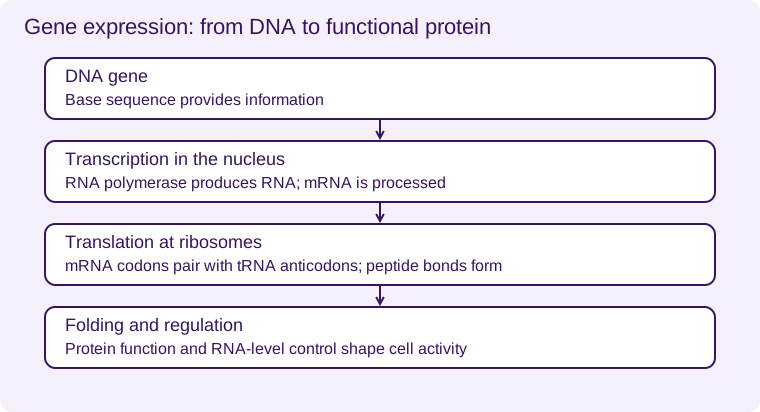
Base sequence provides information
RNA polymerase produces RNA; mRNA is processed
mRNA codons pair with tRNA anticodons; peptide bonds form
Protein function and RNA-level control shape cell activity
Worked application and data skills
For a DNA template segment 3′-TAC GGA-5′, the complementary mRNA is 5′-AUG CCU-3′. Using a supplied code table, AUG specifies methionine and CCU specifies proline. The template is not identical to the mRNA. A coding-strand sequence would match mRNA except for T replacing U; establish which strand the question provides.
Common misconceptions
Transcription makes RNA; translation makes polypeptide. A codon is on mRNA, while an anticodon is on tRNA. Most specialised cells differ in expression rather than possessing entirely different genomes.
Examination tips
Track location, template, product and direction at each stage. Use a supplied genetic-code table rather than guessing.
Check your understanding
Five original questions. Use Tab to move between controls, arrow keys within a radio group, and Enter or Space on buttons. Feedback appears after Check Answer. Try Again clears the question. Attempts are not saved.
Sources and scope
Scope: Unit 1 B4.2. Original BTECRevision notes, schematics and questions. Independent resource; not endorsed by Pearson.
Official Pearson specification. Scientific review references are listed in the accompanying QA report.
EXAM RESOURCES
Biology exam resources
Apply your knowledge with written practice.
Browse exam resources