FREE PHYSICS REVISION · UNIT 3 · A1.1.1
Pearson BTEC Level 3 AAQ Applied Science · Issue 7 (May 2026)
What you will learn
Period, speed, wavelength, frequency, amplitude and oscillation.
Specification mapping: A1.1.1
Prerequisites: Start here; basic arithmetic and SI notation.
Physical principles
A wave transfers energy through a disturbance. In a mechanical wave, particles oscillate about equilibrium; they do not normally travel with the advancing pattern. One complete oscillation returns a particle to the same displacement and direction of motion.
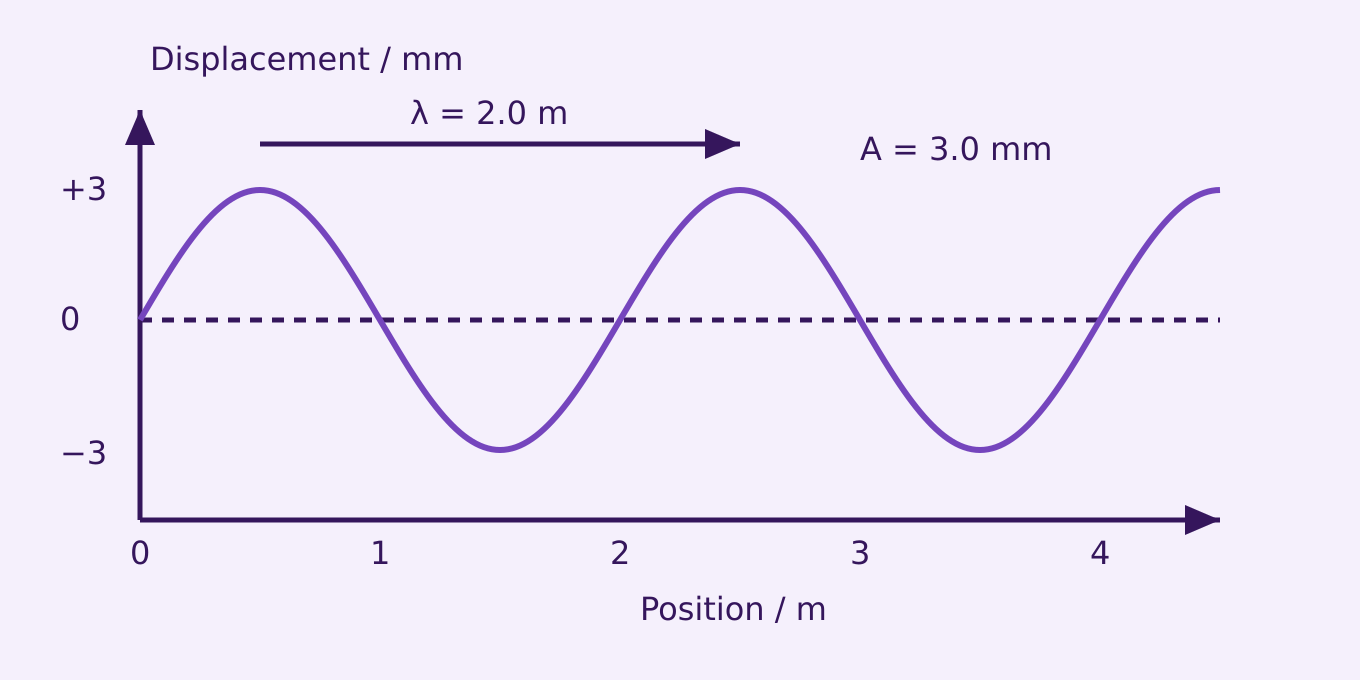
Displacement is a signed distance from equilibrium. Amplitude is the greatest magnitude of displacement, measured in metres. Wavelength λ is the shortest distance between points in the same phase, such as adjacent crests. Frequency f counts complete cycles each second, in hertz (Hz = s⁻¹). Period T is the time for one cycle, in seconds. Consequently f = 1/T.
Wave speed v describes the progress of a feature of the wave through the medium. It is different from the instantaneous speed of a vibrating particle. For a specified medium and mode, a source usually sets frequency while the medium determines propagation speed; wavelength follows from those two quantities.
Scientific diagram and interpretation
Equations and relationships
f = 1/T (supporting relationship)
Worked examples and applications
Timing repeated cycles
A vibrator completes 40 cycles in 2.0 s. T = total time / cycles = 2.0/40 = 0.050 s. f = cycles/time = 40/2.0 = 20 Hz. Timing many cycles reduces the fractional effect of reaction time.
Amplitude from limits
Displacement ranges from −3.0 mm to +3.0 mm. The peak-to-peak displacement is 6.0 mm, but amplitude is 3.0 mm = 0.0030 m. Zero displacement does not imply zero particle speed.
Common misconceptions
Amplitude is not the distance from trough to crest; that is twice the amplitude for a symmetric wave.
Examination technique
Define a quantity with the feature being measured and its unit; do not use “height” without a reference level.
For an explanation, connect the physical cause to its effect. For a calculation, state the model, rearrange before substitution, retain intermediate digits, and finish with units. For a data question, refer to the actual readings and distinguish a trend from proof of a cause.
Check your understanding
Five questions. Choose an option, then Check Answer. Read the feedback and use Try Again to reset. Use Tab between controls, arrow keys within radio groups, and Enter or Space on buttons. These local practice answers are not saved.

FREE RESOURCES
Physics revision
Explore the available lessons, diagrams and questions in your subject hub.
Free No payment
Explore Physics Browse exam resources