Transverse and longitudinal waves
FREE PHYSICS REVISION · UNIT 3 · A1.2
Pearson BTEC Level 3 AAQ Applied Science · Issue 7 (May 2026)
Learning objectives
- Describe transverse and longitudinal waves in terms of oscillation direction relative to energy transfer.
- Identify crests and troughs, or compressions and rarefactions, in appropriate wave representations.
- Determine wavelength between successive points in the same phase for either wave type.
- Compare mechanical and electromagnetic examples, distinguishing particle displacement from wave propagation.
Specification mapping: A1.2
Prerequisites: A1.1.1, A1.1.2
Physical principles
In a transverse wave, displacement is perpendicular to propagation. A wave on a stretched string is a mechanical example. Electromagnetic waves are transverse oscillations of electric and magnetic fields, so no material medium is required in a vacuum.
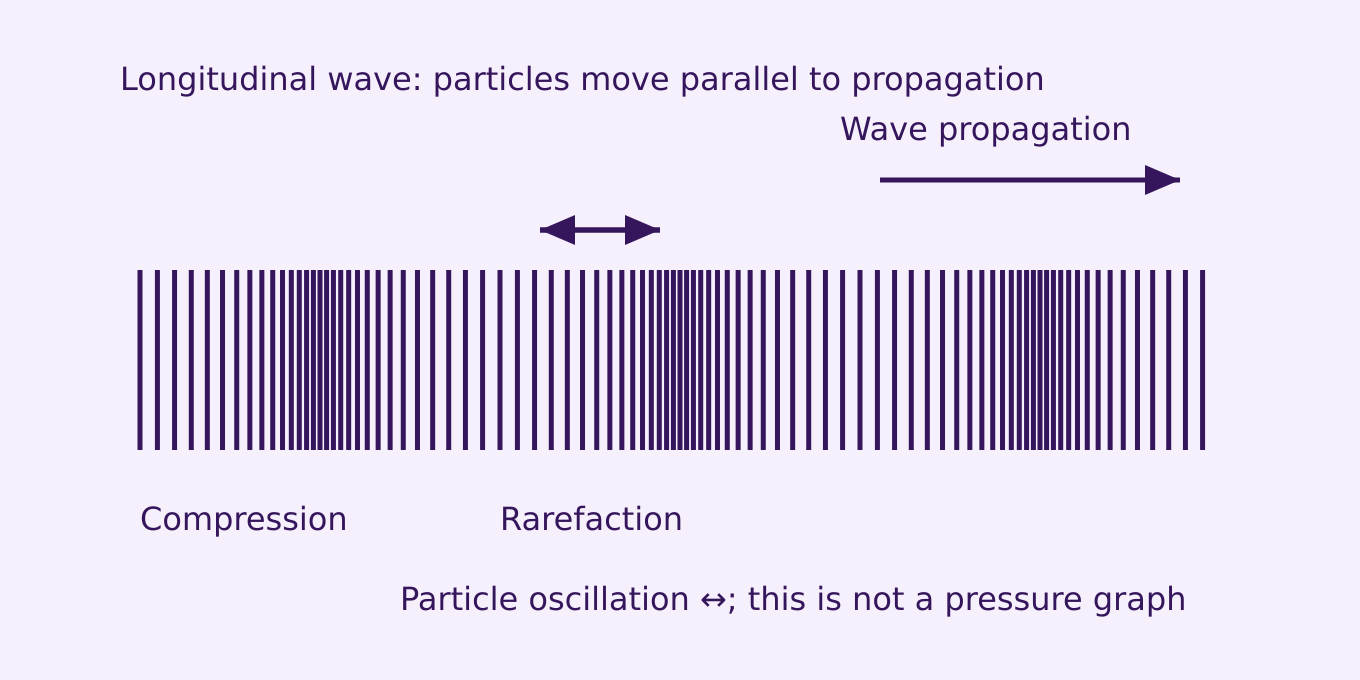
In a longitudinal wave, displacement is parallel to propagation. Sound in air consists of pressure and density variations: compressions are regions of higher pressure and rarefactions of lower pressure. Air molecules vibrate back and forth; they do not accompany the sound all the way from speaker to listener.
Both types have frequency, period, wavelength, amplitude and speed, and both can transfer energy and undergo superposition. On a longitudinal diagram, wavelength can be measured between adjacent compression centres. A plotted pressure sine curve is a representation of pressure variation, not a picture showing air moving sideways. Only transverse waves can be plane polarised.
Scientific diagram and interpretation
Worked examples and applications
Classify an observation
A slinky pulse travels to the right while its coils move left and right. Oscillation is parallel to propagation, so the pulse is longitudinal.
Wavelength in sound
Compression centres are at 0.10, 0.50 and 0.90 m. Two complete wavelengths occupy 0.80 m, so λ = 0.80/2 = 0.40 m.
Common misconceptions
A sine-shaped pressure graph does not make sound transverse.
Examination technique
State both directions in a comparison; naming a direction without the propagation reference is incomplete.
For an explanation, connect the physical cause to its effect. For a calculation, state the model, rearrange before substitution, retain intermediate digits, and finish with units. For a data question, refer to the actual readings and distinguish a trend from proof of a cause.
Check your understanding
Five questions. Choose an option, then Check Answer. Read the feedback and use Try Again to reset. Use Tab between controls, arrow keys within radio groups, and Enter or Space on buttons. These local practice answers are not saved.
Take Your Learning Further
Practise
Build Your Confidence
Reinforce your understanding with our topic-based workbook. Every workbook page links back to its matching online lesson, so you can revisit explanations whenever you need support.
Explore Workbook – PhysicsMaster
Get Exam Ready
Apply your knowledge with exam-style practice papers and detailed mark schemes. Identify what you’ve mastered and what to revise next.
Practice Papers – PhysicsEXAM RESOURCES
Physics exam resources
Apply your knowledge with written practice.
Browse exam resources