Phase, coherence and superposition
FREE PHYSICS REVISION · UNIT 3 · A1.3
Pearson BTEC Level 3 AAQ Applied Science · Issue 7 (May 2026)
Learning objectives
- Define coherence and distinguish a fixed phase relationship from equal frequency alone.
- Apply superposition to determine the resultant displacement of overlapping waves.
- Relate path difference and phase difference to constructive and destructive interference.
- Explain how interference between coherent contributions produces bright and dark regions in a diffraction-grating pattern.
Specification mapping: A1.3
Prerequisites: A1.1.2, A1.2
Physical principles
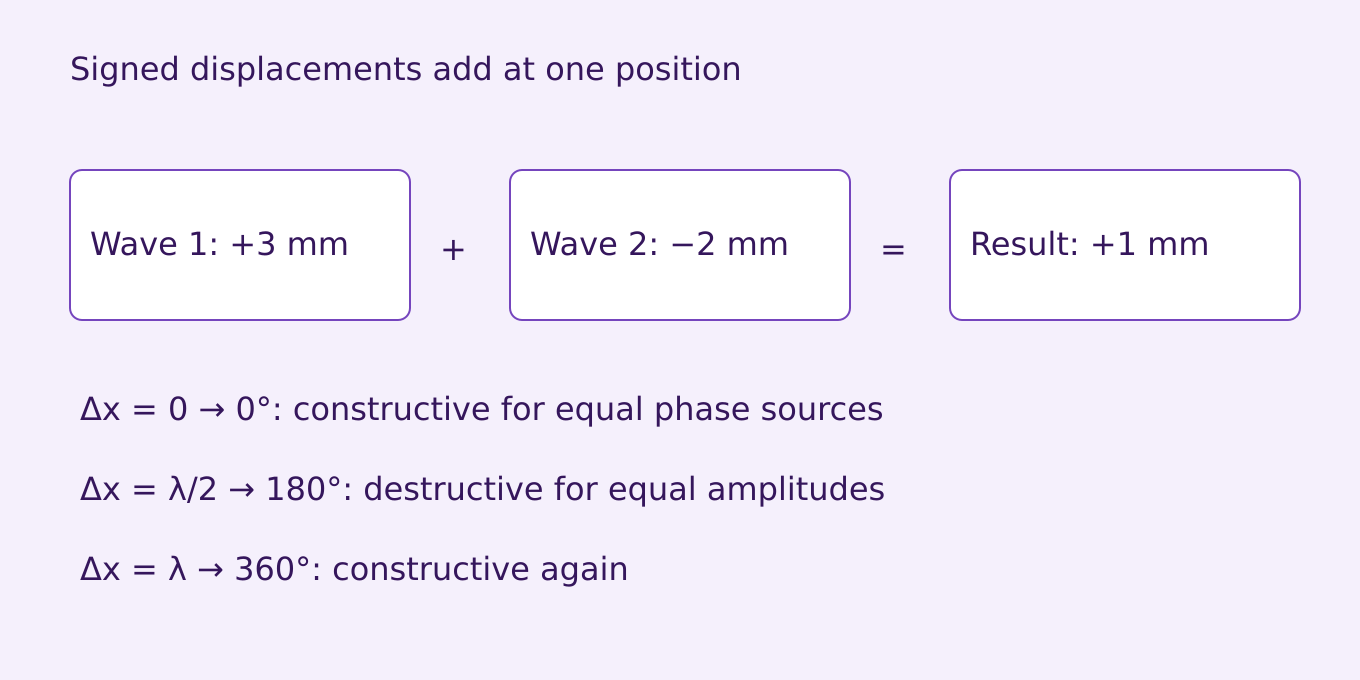
When waves overlap, the resultant displacement at a point is the algebraic sum of their separate displacements. This principle of superposition gives constructive interference when displacements reinforce and destructive interference when they oppose. Complete cancellation requires equal amplitudes and opposite phase.
Phase specifies position within an oscillation cycle. A whole cycle corresponds to 360° or 2π radians. A path difference Δx corresponds to phase difference 2πΔx/λ for waves of the same wavelength propagating in the same medium. Coherent sources maintain a constant phase difference and have the same frequency; equal brightness alone does not establish coherence.
A grating splits incident light into many coherent wave contributions from narrow, regularly spaced apertures. At particular angles, waves from adjacent apertures arrive in phase and reinforce sharply. For normally incident light, the supporting relation d sin θ = mλ describes constructive orders m. Here d is slit spacing, not total grating width. Treat this as an explanatory extension: the specification does not explicitly prescribe numerical use of the grating equation.
Scientific diagram and interpretation
Equations and relationships
Δφ = 2πΔx/λ; d sin θ = mλ (supporting extensions)
Worked examples and applications
Add signed displacements
At an instant, two pulses produce +3 mm and −2 mm at the same point. Resultant displacement = +3 + (−2) = +1 mm. Cancellation is partial.
Convert path difference
A path difference of 1.5λ represents 1.5 × 360° = 540°, equivalent to 180° modulo one cycle. Equal-amplitude waves then cancel at that point.
Common misconceptions
Coherent does not mean permanently in phase; a fixed non-zero phase difference is coherent.
Examination technique
Connect path difference to phase, then explain reinforcement or cancellation.
For an explanation, connect the physical cause to its effect. For a calculation, state the model, rearrange before substitution, retain intermediate digits, and finish with units. For a data question, refer to the actual readings and distinguish a trend from proof of a cause.
Check your understanding
Five questions. Choose an option, then Check Answer. Read the feedback and use Try Again to reset. Use Tab between controls, arrow keys within radio groups, and Enter or Space on buttons. These local practice answers are not saved.
Take Your Learning Further
Practise
Build Your Confidence
Reinforce your understanding with our topic-based workbook. Every workbook page links back to its matching online lesson, so you can revisit explanations whenever you need support.
Explore Workbook – PhysicsMaster
Get Exam Ready
Apply your knowledge with exam-style practice papers and detailed mark schemes. Identify what you’ve mastered and what to revise next.
Practice Papers – PhysicsEXAM RESOURCES
Physics exam resources
Apply your knowledge with written practice.
Browse exam resources