FREE PHYSICS REVISION · UNIT 3 · A2.1.2
Pearson BTEC Level 3 AAQ Applied Science · Issue 7 (May 2026)
What you will learn
Critical angle and two conditions for total internal reflection.
Specification mapping: A2.1.2
Prerequisites: A2.1
Physical principles
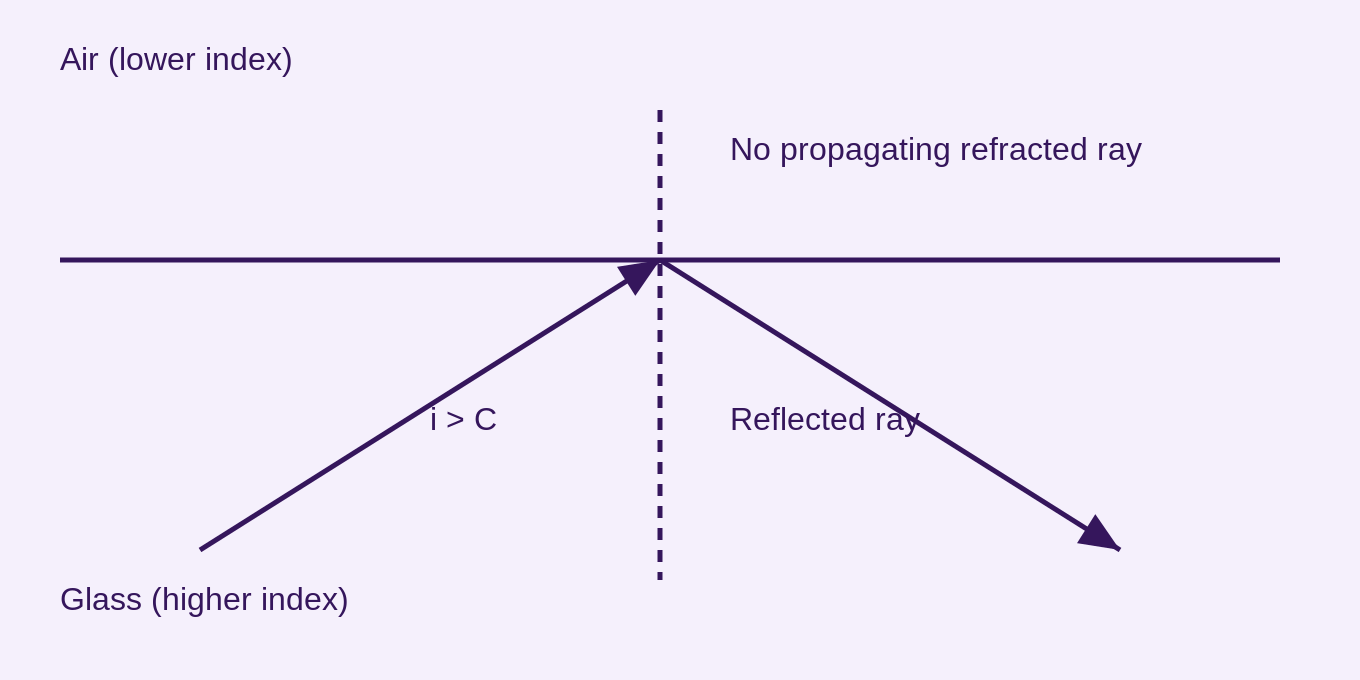
Light travelling from a higher-index medium towards a lower-index medium bends away from the normal when it refracts. As incidence increases, the refracted angle increases until the ray runs along the boundary. This incident angle is the critical angle C. Beyond C there is no propagating refracted ray in the lower-index medium in the ideal ray model; total internal reflection occurs.
Two conditions must both hold: light approaches the boundary from the higher-index side, and incidence exceeds the critical angle. At incidence equal to C the refracted ray is at 90° to the normal, so this is the limiting case rather than the usual greater-than condition for TIR. From air into glass there is no such critical angle.
Ordinary partial reflection can occur below C and at boundaries that do not satisfy TIR conditions. “Total” describes reflected intensity in an ideal lossless interface, not absence of absorption or bending losses in a real fibre. Optical fibres guide light by repeated TIR at a higher-index core/lower-index cladding boundary.
Scientific diagram and interpretation
Worked examples and applications
Apply both tests
Glass-to-air incidence is 50° and C is 42°. Higher-to-lower index and 50° > 42° both hold, so TIR occurs.
Boundary case
At i = 42° for C = 42°, r = 90°. At i = 35°, refraction and partial reflection can occur. Reversing to air-to-glass prevents TIR whatever the air incidence angle.
Common misconceptions
A large angle alone is insufficient: light must approach from the higher-index material.
Examination technique
State both conditions explicitly and distinguish equality from exceeding C.
For an explanation, connect the physical cause to its effect. For a calculation, state the model, rearrange before substitution, retain intermediate digits, and finish with units. For a data question, refer to the actual readings and distinguish a trend from proof of a cause.
Check your understanding
Five questions. Choose an option, then Check Answer. Read the feedback and use Try Again to reset. Use Tab between controls, arrow keys within radio groups, and Enter or Space on buttons. These local practice answers are not saved.
Take Your Learning Further
Practise
Build Your Confidence
Reinforce what you’ve learned with our topic-based workbook. Every workbook page links back to its matching online lesson, so help is always at hand.
Explore Workbooks – PhysicsMaster
Get Exam Ready
Challenge yourself with exam-style practice papers and detailed mark schemes. Apply your knowledge, identify areas to improve and build exam confidence.
Practice Papers – PhysicsEXAM RESOURCES
Physics exam resources
Apply your knowledge with written practice.
Browse exam resources