Analogue and digital signals
FREE PHYSICS REVISION · UNIT 3 · A2.3
Pearson BTEC Level 3 AAQ Applied Science · Issue 7 (May 2026)
Learning objectives
- Distinguish analogue signals from digital representations using appropriate waveform examples.
- Describe sampling and quantisation and identify the information each process records or approximates.
- Explain how noise affects signal quality and why digital signals can be regenerated under suitable conditions.
- Compare analogue and digital transmission, including limitations caused by sampling, quantisation and decision errors.
Specification mapping: A2.3
Prerequisites: A2.2
Physical principles
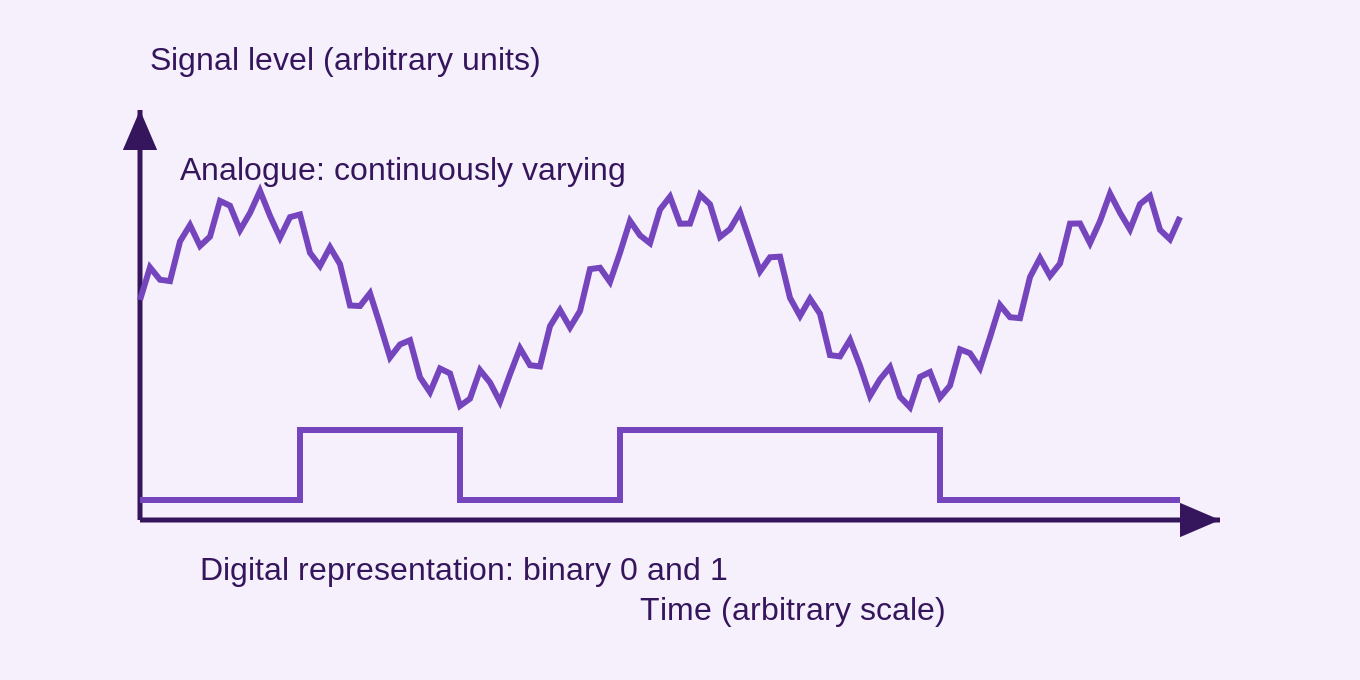
An analogue signal varies continuously to represent information, such as microphone voltage following air-pressure variation. A digital signal represents information using discrete symbols, often binary 0 and 1. The electrical or optical waveform is physical and continuous in time, but receiver decisions assign it to a limited set of valid symbols.
Noise adds unwanted variation. Amplifying an analogue signal also amplifies existing noise, so repeated amplification can degrade quality. A digital receiver can regenerate clean symbols when the received signal remains distinguishable from decision thresholds. Severe noise can still cause bit errors; digital does not mean noise-free.
Converting an analogue quantity to digital form involves sampling at discrete times and quantising each sample to an available numerical level. Higher sampling rates preserve faster variations within system limits; more quantisation levels reduce amplitude rounding error. These supporting concepts explain why data rate and fidelity can trade off. An optical link can carry digital pulses or suitably modulated analogue information.
Scientific diagram and interpretation
Worked examples and applications
Regenerate a bit
A receiver treats voltages above 2.5 V as 1 and below as 0 in an illustrative system. A noisy 4.6 V sample is regenerated as 1. A nominal 0 corrupted to 3.0 V is misread as 1.
Quantisation
Levels are 0, 1, 2 and 3 V. A 1.7 V sample rounded to the nearest available level becomes 2 V, introducing +0.3 V quantisation error. Smaller level spacing reduces this error.
Common misconceptions
Digital signals can be corrupted; regeneration works only when symbols can still be identified correctly.
Examination technique
Compare how noise accumulates in analogue amplification with threshold-based digital regeneration.
For an explanation, connect the physical cause to its effect. For a calculation, state the model, rearrange before substitution, retain intermediate digits, and finish with units. For a data question, refer to the actual readings and distinguish a trend from proof of a cause.
Check your understanding
Five questions. Choose an option, then Check Answer. Read the feedback and use Try Again to reset. Use Tab between controls, arrow keys within radio groups, and Enter or Space on buttons. These local practice answers are not saved.
Take Your Learning Further
Practise
Build Your Confidence
Reinforce your understanding with our topic-based workbook. Every workbook page links back to its matching online lesson, so you can revisit explanations whenever you need support.
Explore Workbook – PhysicsMaster
Get Exam Ready
Apply your knowledge with exam-style practice papers and detailed mark schemes. Identify what you’ve mastered and what to revise next.
Practice Papers – PhysicsEXAM RESOURCES
Physics exam resources
Apply your knowledge with written practice.
Browse exam resources