Electromagnetic wave speed
FREE PHYSICS REVISION · UNIT 3 · A3.1
Pearson BTEC Level 3 AAQ Applied Science · Issue 7 (May 2026)
Learning objectives
- State the common vacuum speed of electromagnetic waves and use its SI units correctly.
- Describe electromagnetic waves as transverse disturbances that can propagate through a vacuum.
- Calculate wavelength or frequency using c = fλ and appropriate SI-prefix conversions.
- Explain why changing wavelength in a vacuum does not imply a different electromagnetic propagation speed.
Specification mapping: A3.1
Prerequisites: A1.4, A1.2
Physical principles
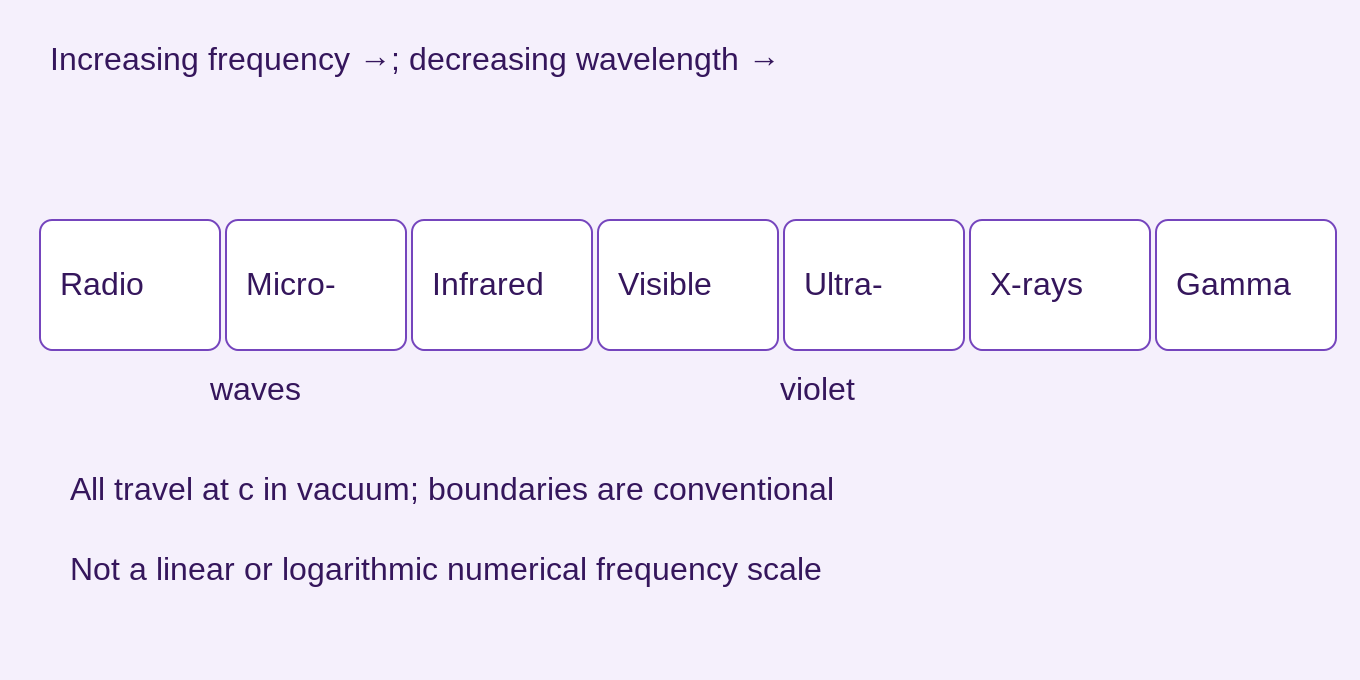
All electromagnetic waves travel at the same speed c in vacuum, approximately 3.00 × 10⁸ m s⁻¹ for calculations at three significant figures. Radio, microwave, infrared, visible, ultraviolet, X-ray and gamma radiation differ in frequency and wavelength, not in vacuum propagation speed. Electromagnetic fields oscillate transversely.
Vacuum speed is not necessarily the speed inside matter. Refractive index describes phase speed for a specified wavelength; absorption and dispersion depend on material and frequency. Signals in cables, atmosphere and devices also acquire delays. A satellite signal therefore has both propagation time and possible processing delay.
For an unobstructed path of length d in vacuum, one-way travel time is t = d/c. A reflected or echo path may involve twice the source–reflector distance. Use the actual total path and do not confuse propagation speed with data rate, which measures bits per second.
Scientific diagram and interpretation
Equations and relationships
c ≈ 3.00 × 10⁸ m s⁻¹ (adopted working value)
Worked examples and applications
One-way delay
A radio signal crosses 3.60 × 10⁷ m. t = d/c = (3.60 × 10⁷)/(3.00 × 10⁸) = 0.120 s. A return path of equal length would double the propagation delay.
Compare two bands
A 3.0 GHz microwave has λ = 0.10 m. A 300 MHz radio wave has λ = 1.0 m. Both travel at c in vacuum despite their tenfold frequency difference.
Common misconceptions
Higher frequency does not mean higher vacuum speed. Data rate is not propagation speed.
Examination technique
Check whether the stated distance is one way, round trip or a complete multi-leg route.
For an explanation, connect the physical cause to its effect. For a calculation, state the model, rearrange before substitution, retain intermediate digits, and finish with units. For a data question, refer to the actual readings and distinguish a trend from proof of a cause.
Check your understanding
Five questions. Choose an option, then Check Answer. Read the feedback and use Try Again to reset. Use Tab between controls, arrow keys within radio groups, and Enter or Space on buttons. These local practice answers are not saved.
Take Your Learning Further
Practise
Build Your Confidence
Reinforce your understanding with our topic-based workbook. Every workbook page links back to its matching online lesson, so you can revisit explanations whenever you need support.
Explore Workbook – PhysicsMaster
Get Exam Ready
Apply your knowledge with exam-style practice papers and detailed mark schemes. Identify what you’ve mastered and what to revise next.
Practice Papers – PhysicsEXAM RESOURCES
Physics exam resources
Apply your knowledge with written practice.
Browse exam resources