FREE PHYSICS REVISION · UNIT 3 · C4.4.1
Pearson BTEC Level 3 AAQ Applied Science · Issue 7 (May 2026)
What you will learn
Electrical determination for solids and liquids; measurements, heat losses and uncertainty.
Specification mapping: C4.4, C4.4.1
Prerequisites: C2.1.4, C4.3
Physical principles
Specific heat capacity can be measured by supplying known energy to a known mass and measuring its temperature rise. In the simple electrical method, E = VIt and c ≈ VIt/(mΔT). This estimate assumes the recorded electrical energy heats only the sample, so a practical method must address other energy transfers.
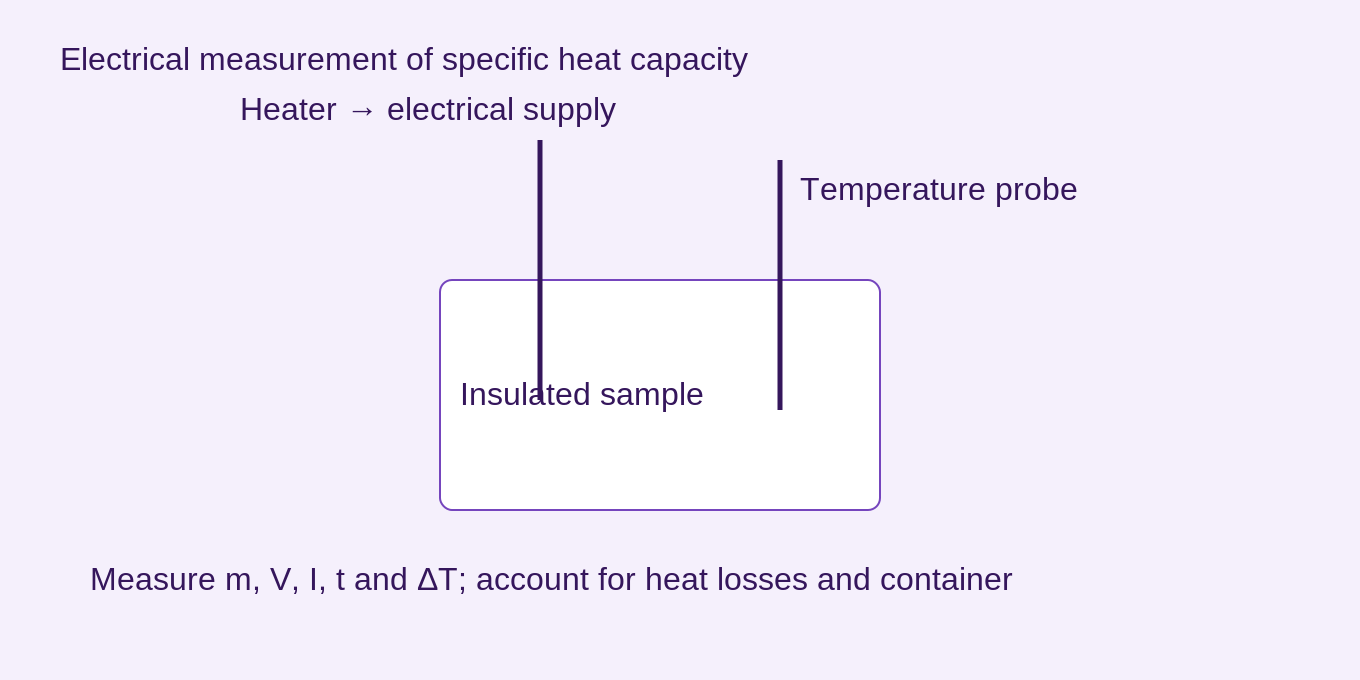
For a solid block, measure its mass, insert a suitable heater and temperature probe in close thermal contact, insulate the block and record initial temperature. Use a safe low-voltage supply, measure V and I, start timing, and record temperature through a useful rise. Good contact, sometimes aided by suitable thermal paste or oil in prepared holes, reduces local temperature differences.
For a liquid, weigh the liquid by difference, immerse the heater and thermometer appropriately, insulate the vessel and stir gently for uniform temperature. Keep the probe away from direct heater contact. Account for container heat capacity if known: VIt ≈ mcΔT + CcontainerΔT + Eloss.
Heat loss to the environment and heating the apparatus generally make the uncorrected VIt/(mΔT) overestimate the sample’s c. Reduce losses with insulation, an appropriate lid and a manageable temperature rise; consider a cooling correction or a power–temperature-rate method. Repeat trials and quantify measurement resolution rather than claiming losses are eliminated.
Scientific diagram and interpretation
Equations and relationships
c ≈ VIt/(mΔT), with apparatus and loss corrections
Worked examples and applications
Uncorrected result
A 0.50 kg sample receives 12 V × 2.0 A × 300 s = 7200 J and warms by 30 K. cestimate = 7200/(0.50×30) = 480 J kg⁻¹ K⁻¹.
Container correction
If 600 J heats the container and 600 J is lost, sample energy is 7200−600−600 = 6000 J. c = 6000/(0.50×30) = 400 J kg⁻¹ K⁻¹. The correction lowers the estimate in this model.
Common misconceptions
Electrical energy supplied is not automatically energy gained by the sample. Poor mixing can make one temperature reading unrepresentative.
Examination technique
Give a method for both measuring energy and reducing or estimating losses.
For an explanation, connect the physical cause to its effect. For a calculation, state the model, rearrange before substitution, retain intermediate digits, and finish with units. For a data question, refer to the actual readings and distinguish a trend from proof of a cause.
Check your understanding
Five questions. Choose an option, then Check Answer. Read the feedback and use Try Again to reset. Use Tab between controls, arrow keys within radio groups, and Enter or Space on buttons. These local practice answers are not saved.
Take Your Learning Further
Practise
Build Your Confidence
Reinforce what you’ve learned with our topic-based workbook. Every workbook page links back to its matching online lesson, so help is always at hand.
Explore Workbooks – PhysicsMaster
Get Exam Ready
Challenge yourself with exam-style practice papers and detailed mark schemes. Apply your knowledge, identify areas to improve and build exam confidence.
Practice Papers – PhysicsEXAM RESOURCES
Physics exam resources
Apply your knowledge with written practice.
Browse exam resources