Latent heat and multi-stage thermal calculations
FREE PHYSICS REVISION · UNIT 3 · C5.2
Pearson BTEC Level 3 AAQ Applied Science · Issue 7 (May 2026)
Learning objectives
- Distinguish specific latent heat of fusion from specific latent heat of vaporisation.
- Apply ΔQ = mL to calculate the energy, mass or specific latent heat for a stated phase change.
- Separate a multi-stage thermal process into temperature-change and phase-change contributions.
- Calculate a total energy change using mcΔT and mL where appropriate, stating the relevant modelling assumptions.
Specification mapping: C5.2
Prerequisites: C5.1, C4.4.2
Physical principles
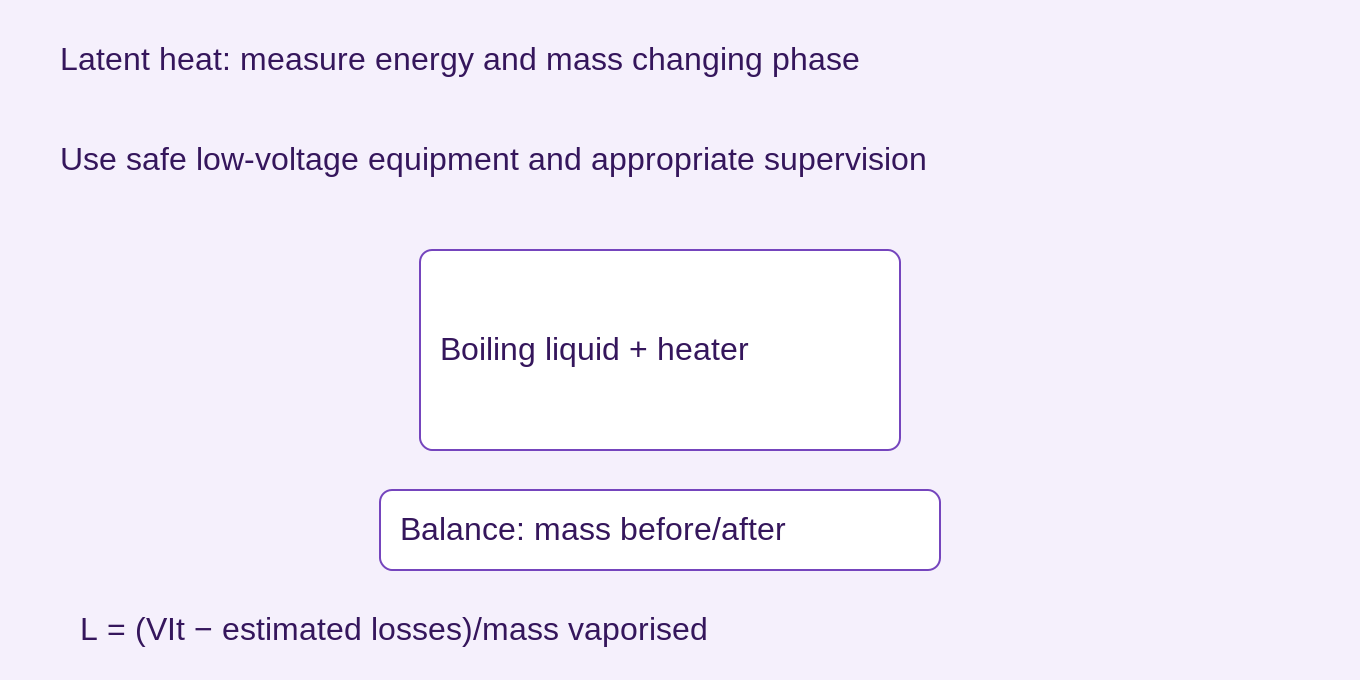
The latent-energy equation is ΔQ = mL, where m is the mass changing phase and L is specific latent heat in J kg⁻¹. Rearrange to L = ΔQ/m or m = ΔQ/L. The temperature does not appear because the energy changes the state at the transition condition, rather than producing a temperature rise.
Melting and vaporisation absorb energy; freezing and condensation release the corresponding energy magnitudes under the reverse conditions. Use a sign convention if tracking the sample’s energy change, or report a positive released-energy magnitude with its direction. Do not insert specific heat capacity into a latent calculation.
A multi-stage problem may require warming a solid, melting, warming a liquid, boiling and warming vapour. Compute each applicable mcΔT or mL term separately and add. Material properties and transition temperatures must be supplied or sourced for the specified conditions; do not treat illustrative water data as universal constants. If input power is known and losses negligible, total time is total energy divided by power.
Scientific diagram and interpretation
Equations and relationships
ΔQ = mL; L in J kg⁻¹
Worked examples and applications
Melt a known mass
Using supplied Lf = 3.34 × 10⁵ J kg⁻¹, melting 0.200 kg at its melting point requires ΔQ = 0.200×3.34×10⁵ = 66800 J = 66.8 kJ.
Mass condensed
If 226 kJ is released during condensation and supplied Lv = 2.26 × 10⁶ J kg⁻¹, m = 226000/(2.26×10⁶) = 0.100 kg.
Heat then boil
For 0.100 kg water from 20 to 100 °C, use supplied c = 4200 J kg⁻¹ K⁻¹ and Lv = 2.26 × 10⁶ J kg⁻¹. Sensible energy = 0.100×4200×80 = 33600 J; vaporisation = 226000 J. Total = 259600 J ≈ 260 kJ. At 500 W with negligible losses, t = 259600/500 = 519.2 s ≈ 520 s.
Common misconceptions
For multi-stage heating, mL covers only the phase change, not warming before or after it.
Examination technique
Lay out a stage table with starting state, ending state, equation and energy.
For an explanation, connect the physical cause to its effect. For a calculation, state the model, rearrange before substitution, retain intermediate digits, and finish with units. For a data question, refer to the actual readings and distinguish a trend from proof of a cause.
Check your understanding
Five questions. Choose an option, then Check Answer. Read the feedback and use Try Again to reset. Use Tab between controls, arrow keys within radio groups, and Enter or Space on buttons. These local practice answers are not saved.
Take Your Learning Further
Practise
Build Your Confidence
Reinforce your understanding with our topic-based workbook. Every workbook page links back to its matching online lesson, so you can revisit explanations whenever you need support.
Explore Workbook – PhysicsMaster
Get Exam Ready
Apply your knowledge with exam-style practice papers and detailed mark schemes. Identify what you’ve mastered and what to revise next.
Practice Papers – PhysicsEXAM RESOURCES
Physics exam resources
Apply your knowledge with written practice.
Browse exam resources