FREE PHYSICS REVISION · UNIT 3 · C1.4
Pearson BTEC Level 3 AAQ Applied Science · Issue 7 (May 2026)
What you will learn
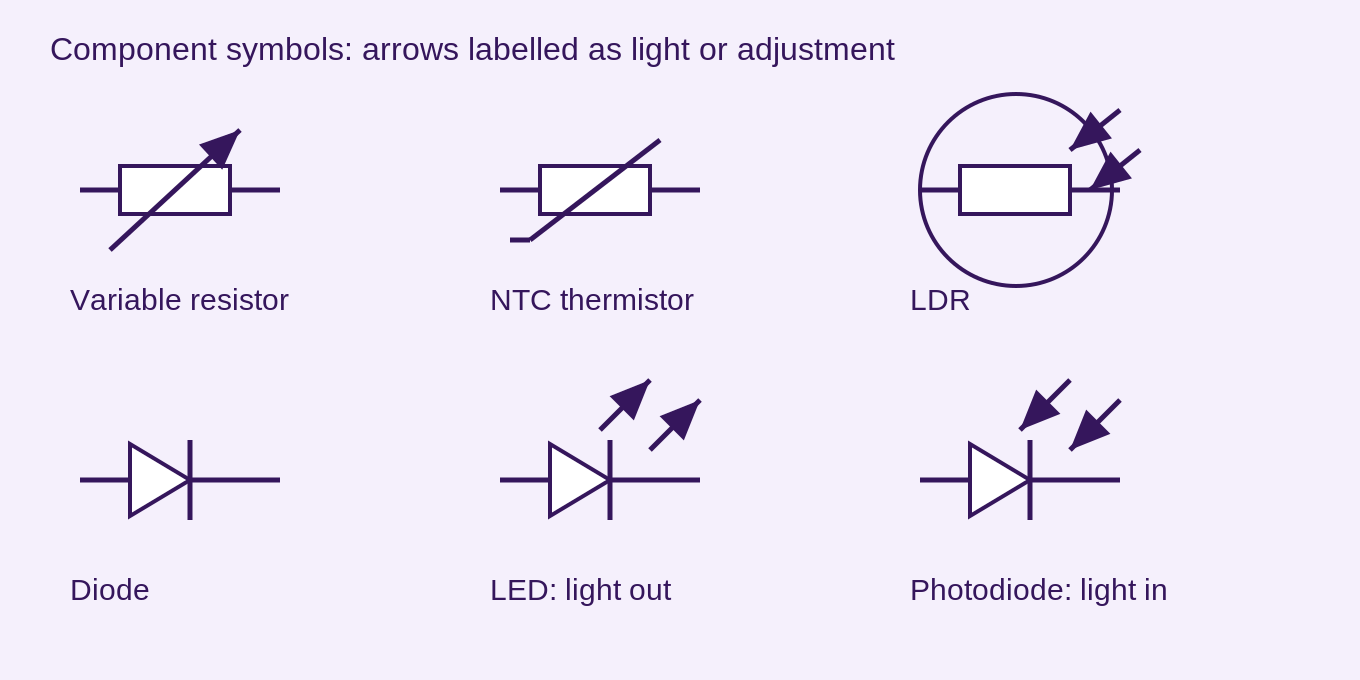
Filament lamps, diodes, NTC thermistors, LDRs, photodiodes and LEDs; characteristics and applications.
Specification mapping: C1.4
Prerequisites: C1.2, C1.3
Physical principles
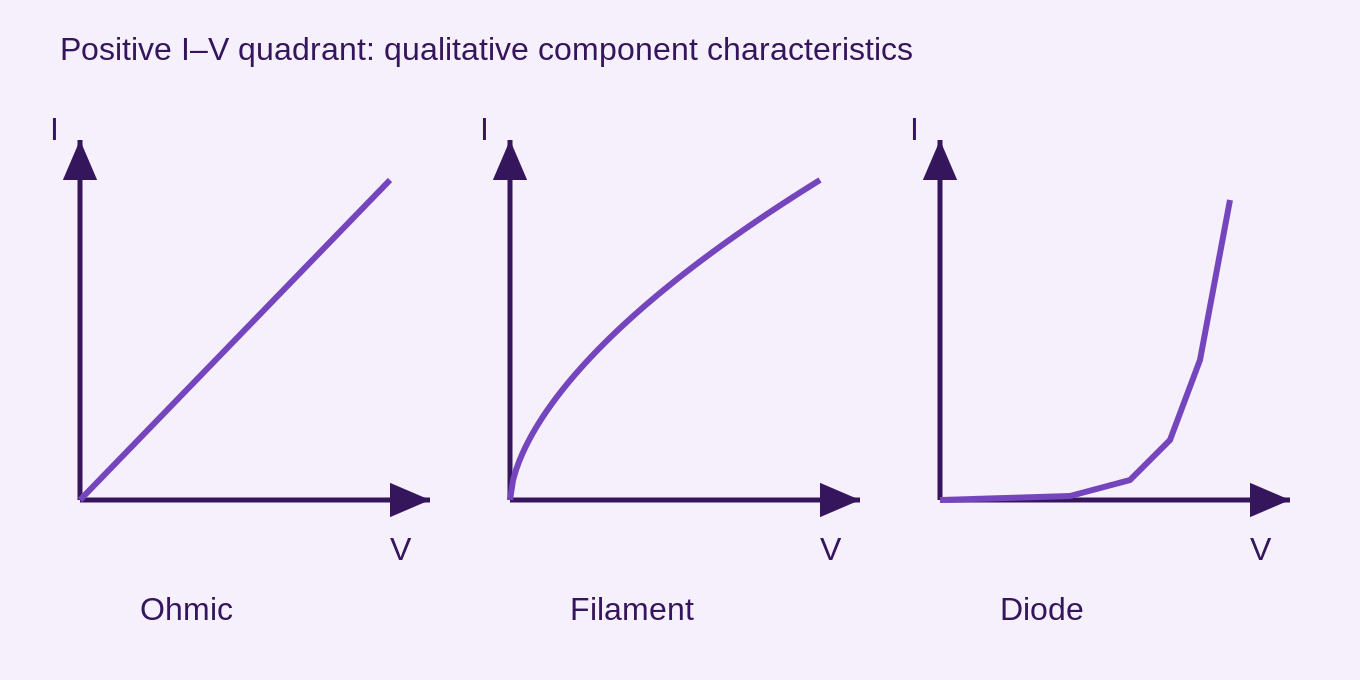
A filament lamp heats as current flows. Its metal filament’s resistance rises with temperature, so current is not proportional to voltage across the full operating range. On an I-against-V graph the gradient decreases as the magnitude of voltage rises; the characteristic is approximately symmetric about the origin. Gradient is not generally the same as I/V for a nonlinear curve.
A diode conducts readily in the forward direction after its characteristic turn-on region and conducts little in reverse before breakdown. An LED emits light under forward bias and needs current limiting, often a series resistor. Reverse-bias ratings must be respected. Threshold voltage depends on device type and conditions; there is no universal diode voltage.
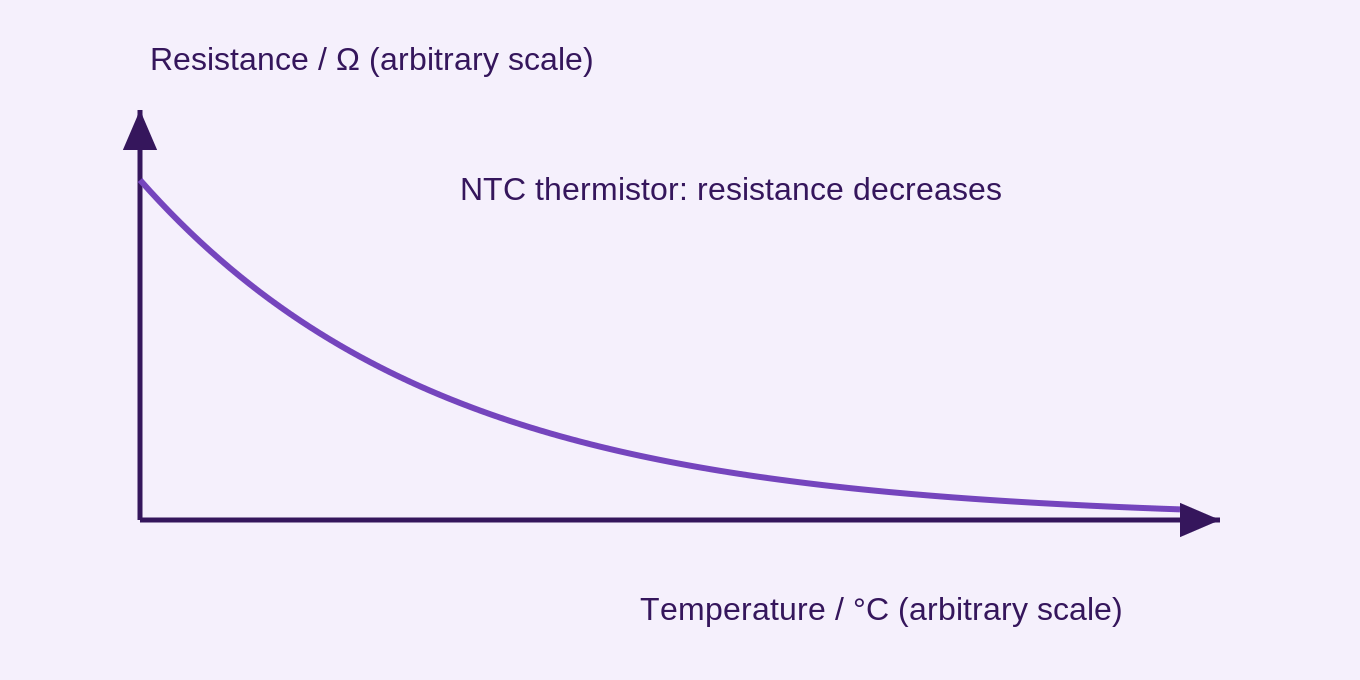
A negative-temperature-coefficient thermistor’s resistance falls as temperature increases. An LDR’s resistance generally falls with increasing illumination. These can be used in sensing circuits, but a resistance change does not by itself specify whether a particular circuit’s output voltage rises or falls: the connection matters.
A photodiode converts light into an electrical response, commonly operated under reverse bias so photocurrent varies with illumination. An LED performs the opposite functional conversion, electrical input to light. Obtain current–voltage data with a current-limited low-voltage supply, vary voltage, record current and temperature conditions, and reverse polarity only within ratings.
Scientific diagram and interpretation
Worked examples and applications
Filament resistance
At one point V = 2.0 V and I = 0.40 A, so R = 5.0 Ω. At a hotter point V = 6.0 V and I = 0.60 A, R = 10 Ω. The increasing resistance shows non-ohmic behaviour.
LED current limiting
Illustrative LED drop 2.0 V, source 5.0 V, target current 0.010 A. Series resistor R = (5.0−2.0)/0.010 = 300 Ω. Check resistor power and actual LED ratings before use.
Common misconceptions
Photodiodes detect light; LEDs emit it. A nonlinear I–V curve does not have one constant resistance.
Examination technique
State whether the graph is I against V or V against I before discussing gradients.
For an explanation, connect the physical cause to its effect. For a calculation, state the model, rearrange before substitution, retain intermediate digits, and finish with units. For a data question, refer to the actual readings and distinguish a trend from proof of a cause.
Check your understanding
Five questions. Choose an option, then Check Answer. Read the feedback and use Try Again to reset. Use Tab between controls, arrow keys within radio groups, and Enter or Space on buttons. These local practice answers are not saved.

FREE RESOURCES
Physics revision
Explore the available lessons, diagrams and questions in your subject hub.
Free No payment
Explore Physics Browse exam resources