Scalars, vectors and one-dimensional motion
FREE PHYSICS REVISION · UNIT 3 · B1.3
Pearson BTEC Level 3 AAQ Applied Science · Issue 7 (May 2026)
Learning objectives
- Distinguish scalar quantities from vector quantities using speed, velocity, distance and displacement.
- Use a stated reference direction to assign signs to one-dimensional displacements and velocities.
- Calculate total distance and resultant displacement for a journey containing direction changes.
- Compare average speed with average velocity and explain why a return journey can have zero average velocity.
Specification mapping: B1.3, B1.3.1, B1.3.2
Prerequisites: B1.1, B1.2
Physical principles
A scalar has magnitude only; examples include distance, time, mass, speed and energy. A vector has magnitude and direction; examples include displacement, velocity, acceleration, force and momentum. Include direction or a defined sign when giving a vector answer.
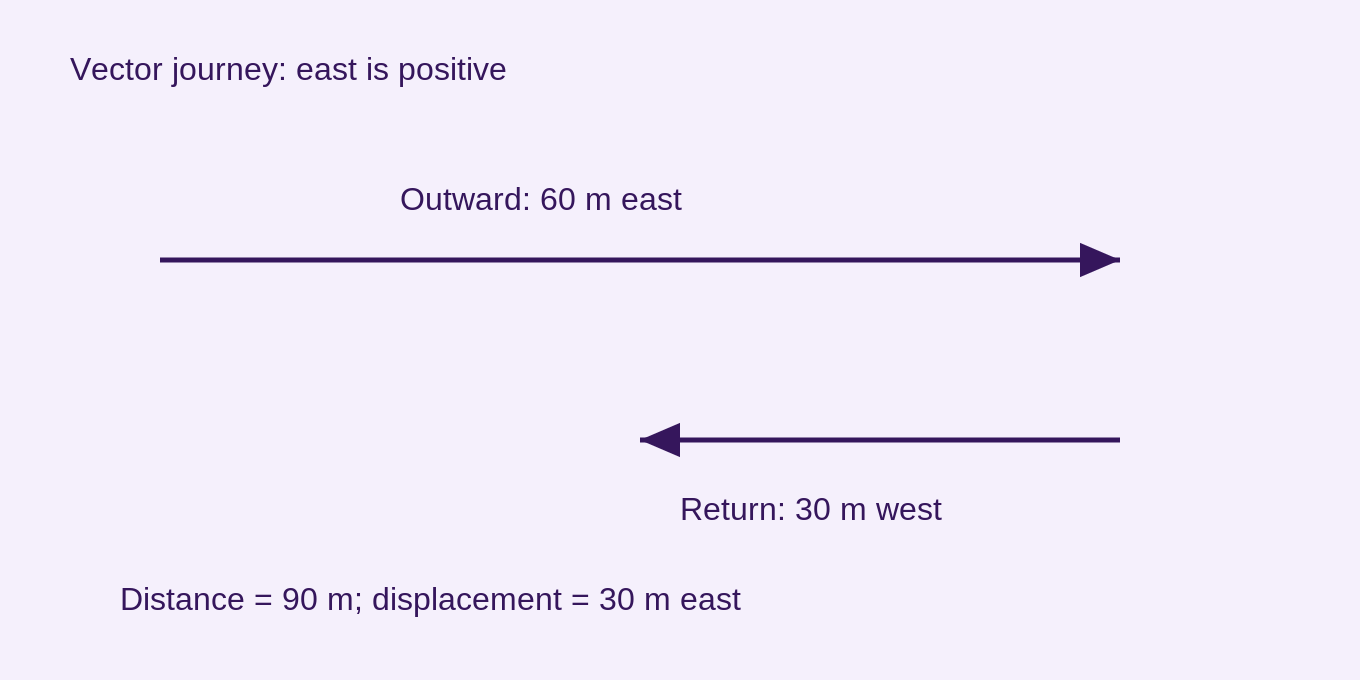
Distance is the length of the actual path. Displacement is the straight-line change in position from start to finish. In one dimension choose a positive axis and add directed changes algebraically. Average velocity is displacement divided by elapsed time. Speed is the magnitude of instantaneous velocity, but average speed need not equal the magnitude of average velocity.
Changing direction changes velocity even when speed is constant, so motion around a bend involves acceleration. A negative velocity means motion in the negative direction; a negative displacement specifies the final position relative to the chosen origin. These signs do not imply negative distance or negative elapsed time.
Scientific diagram and interpretation
Worked examples and applications
Out and back
An object goes 60 m east then 30 m west. Distance = 60 + 30 = 90 m. With east positive, displacement = +60 − 30 = +30 m, or 30 m east.
Average velocity
The journey above takes 15 s. Average speed = 90/15 = 6.0 m s⁻¹; average velocity = +30/15 = +2.0 m s⁻¹, east.
Common misconceptions
A constant speed does not guarantee constant velocity when direction changes.
Examination technique
Name your coordinate direction and keep distance separate from signed displacement.
For an explanation, connect the physical cause to its effect. For a calculation, state the model, rearrange before substitution, retain intermediate digits, and finish with units. For a data question, refer to the actual readings and distinguish a trend from proof of a cause.
Check your understanding
Five questions. Choose an option, then Check Answer. Read the feedback and use Try Again to reset. Use Tab between controls, arrow keys within radio groups, and Enter or Space on buttons. These local practice answers are not saved.
Take Your Learning Further
Practise
Build Your Confidence
Reinforce your understanding with our topic-based workbook. Every workbook page links back to its matching online lesson, so you can revisit explanations whenever you need support.
Explore Workbook – PhysicsMaster
Get Exam Ready
Apply your knowledge with exam-style practice papers and detailed mark schemes. Identify what you’ve mastered and what to revise next.
Practice Papers – PhysicsEXAM RESOURCES
Physics exam resources
Apply your knowledge with written practice.
Browse exam resources