FREE PHYSICS REVISION · UNIT 3 · B2.5.2
Pearson BTEC Level 3 AAQ Applied Science · Issue 7 (May 2026)
What you will learn
Compare high-speed low-mass and low-speed high-mass transport; stopping assumptions.
Specification mapping: B2.5.2
Prerequisites: B2.5
Physical principles
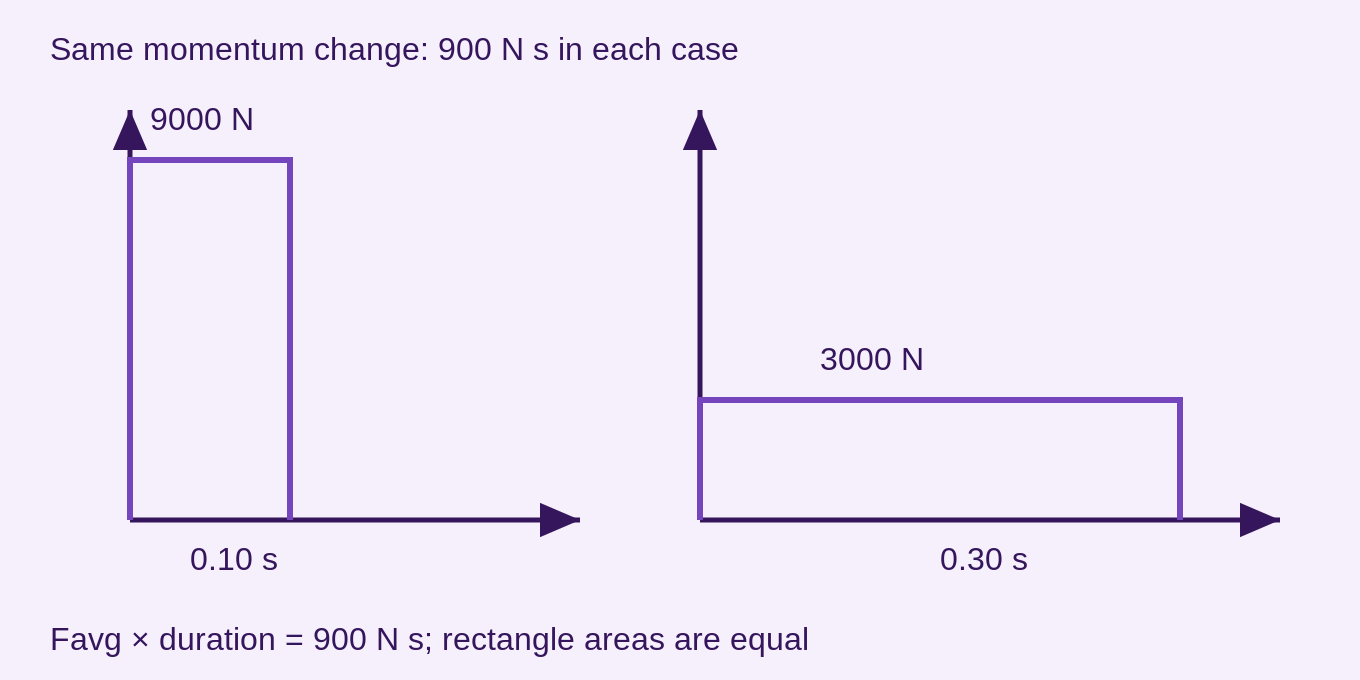
Transport risk depends on several quantities. Momentum mv determines the change needed to stop; stopping time and distance determine how forces act. A large mass at a modest speed can have substantial momentum, so a slow heavy vehicle is not automatically easy to stop.
For a fixed mass and stopping time, a higher initial speed gives a greater momentum change and average stopping-force magnitude. For a fixed mass and braking deceleration, stopping distance follows v² = u² + 2as, so it grows with the square of initial speed when stopping. These comparisons have different controlled conditions and must not be mixed.
Two vehicles can have equal momentum despite different masses and speeds. Their kinetic energies need not be equal: the supporting relation Ek = ½mv² helps explain why higher speed can carry a disproportionate energy burden. This is a contextual extension, not an additional equation explicitly listed in Unit 3’s content.
Real braking depends on road grip, tyres, slope, driver reaction and brake performance. The thinking distance adds to braking distance but involves a different model. Use supplied data to compare rather than asserting a universal force or distance for a vehicle class.
Scientific diagram and interpretation
Equations and relationships
p = mv; Favg = Δp/t; v² = u²+2as; Ek = ½mv² (supporting extension)
Worked examples and applications
Equal momentum
A 1000 kg car at 20 m s⁻¹ and a 10000 kg lorry at 2.0 m s⁻¹ each have p = 20000 kg m s⁻¹. Equal stopping time would require equal average resultant-force magnitude.
Speed and braking distance
At a = −5.0 m s⁻², stopping from 10 m s⁻¹ takes s = 10²/10 = 10 m. Stopping from 20 m s⁻¹ takes 40 m: twice the speed gives four times the braking distance under this model.
Common misconceptions
Equal momentum does not establish equal kinetic energy, stopping distance or injury outcome.
Examination technique
State what is held fixed: mass, stopping time, braking force or deceleration.
For an explanation, connect the physical cause to its effect. For a calculation, state the model, rearrange before substitution, retain intermediate digits, and finish with units. For a data question, refer to the actual readings and distinguish a trend from proof of a cause.
Check your understanding
Five questions. Choose an option, then Check Answer. Read the feedback and use Try Again to reset. Use Tab between controls, arrow keys within radio groups, and Enter or Space on buttons. These local practice answers are not saved.
Take Your Learning Further
Practise
Build Your Confidence
Reinforce what you’ve learned with our topic-based workbook. Every workbook page links back to its matching online lesson, so help is always at hand.
Explore Workbooks – PhysicsMaster
Get Exam Ready
Challenge yourself with exam-style practice papers and detailed mark schemes. Apply your knowledge, identify areas to improve and build exam confidence.
Practice Papers – PhysicsEXAM RESOURCES
Physics exam resources
Apply your knowledge with written practice.
Browse exam resources