FREE PHYSICS REVISION · UNIT 3 · B1.2
Pearson BTEC Level 3 AAQ Applied Science · Issue 7 (May 2026)
What you will learn
Distance/time and total-distance/total-time calculations, including unequal journey intervals.
Specification mapping: B1.2, B1.2.1, B1.2.2
Prerequisites: B1.1
Physical principles
Speed is the rate at which distance is travelled. Average speed over a finite interval is total distance divided by total elapsed time. Instantaneous speed describes a particular moment; a speedometer approximates this rather than an entire journey average.
Include stops when the question asks for the average over the whole journey. Add all distances and all relevant times before dividing. An arithmetic mean of two speeds is correct only under suitable weighting, such as equal time at each speed. Equal distances require time weighting and generally give a different result.
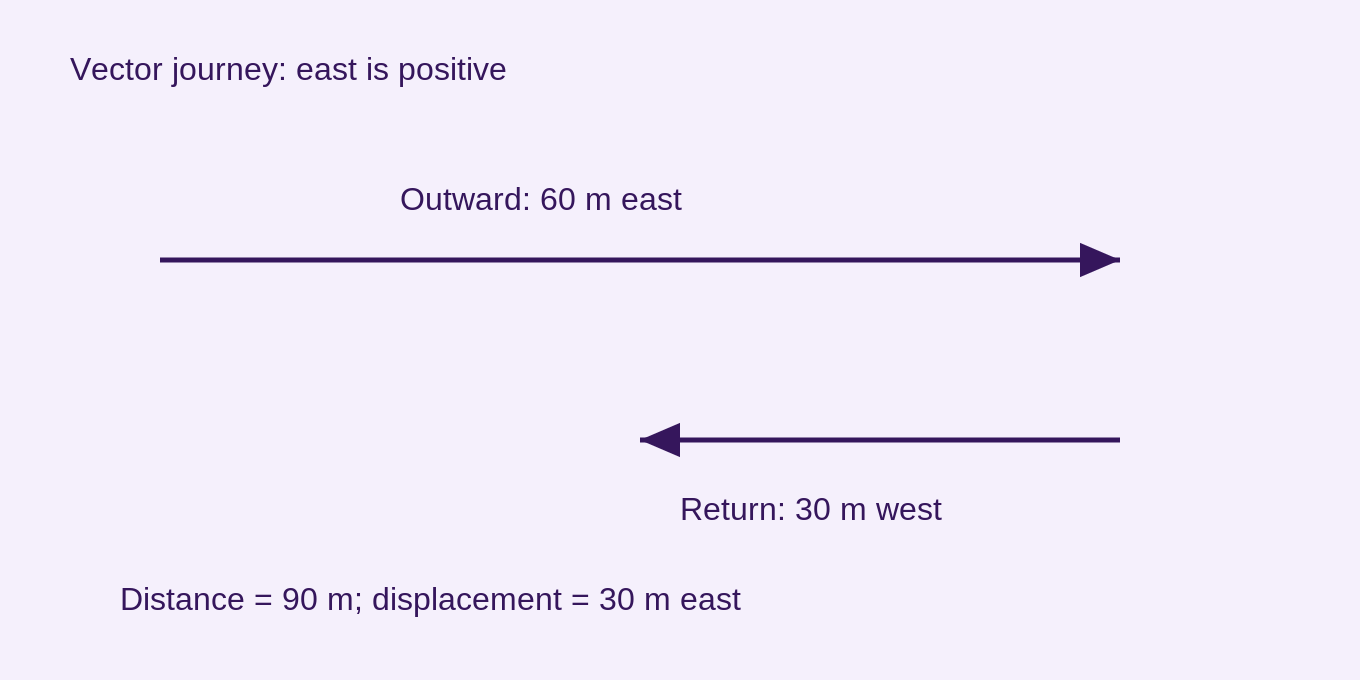
Distance is non-negative, so average speed is non-negative. Average velocity instead uses displacement and can be zero for a return journey even when average speed is not zero. A measured distance and transit time should refer to the same part of the journey; uncertain timing is especially important over short distances.
Scientific diagram and interpretation
Equations and relationships
speed = distance/time; average speed = total distance/total time
Worked examples and applications
Unequal speeds, equal distances
Travel 100 m at 5.0 m s⁻¹ and 100 m at 10 m s⁻¹. Times are 20 s and 10 s. Average speed = 200/30 = 6.67 m s⁻¹ ≈ 6.7 m s⁻¹, not 7.5 m s⁻¹.
Include a stop
A 600 m journey takes 100 s moving plus 20 s stopped. Whole-journey average = 600/120 = 5.0 m s⁻¹. Excluding the stop answers a different question.
Common misconceptions
The average of speeds is not generally the average speed.
Examination technique
Show total distance and total elapsed time as separate lines.
For an explanation, connect the physical cause to its effect. For a calculation, state the model, rearrange before substitution, retain intermediate digits, and finish with units. For a data question, refer to the actual readings and distinguish a trend from proof of a cause.
Check your understanding
Five questions. Choose an option, then Check Answer. Read the feedback and use Try Again to reset. Use Tab between controls, arrow keys within radio groups, and Enter or Space on buttons. These local practice answers are not saved.

FREE RESOURCES
Physics revision
Explore the available lessons, diagrams and questions in your subject hub.
Free No payment
Explore Physics Browse exam resources