Motion quantities, SI units and conversions
FREE PHYSICS REVISION · UNIT 3 · B1.1
Pearson BTEC Level 3 AAQ Applied Science · Issue 7 (May 2026)
Learning objectives
- Identify the motion symbols u, v, s, t and a and state their meanings.
- Use metres, seconds, m s⁻¹ and m s⁻² consistently in motion calculations.
- Convert speeds between km h⁻¹, km s⁻¹ and m s⁻¹.
- Check the units and order of magnitude of a stated motion measurement or calculation.
Specification mapping: B1.1, B1.1.1, B1.1.2
Prerequisites: A1.4
Physical principles
Use u for initial velocity, v for final velocity, s for displacement in a one-dimensional motion equation, t for elapsed time and a for acceleration. SI units are m, s, m s⁻¹ and m s⁻². The same symbol s can denote distance in a speed calculation; state which quantity is intended rather than relying on the symbol alone.
A kilometre is 1000 m and an hour is 3600 s. Convert km h⁻¹ to m s⁻¹ by dividing by 3.6; convert back by multiplying by 3.6. Convert km s⁻¹ to m s⁻¹ by multiplying by 1000. Keep the time denominator: km s⁻¹ is not km h⁻¹.
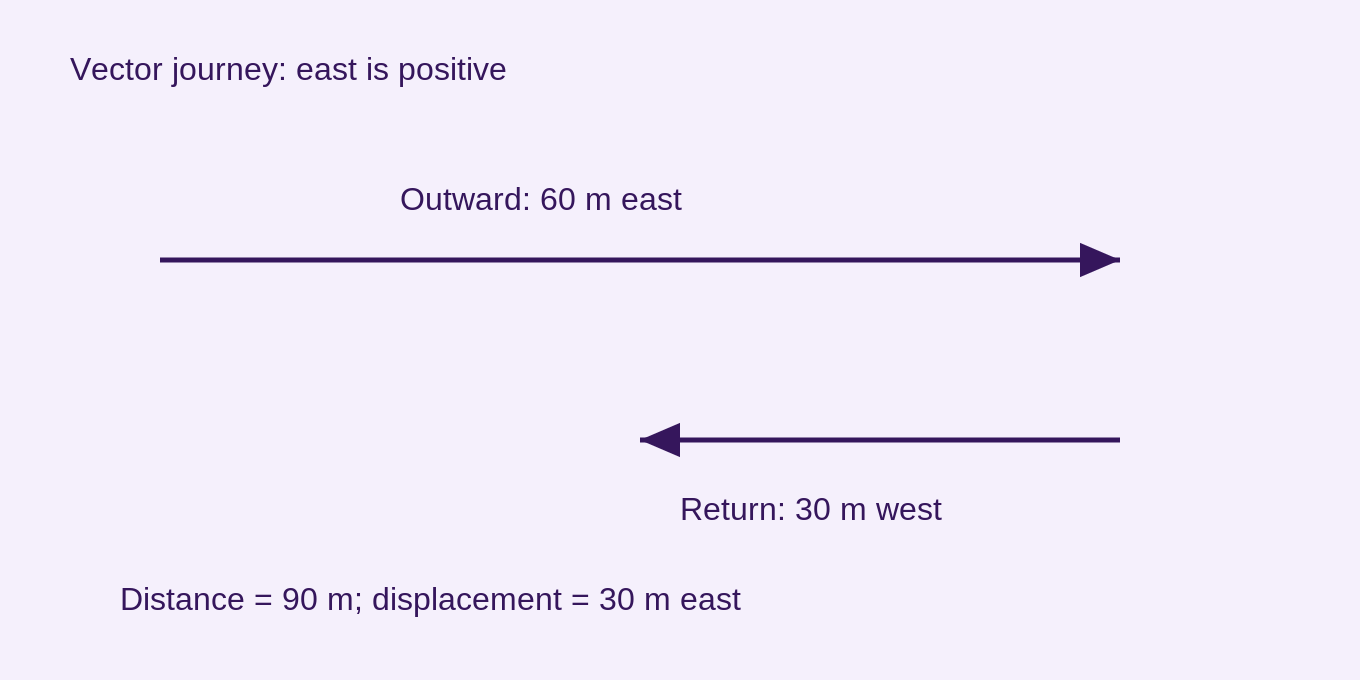
Acceleration measures velocity change per second. An acceleration of 2 m s⁻² means velocity changes by 2 m s⁻¹ in each second while that acceleration is maintained. A negative value describes acceleration opposite to the chosen positive direction; it does not always mean decreasing speed.
Scientific diagram and interpretation
Worked examples and applications
Road speed
72 km h⁻¹ = 72 × 1000/3600 = 20 m s⁻¹. In the reverse conversion, 15 m s⁻¹ × 3.6 = 54 km h⁻¹.
Kilometres each second
7.5 km s⁻¹ = 7.5 × 1000 = 7500 m s⁻¹. Multiplying by 3600 would instead convert the value to km h⁻¹.
Common misconceptions
m s⁻² is a change in velocity per second, not a speed squared.
Examination technique
Make the positive direction explicit before assigning signs to velocities.
For an explanation, connect the physical cause to its effect. For a calculation, state the model, rearrange before substitution, retain intermediate digits, and finish with units. For a data question, refer to the actual readings and distinguish a trend from proof of a cause.
Check your understanding
Five questions. Choose an option, then Check Answer. Read the feedback and use Try Again to reset. Use Tab between controls, arrow keys within radio groups, and Enter or Space on buttons. These local practice answers are not saved.
Take Your Learning Further
Practise
Build Your Confidence
Reinforce your understanding with our topic-based workbook. Every workbook page links back to its matching online lesson, so you can revisit explanations whenever you need support.
Explore Workbook – PhysicsMaster
Get Exam Ready
Apply your knowledge with exam-style practice papers and detailed mark schemes. Identify what you’ve mastered and what to revise next.
Practice Papers – PhysicsEXAM RESOURCES
Physics exam resources
Apply your knowledge with written practice.
Browse exam resources