Impact protection: restraints and vehicle structures
FREE PHYSICS REVISION · UNIT 3 · B2.5.3
Pearson BTEC Level 3 AAQ Applied Science · Issue 7 (May 2026)
Learning objectives
- Explain how increasing stopping time can reduce average force for the same momentum change.
- Describe the roles of seat belts, airbags and motorcycle helmets in impact protection.
- Distinguish the protective functions of a rigid passenger cell and deformable crumple zones.
- Apply momentum and energy-transfer ideas to evaluate a stated vehicle-safety design and its limitations.
Specification mapping: B2.5.3
Prerequisites: B2.5.2
Physical principles
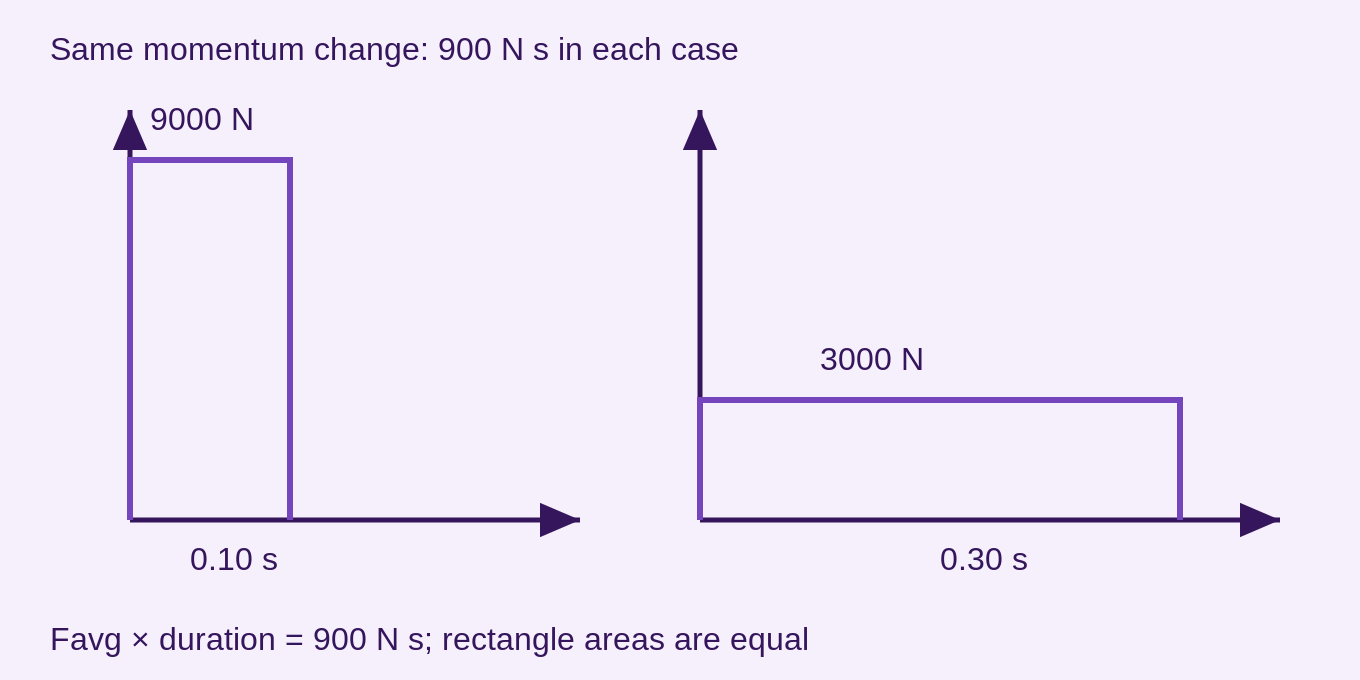
Impact protection manages forces, energy transfer and occupant motion. For a given momentum change, increasing stopping time reduces average force. Controlled deformation also increases stopping distance and absorbs energy. A smaller average force does not by itself specify the peak or injury risk, so design also controls force distribution and intrusion.
Seat belts restrain occupants so they decelerate with the vehicle rather than striking the interior or being ejected. Load limiting and controlled stretch can manage force; a belt must still hold the occupant safely. Airbags supplement belts, increase effective stopping time and spread contact over a larger area. They do not eliminate momentum change.
A motorcycle helmet’s deformable liner increases head stopping time and spreads loading; its shell protects against penetration and distributes force. Crumple zones deform to lengthen vehicle deceleration and dissipate kinetic energy. A passenger cell is designed to preserve survival space and resist intrusion, so it has a different function from an intentionally deforming crumple zone.
Assess an entire restraint system: posture, correct fit, collision direction and structural integrity matter. Do not propose removing belts because airbags exist. Energy is transferred into deformation, heating and other forms; it is not destroyed by a crash structure.
Scientific diagram and interpretation
Worked examples and applications
Stopping-time benefit
A 60 kg occupant changes speed from 15 to 0 m s⁻¹. |Δp| = 900 N s. Over 0.10 s average force magnitude is 9000 N; over 0.30 s it is 3000 N. These are simplified resultant averages, not medical injury thresholds.
Different structural roles
A crumple zone deforming while a passenger cell retains shape is not contradictory: the first manages deceleration energy, the second protects occupant space.
Common misconceptions
Airbags supplement seat belts; a passenger cell is not meant to collapse like a crumple zone.
Examination technique
Link named design features to time, distance, force distribution or survival space.
For an explanation, connect the physical cause to its effect. For a calculation, state the model, rearrange before substitution, retain intermediate digits, and finish with units. For a data question, refer to the actual readings and distinguish a trend from proof of a cause.
Check your understanding
Five questions. Choose an option, then Check Answer. Read the feedback and use Try Again to reset. Use Tab between controls, arrow keys within radio groups, and Enter or Space on buttons. These local practice answers are not saved.
Take Your Learning Further
Practise
Build Your Confidence
Reinforce your understanding with our topic-based workbook. Every workbook page links back to its matching online lesson, so you can revisit explanations whenever you need support.
Explore Workbook – PhysicsMaster
Get Exam Ready
Apply your knowledge with exam-style practice papers and detailed mark schemes. Identify what you’ve mastered and what to revise next.
Practice Papers – PhysicsEXAM RESOURCES
Physics exam resources
Apply your knowledge with written practice.
Browse exam resources