Potential difference, current and resistance
FREE PHYSICS REVISION · UNIT 3 · C2.1.2
Pearson BTEC Level 3 AAQ Applied Science · Issue 7 (May 2026)
Learning objectives
- Apply V = IR to determine potential difference, current or resistance at a stated operating point.
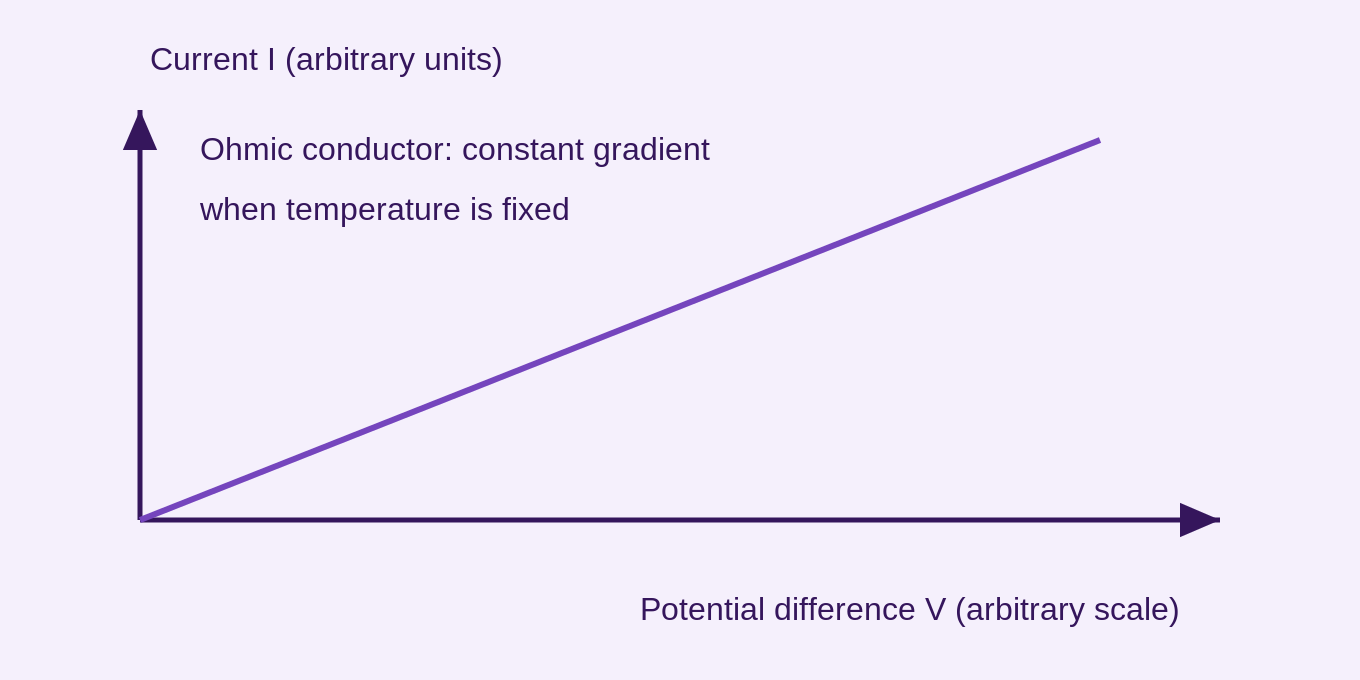
- Explain the conditions under which a component shows an ohmic relationship.
- Interpret current–potential-difference graphs and distinguish constant from changing resistance.
- Determine resistance from suitable graph data while checking the axes and units.
Specification mapping: C2.1.2
Prerequisites: C1.4
Physical principles
V = IR relates the potential difference across a component to its current and resistance at a specified operating point. Rearrange to R = V/I or I = V/R. Ohm’s law is the additional statement that current is proportional to voltage when physical conditions such as temperature are constant for an ohmic conductor.
For a fixed resistor at constant temperature, an I–V graph is a straight line through the origin. Its gradient is I/V = 1/R. On a V-against-I graph the gradient is R. Axis choice reverses the interpretation. For a nonlinear component, V/I gives its static resistance at the chosen point; a local tangent slope describes a different incremental relationship.
Convert kΩ to Ω and mA to A before substituting. An increase in resistance reduces current if voltage is fixed; increasing voltage raises current if resistance is fixed. Do not assume both stay fixed while discussing a change. Heating at high current can alter resistance and invalidate a nominal constant-resistance model.
Scientific diagram and interpretation
Equations and relationships
V = IR
Worked examples and applications
Find resistance
V = 9.0 V, I = 0.030 A. R = V/I = 9.0/0.030 = 300 Ω = 0.30 kΩ.
Find current
A 2.2 kΩ resistor has 11 V across it. I = V/R = 11/2200 = 0.0050 A = 5.0 mA.
Graph slope
An I-against-V line rises 0.20 A over 4.0 V. Gradient = 0.050 A V⁻¹. R = 1/gradient = 20 Ω.
Common misconceptions
Ohm’s law is not the claim that every component has constant resistance at every temperature.
Examination technique
Name the graph axes before using its slope to find resistance.
For an explanation, connect the physical cause to its effect. For a calculation, state the model, rearrange before substitution, retain intermediate digits, and finish with units. For a data question, refer to the actual readings and distinguish a trend from proof of a cause.
Check your understanding
Five questions. Choose an option, then Check Answer. Read the feedback and use Try Again to reset. Use Tab between controls, arrow keys within radio groups, and Enter or Space on buttons. These local practice answers are not saved.
Take Your Learning Further
Practise
Build Your Confidence
Reinforce your understanding with our topic-based workbook. Every workbook page links back to its matching online lesson, so you can revisit explanations whenever you need support.
Explore Workbook – PhysicsMaster
Get Exam Ready
Apply your knowledge with exam-style practice papers and detailed mark schemes. Identify what you’ve mastered and what to revise next.
Practice Papers – PhysicsEXAM RESOURCES
Physics exam resources
Apply your knowledge with written practice.
Browse exam resources