FREE PHYSICS REVISION · UNIT 3 · A1.3.1
Pearson BTEC Level 3 AAQ Applied Science · Issue 7 (May 2026)
What you will learn
Discrete electron energies and emission of different light frequencies.
Specification mapping: A1.3.1
Prerequisites: A1.1.1
Physical principles
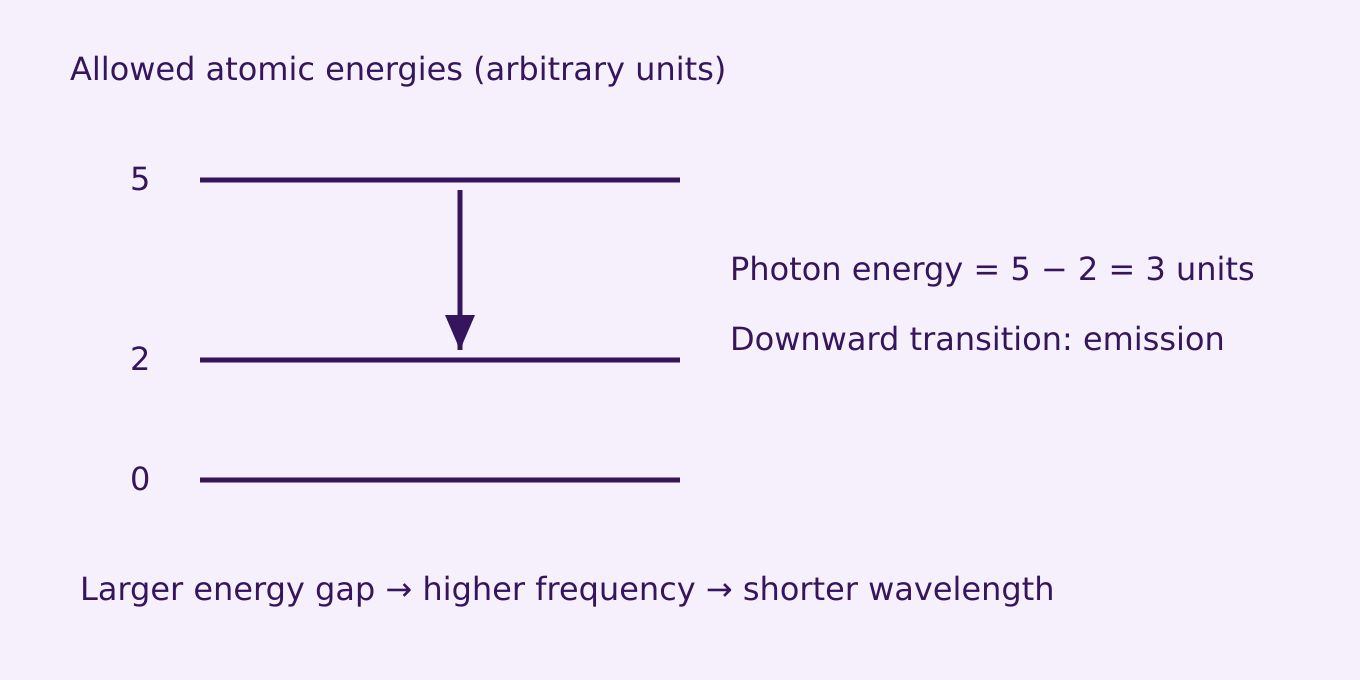
An atom has allowed electron energy states. Energy absorbed from a discharge or flame can excite an electron to a higher state. When it drops to a lower allowed state, the atom can emit a photon carrying the energy difference. The lower state need not be the ground state.
Because allowed differences are discrete, emitted photons have particular frequencies. A larger downward energy difference produces a higher frequency and shorter vacuum wavelength. The supporting relation ΔE = hf links photon energy to frequency; h is Planck’s constant. It explains the mechanism rather than adding an unlisted Unit 3 calculation requirement.
A collection of atoms can produce several lines because different transitions are possible. A line spectrum is not a continuous rainbow: missing frequencies reflect unavailable transitions. Some transitions lie outside the visible region, so a visible spectrum alone may show only part of an element’s emission.
Scientific diagram and interpretation
Equations and relationships
ΔE = hf (supporting explanation)
Worked examples and applications
Compare transitions
Transition X has twice the energy difference of Y. Since ΔE = hf, fX = 2fY. With c = fλ, λX = λY/2. Neither photon travels faster in vacuum.
Interpret an energy diagram
An electron falls from a state marked 5 arbitrary energy units to one marked 2. The emitted photon has energy 3 units, not 5. A transition from 5 to 4 emits a lower-frequency photon.
Common misconceptions
Electrons emit photons on downward transitions, not simply because they orbit an atom.
Examination technique
Describe excitation, a lower final state, and energy conservation in that order.
For an explanation, connect the physical cause to its effect. For a calculation, state the model, rearrange before substitution, retain intermediate digits, and finish with units. For a data question, refer to the actual readings and distinguish a trend from proof of a cause.
Check your understanding
Five questions. Choose an option, then Check Answer. Read the feedback and use Try Again to reset. Use Tab between controls, arrow keys within radio groups, and Enter or Space on buttons. These local practice answers are not saved.
Take Your Learning Further
Practise
Build Your Confidence
Reinforce what you’ve learned with our topic-based workbook. Every workbook page links back to its matching online lesson, so help is always at hand.
Explore Workbooks – PhysicsMaster
Get Exam Ready
Challenge yourself with exam-style practice papers and detailed mark schemes. Apply your knowledge, identify areas to improve and build exam confidence.
Practice Papers – PhysicsEXAM RESOURCES
Physics exam resources
Apply your knowledge with written practice.
Browse exam resources