Calculating wave speed, frequency and wavelength
FREE PHYSICS REVISION · UNIT 3 · A1.4
Pearson BTEC Level 3 AAQ Applied Science · Issue 7 (May 2026)
Learning objectives
- Apply v = fλ to calculate wave speed, frequency or wavelength.
- Rearrange the wave equation before substituting values with consistent units.
- Convert between relevant SI prefixes and express calculated answers with appropriate units.
- Explain how wavelength changes when frequency or wave speed changes under stated conditions.
Specification mapping: A1.4
Prerequisites: A1.1.1
Physical principles
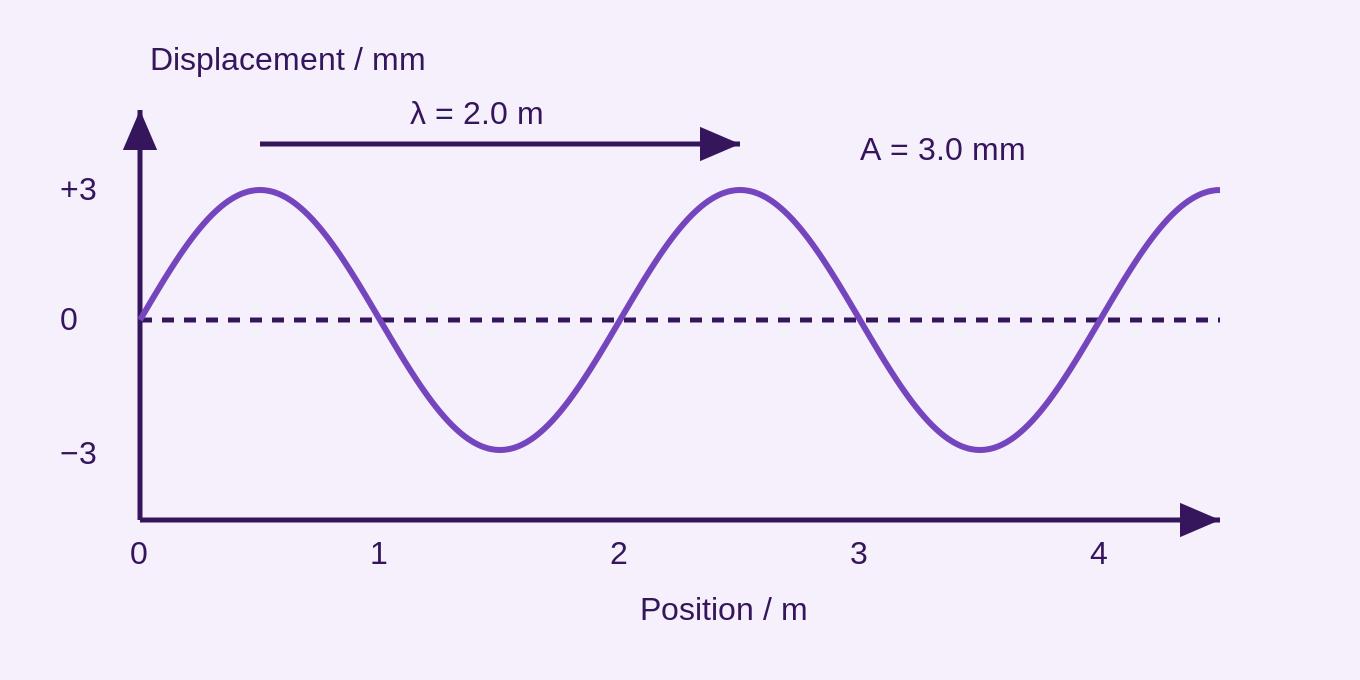
In one period a travelling wave advances one wavelength. Speed is therefore λ/T, and because f = 1/T this becomes v = fλ. This relation applies to periodic transverse and longitudinal waves. Use the propagation speed in the particular medium, not automatically the speed of light.
Rearrange before substituting: f = v/λ and λ = v/f. Convert kilohertz to hertz, millimetres to metres and nanometres to metres first. The dimensions confirm the equation: s⁻¹ × m = m s⁻¹. Quote answers with units and a precision justified by the input data.
At a stationary boundary, frequency is unchanged because the boundary is driven by the source oscillations. If speed decreases on entering another medium, wavelength decreases proportionally. The speed–frequency relationship is not a universal claim that raising frequency increases speed: for a given non-dispersive medium, wavelength adjusts.
Scientific diagram and interpretation
Equations and relationships
v = fλ
Worked examples and applications
Find sound wavelength
Sound has v = 340 m s⁻¹ and f = 850 Hz. λ = v/f = 340/850 = 0.400 m ≈ 0.40 m to two significant figures.
Convert radio units
A 100 MHz wave has f = 1.00 × 10⁸ Hz. With c = 3.00 × 10⁸ m s⁻¹, λ = c/f = 3.00 m.
Rearrange for frequency
A wave travels at 12 m s⁻¹ with λ = 0.080 m. f = v/λ = 12/0.080 = 150 Hz = 1.5 × 10² Hz.
Common misconceptions
Use the wave speed appropriate to the medium; sound does not travel at 3 × 10⁸ m s⁻¹.
Examination technique
Write prefix conversions explicitly before entering a calculator expression.
For an explanation, connect the physical cause to its effect. For a calculation, state the model, rearrange before substitution, retain intermediate digits, and finish with units. For a data question, refer to the actual readings and distinguish a trend from proof of a cause.
Check your understanding
Five questions. Choose an option, then Check Answer. Read the feedback and use Try Again to reset. Use Tab between controls, arrow keys within radio groups, and Enter or Space on buttons. These local practice answers are not saved.
Take Your Learning Further
Practise
Build Your Confidence
Reinforce your understanding with our topic-based workbook. Every workbook page links back to its matching online lesson, so you can revisit explanations whenever you need support.
Explore Workbook – PhysicsMaster
Get Exam Ready
Apply your knowledge with exam-style practice papers and detailed mark schemes. Identify what you’ve mastered and what to revise next.
Practice Papers – PhysicsEXAM RESOURCES
Physics exam resources
Apply your knowledge with written practice.
Browse exam resources