FREE PHYSICS REVISION · UNIT 3 · A1.5
Pearson BTEC Level 3 AAQ Applied Science · Issue 7 (May 2026)
What you will learn
Stationary waves and resonance in strings, open pipes and closed pipes; instruments.
Specification mapping: A1.5, A1.5.1
Prerequisites: A1.3, A1.4
Physical principles
A stationary wave forms when waves of the same frequency and similar amplitude travel in opposite directions and superpose, often because of reflection. Nodes have zero displacement at all times; antinodes have the greatest oscillation amplitude. Adjacent nodes are λ/2 apart and a node is λ/4 from the next antinode. The pattern does not travel along the medium.
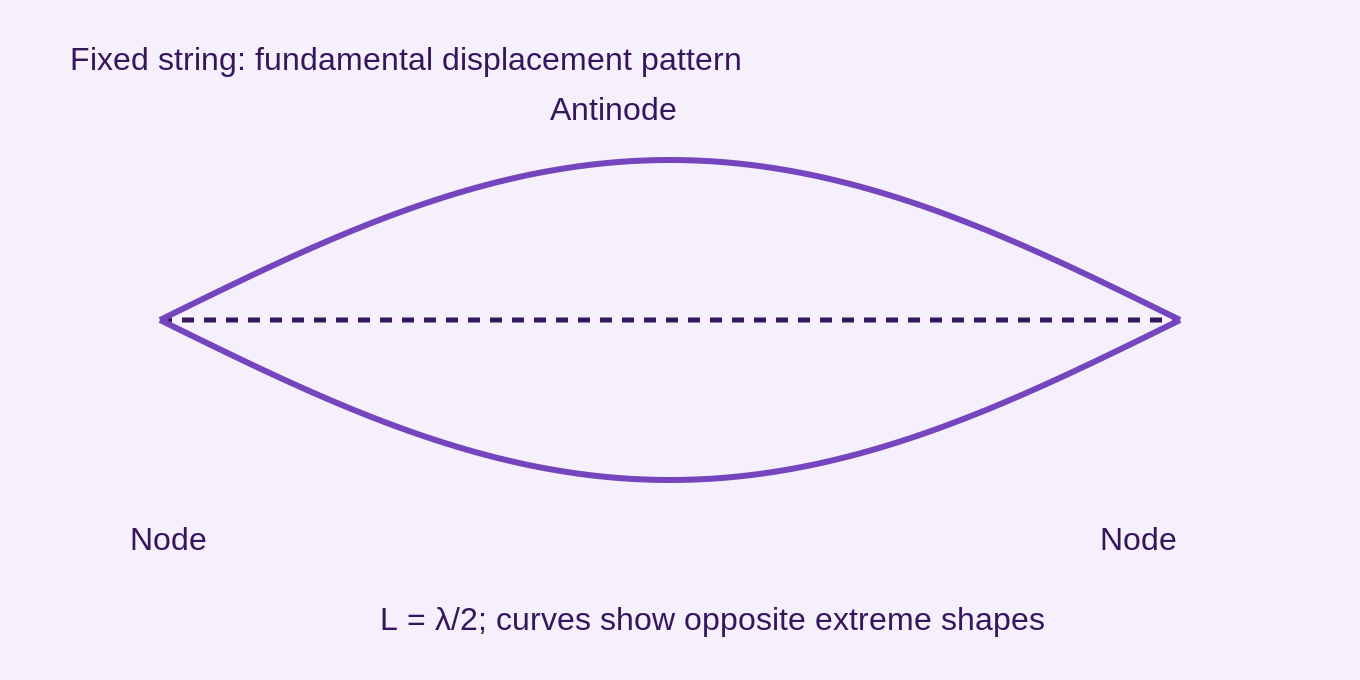
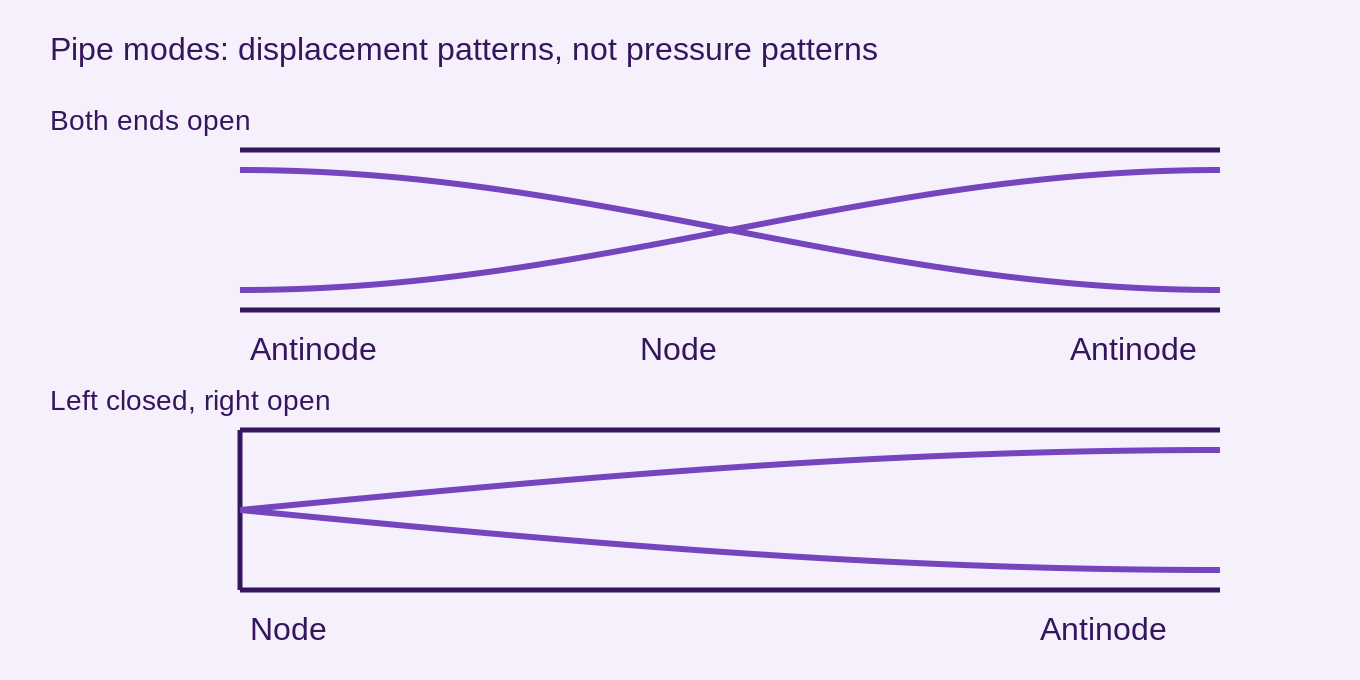
A string fixed at both ends has displacement nodes at the ends. Its fundamental has one antinode and length L = λ/2, giving f₁ = v/(2L). Higher allowed modes have L = nλ/2. A pipe open at both ends has displacement antinodes near both openings and, approximately, the same half-wavelength fundamental condition.
A pipe closed at one end has a displacement node at the closed end and antinode at the open end. Its fundamental has L ≈ λ/4, so f₁ ≈ v/(4L); ideal modes are odd harmonics. Pressure nodes and antinodes are reversed relative to displacement. Real pipes need end corrections.
Resonance is a large response when driving frequency is near a natural frequency. Energy input per cycle balances dissipation at a steady amplitude; damping limits the response. Finger positions, string tension, pipe length and opening keys change allowed frequencies in musical instruments. Stationary waves store and exchange energy locally; an ideal stationary wave has no net average energy flux along its length.
Scientific diagram and interpretation
Equations and relationships
f₁ = v/(2L); f₁ ≈ v/(4L) (boundary-derived supporting relations)
Worked examples and applications
String fundamental
A string has L = 0.65 m and v = 260 m s⁻¹. λ₁ = 2L = 1.30 m; f₁ = v/λ₁ = 260/1.30 = 200 Hz.
Closed pipe
For L = 0.25 m and sound speed 340 m s⁻¹, ignoring end correction, λ₁ = 4L = 1.0 m; f₁ = 340/1.0 = 340 Hz. The next ideal mode is 3f₁ = 1020 Hz, not 680 Hz.
Common misconceptions
An open pipe end is a displacement antinode, but a pressure node. Specify which quantity the diagram represents.
Examination technique
Mark boundaries first, then count half- or quarter-wavelength segments.
For an explanation, connect the physical cause to its effect. For a calculation, state the model, rearrange before substitution, retain intermediate digits, and finish with units. For a data question, refer to the actual readings and distinguish a trend from proof of a cause.
Check your understanding
Five questions. Choose an option, then Check Answer. Read the feedback and use Try Again to reset. Use Tab between controls, arrow keys within radio groups, and Enter or Space on buttons. These local practice answers are not saved.

FREE RESOURCES
Physics revision
Explore the available lessons, diagrams and questions in your subject hub.
Free No payment
Explore Physics Browse exam resources