FREE PHYSICS REVISION · UNIT 3 · A3.3
Pearson BTEC Level 3 AAQ Applied Science · Issue 7 (May 2026)
What you will learn
Overlapping spectral regions; satellite/GPS, mobile, Bluetooth, infrared and Wi-Fi.
Specification mapping: A3.3, A3.3.1
Prerequisites: A3.1, A3.2
Physical principles
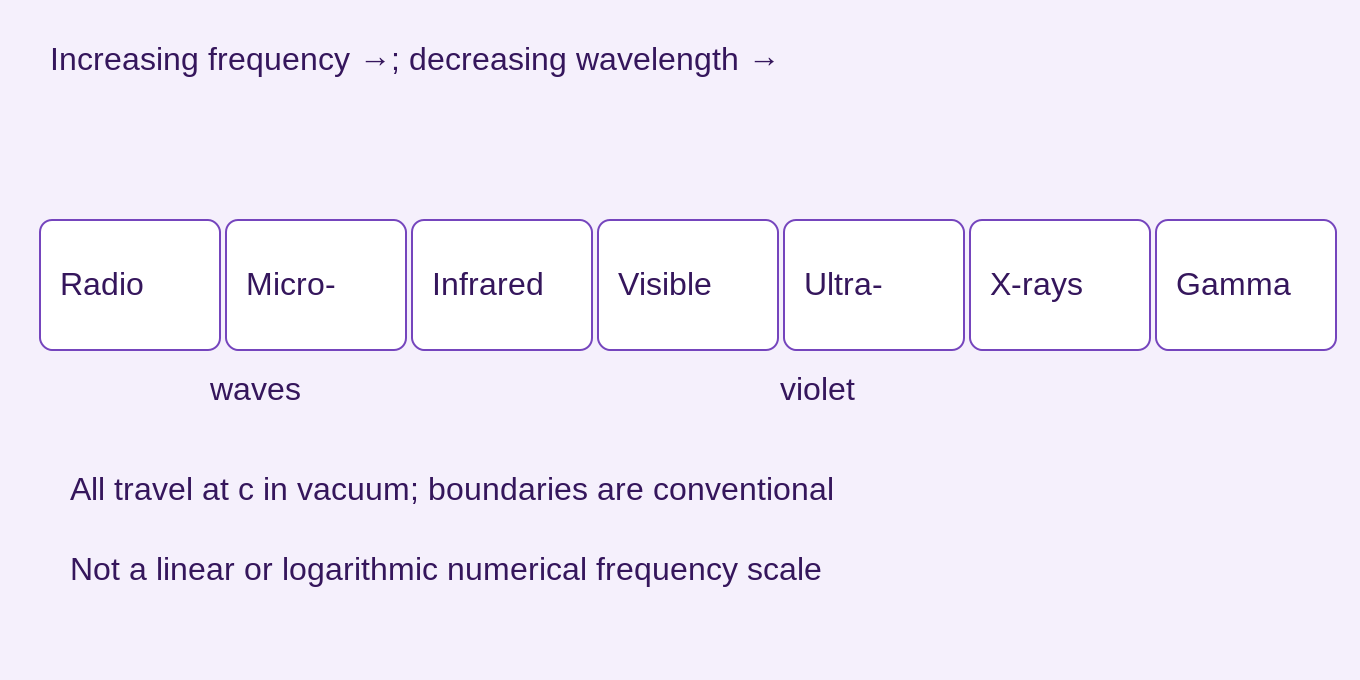
The electromagnetic spectrum is continuous. In increasing frequency order the conventional regions are radio, microwave, infrared, visible, ultraviolet, X-rays and gamma rays. Wavelength decreases as frequency increases. Region boundaries are conventions and can overlap; X-rays and gamma rays are also distinguished by production mechanisms. No sharp physical wall separates every named region.
Satellite links and GPS use microwave radio signals that can pass through the atmosphere in selected bands. GPS receivers use timed coded signals from multiple satellites plus orbital information to estimate position and receiver clock offset. A receiver does not generally send a return pulse to each GPS satellite to measure an echo.
Mobile networks use allocated radio bands, including microwave frequencies, with base stations routing communication. Bluetooth commonly uses the 2.4 GHz band for short-range links. Wi-Fi uses radio/microwave bands such as 2.4, 5 and 6 GHz where permitted. These are examples, not an exhaustive or permanent allocation table. Infrared supports short-range remote controls and optical links but is readily blocked by opaque objects.
Choose a system using range, bandwidth, obstacles, power and interference. Higher frequency alone does not guarantee greater range. Fibre uses optical infrared in selected low-loss windows, while free-space infrared links need suitable line of sight. Many devices share bands, so channel selection, modulation and coding are important. All examples obey c = fλ in vacuum.
Scientific diagram and interpretation
Worked examples and applications
Bluetooth wavelength
Using f = 2.4 × 10⁹ Hz, λ = c/f = (3.0 × 10⁸)/(2.4 × 10⁹) = 0.125 m ≈ 0.13 m. The band is shared with some Wi-Fi systems.
GPS timing sensitivity
A timing error of 10 ns = 1.0 × 10⁻⁸ s corresponds to distance cΔt = 3.0 m. This illustrates why timing and clock corrections matter; a complete position solution uses multiple satellites.
Common misconceptions
GPS positioning uses one-way satellite broadcasts and timing, not a simple two-way echo. “Microwave” and “radio” labels can overlap.
Examination technique
Link each communication use to transmission conditions; do not claim every frequency passes through all obstacles.
For an explanation, connect the physical cause to its effect. For a calculation, state the model, rearrange before substitution, retain intermediate digits, and finish with units. For a data question, refer to the actual readings and distinguish a trend from proof of a cause.
Check your understanding
Five questions. Choose an option, then Check Answer. Read the feedback and use Try Again to reset. Use Tab between controls, arrow keys within radio groups, and Enter or Space on buttons. These local practice answers are not saved.

FREE RESOURCES
Physics revision
Explore the available lessons, diagrams and questions in your subject hub.
Free No payment
Explore Physics Browse exam resources