Constant-acceleration motion equations
FREE PHYSICS REVISION · UNIT 3 · B1.3.8
Pearson BTEC Level 3 AAQ Applied Science · Issue 7 (May 2026)
Learning objectives
- Select an appropriate constant-acceleration equation for the quantities supplied in a problem.
- Rearrange and apply the stated motion equations using consistent SI units.
- Use signed displacements, velocities and accelerations to solve one-dimensional motion problems.
- Evaluate whether constant acceleration is a reasonable assumption for the situation described.
Specification mapping: B1.3.8
Prerequisites: B1.3.6
Physical principles
For straight-line motion with constant acceleration, v = u + at, s = (u+v)t/2, s = ut + ½at² and v² = u² + 2as. Here s is signed displacement, not automatically total path length. These equations are alternative descriptions of the same constant-acceleration model.
Choose the equation that contains the required unknown and the known quantities. Define direction, list signed values and rearrange before substitution. If taking a square root after using v², choose the velocity sign consistent with the motion. If the object reverses direction, split the journey when calculating total distance.
The equations do not apply unchanged to varying acceleration, such as a falling object approaching terminal velocity. An average acceleration does not justify using every constant-acceleration relationship. Check dimensions: ut and at² both have units of length; 2as has units of speed squared. For vertical motion without significant air resistance, choose the sign of g according to the axis.
Scientific diagram and interpretation
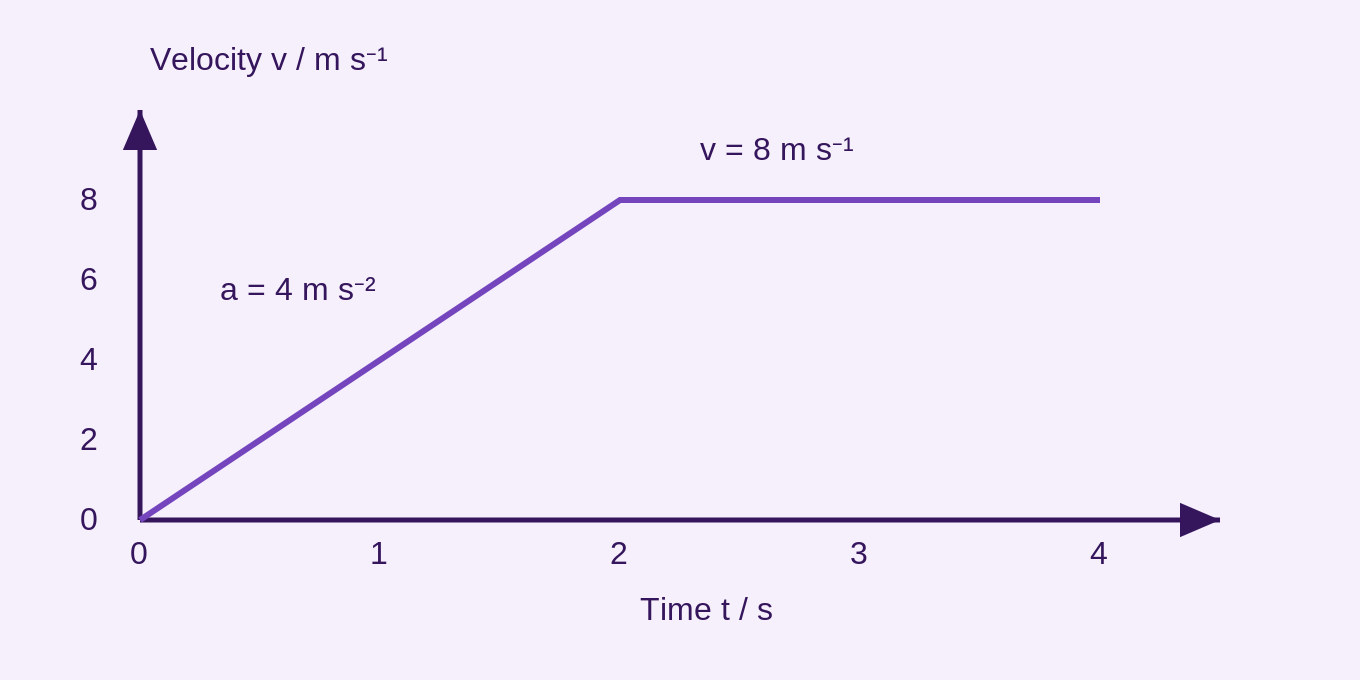
Equations and relationships
s = (u+v)t/2; v = u+at; s = ut+½at²; v² = u²+2as
Worked examples and applications
Final velocity
u = 3.0 m s⁻¹, a = 2.0 m s⁻², t = 4.0 s. v = u + at = 3.0 + 2.0 × 4.0 = 11 m s⁻¹.
Displacement
With those values, s = ut + ½at² = 3.0 × 4.0 + 0.5 × 2.0 × 4.0² = 28 m. Check s = (3.0+11)×4.0/2 = 28 m.
Stopping distance
u = 20 m s⁻¹, v = 0, a = −5.0 m s⁻². Rearrange v² = u² + 2as to s = (v²−u²)/(2a) = (0−400)/(−10) = 40 m.
Time from velocities
For u = 4.0 m s⁻¹, v = 12 m s⁻¹ and s = 32 m, t = 2s/(u+v) = 64/16 = 4.0 s.
Common misconceptions
Constant acceleration is a condition of the model, not a guaranteed property of every moving object.
Examination technique
Select an equation that avoids unneeded unknowns and check the sign of the result.
For an explanation, connect the physical cause to its effect. For a calculation, state the model, rearrange before substitution, retain intermediate digits, and finish with units. For a data question, refer to the actual readings and distinguish a trend from proof of a cause.
Check your understanding
Five questions. Choose an option, then Check Answer. Read the feedback and use Try Again to reset. Use Tab between controls, arrow keys within radio groups, and Enter or Space on buttons. These local practice answers are not saved.
Take Your Learning Further
Practise
Build Your Confidence
Reinforce your understanding with our topic-based workbook. Every workbook page links back to its matching online lesson, so you can revisit explanations whenever you need support.
Explore Workbook – PhysicsMaster
Get Exam Ready
Apply your knowledge with exam-style practice papers and detailed mark schemes. Identify what you’ve mastered and what to revise next.
Practice Papers – PhysicsEXAM RESOURCES
Physics exam resources
Apply your knowledge with written practice.
Browse exam resources