Diffraction gratings and line spectra
FREE PHYSICS REVISION · UNIT 3 · A1.3.2
Pearson BTEC Level 3 AAQ Applied Science · Issue 7 (May 2026)
Learning objectives
- Describe how a diffraction grating separates light into directions associated with different wavelengths.
- Explain why an excited low-pressure gas produces discrete emission lines rather than a continuous spectrum.
- Interpret a grating spectrum to distinguish spectral lines, orders and the central image.
- Describe how to observe line spectra safely and identify limitations of the resulting measurements.
Specification mapping: A1.3.2
Prerequisites: A1.3, A1.3.1
Physical principles
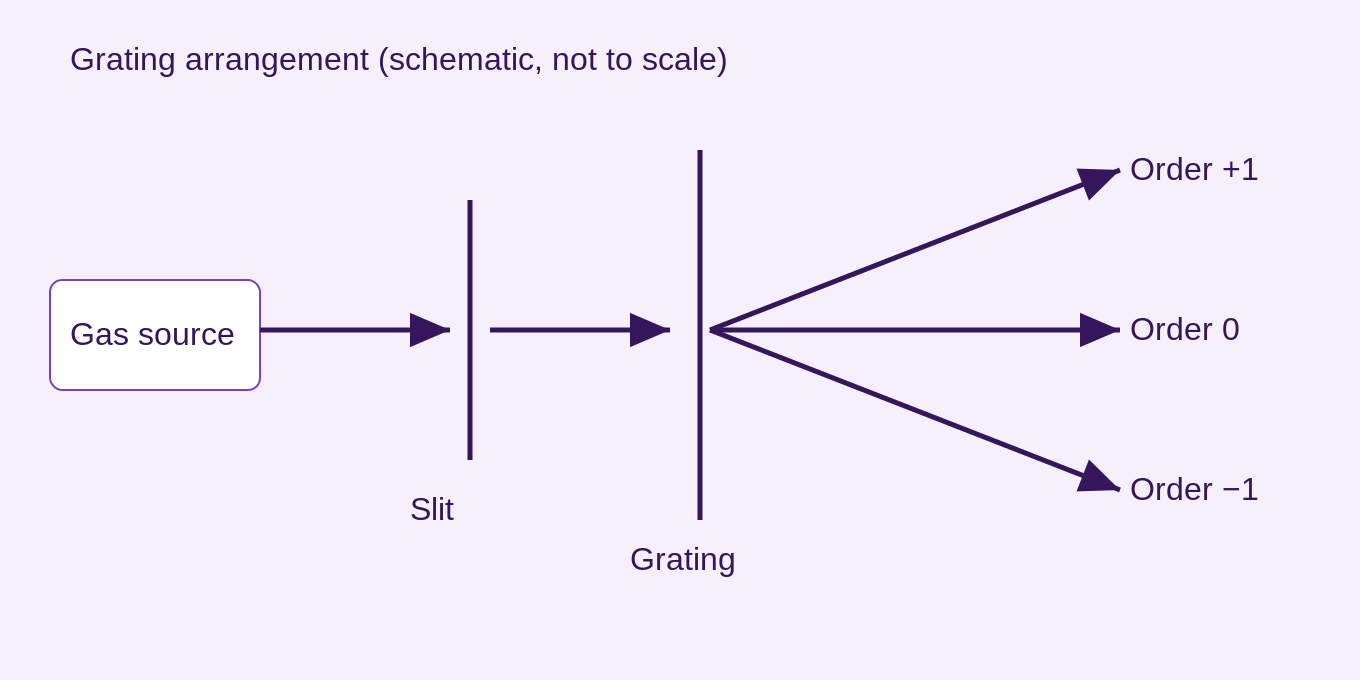
A diffraction grating contains many equally spaced narrow apertures or grooves. Diffraction spreads light from each aperture; interference selects angles at which the contributions reinforce. With several wavelengths present, each has its own reinforcement angles. A slit and collimator give a narrow, approximately parallel incident beam so individual lines can be resolved.
The central, zero-order image is undeviated and overlaps all incident wavelengths. First and higher orders appear on both sides. Within a given non-zero order under normal incidence, longer wavelengths have larger deviation angles. A monochromatic source gives repeated images of one wavelength, whereas a gas discharge gives separate coloured lines from its discrete emitted wavelengths.
Use a spectrometer to locate line angles relative to the central direction. Subtract angular readings rather than using an arbitrary scale reading as deviation. Measuring corresponding left and right orders can reduce alignment bias. Gratings separate frequencies already present; they do not create the atomic spectrum. Never look into a laser or use an unfiltered solar source.
Scientific diagram and interpretation
Worked examples and applications
Compare colours
In the first order, a red line appears farther from the centre than a blue line. This is consistent with red having longer wavelength. Their vacuum speeds are equal.
Use symmetric readings
Corresponding lines occur at −18.0° and +18.4° relative to a reference. Half their separation gives a deviation estimate (18.0 + 18.4)/2 = 18.2°, reducing a small zero offset.
Common misconceptions
Diffraction spreading and interference selection both contribute; refraction in a prism is a different mechanism.
Examination technique
Distinguish the light source, the grating and the detector in a labelled arrangement.
For an explanation, connect the physical cause to its effect. For a calculation, state the model, rearrange before substitution, retain intermediate digits, and finish with units. For a data question, refer to the actual readings and distinguish a trend from proof of a cause.
Check your understanding
Five questions. Choose an option, then Check Answer. Read the feedback and use Try Again to reset. Use Tab between controls, arrow keys within radio groups, and Enter or Space on buttons. These local practice answers are not saved.
Take Your Learning Further
Practise
Build Your Confidence
Reinforce your understanding with our topic-based workbook. Every workbook page links back to its matching online lesson, so you can revisit explanations whenever you need support.
Explore Workbook – PhysicsMaster
Get Exam Ready
Apply your knowledge with exam-style practice papers and detailed mark schemes. Identify what you’ve mastered and what to revise next.
Practice Papers – PhysicsEXAM RESOURCES
Physics exam resources
Apply your knowledge with written practice.
Browse exam resources