FREE PHYSICS REVISION · UNIT 3 · A3.2
Pearson BTEC Level 3 AAQ Applied Science · Issue 7 (May 2026)
What you will learn
I = k/r²; ratios, graphs, assumptions and data analysis.
Specification mapping: A3.2
Prerequisites: A3.1
Physical principles
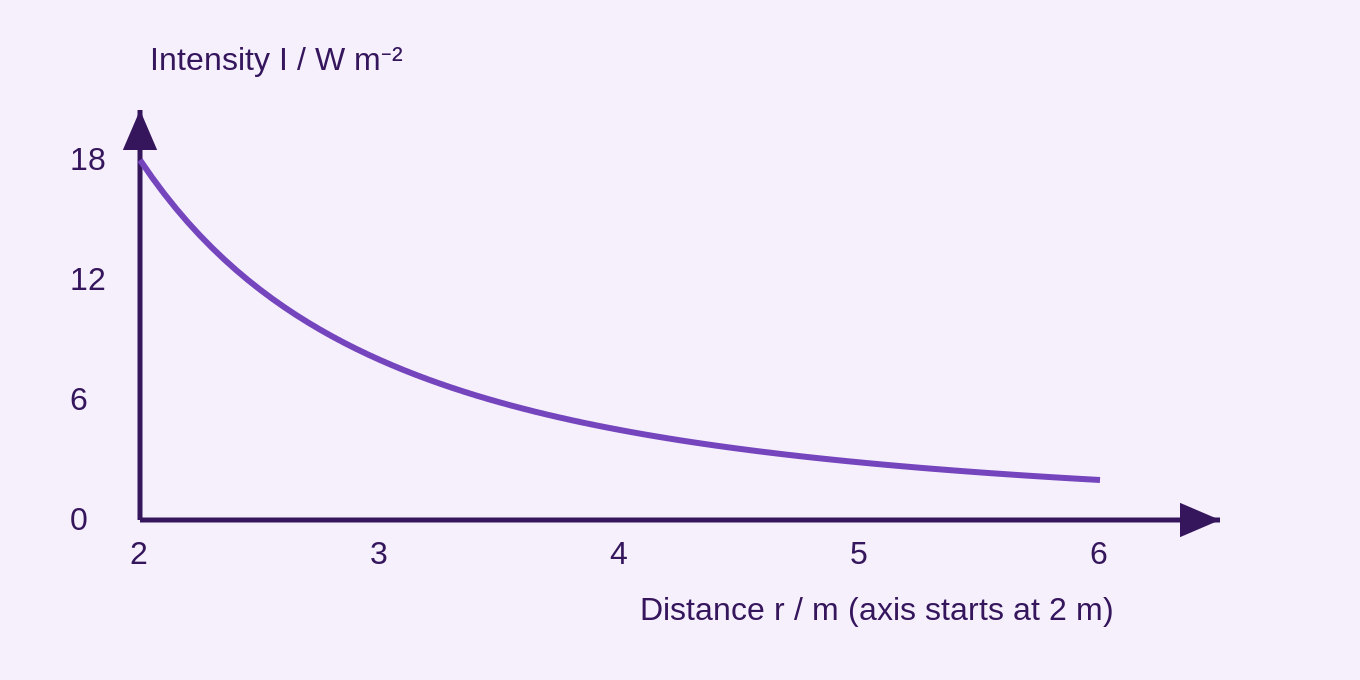
Intensity is power transferred per unit area, measured in W m⁻². If a point source radiates uniformly and energy is not absorbed, its power spreads over spherical area 4πr². Therefore I = P/(4πr²) = k/r², where k is constant for that source and geometry. The equation requires distance from the source, not distance from an arbitrary detector zero.
Doubling r makes intensity one quarter; tripling r makes it one ninth. A plot of I against r is curved, while I against 1/r² should be a straight line through the origin for an ideal source with no background. The gradient equals k and has units W. Measured detector output must be proportional to intensity for the test to work.
Background radiation gives an offset. Subtract a separately measured background when appropriate. Near a large source, in a collimated beam, in absorbing material or where reflections matter, the point-source inverse-square approximation may fail. Increasing distance does not make the wave lose frequency; the energy is distributed over a greater area.
Scientific diagram and interpretation
Equations and relationships
I = k/r²
Worked examples and applications
Use a ratio
Intensity is 12 W m⁻² at 2.0 m. At 5.0 m, I₂ = I₁(r₁/r₂)² = 12(2.0/5.0)² = 1.92 W m⁻² ≈ 1.9 W m⁻².
Find k
At r = 3.0 m, I = 8.0 W m⁻². k = Ir² = 8.0 × 3.0² = 72 W. The model predicts I = 72/6.0² = 2.0 W m⁻² at 6.0 m.
Common misconceptions
Intensity is not total source power; distance redistributes power across area.
Examination technique
Square the distance ratio and state the point-source, low-absorption assumption.
For an explanation, connect the physical cause to its effect. For a calculation, state the model, rearrange before substitution, retain intermediate digits, and finish with units. For a data question, refer to the actual readings and distinguish a trend from proof of a cause.
Check your understanding
Five questions. Choose an option, then Check Answer. Read the feedback and use Try Again to reset. Use Tab between controls, arrow keys within radio groups, and Enter or Space on buttons. These local practice answers are not saved.
FREE RESOURCES
Physics revision
Explore the available lessons, diagrams and questions in your subject hub.
Free No payment
Explore Physics Browse exam resources