FREE PHYSICS REVISION · UNIT 3 · B1.3.3
Pearson BTEC Level 3 AAQ Applied Science · Issue 7 (May 2026)
What you will learn
Velocity from gradients, tangents and curved displacement graphs.
Specification mapping: B1.3.3
Prerequisites: B1.3
Physical principles
The gradient of a displacement–time graph is velocity: Δs/Δt for a straight segment. A positive gradient means motion in the positive direction; a negative gradient means motion in the opposite direction. A horizontal segment means constant displacement and hence zero velocity.
On a curved graph, the instantaneous velocity is the gradient of the tangent at the required time. Choose two well-separated points on the tangent, not necessarily measured data points, and calculate rise divided by run. The average velocity between two times is the gradient of their connecting chord, which can differ from the tangent gradient.
A steeper magnitude of gradient corresponds to greater speed. The graph’s height gives position relative to the origin, not velocity. An object can be far from the origin and stationary or pass through the origin at a large speed. Displacement–time area has units m s and does not directly give distance travelled.
Scientific diagram and interpretation
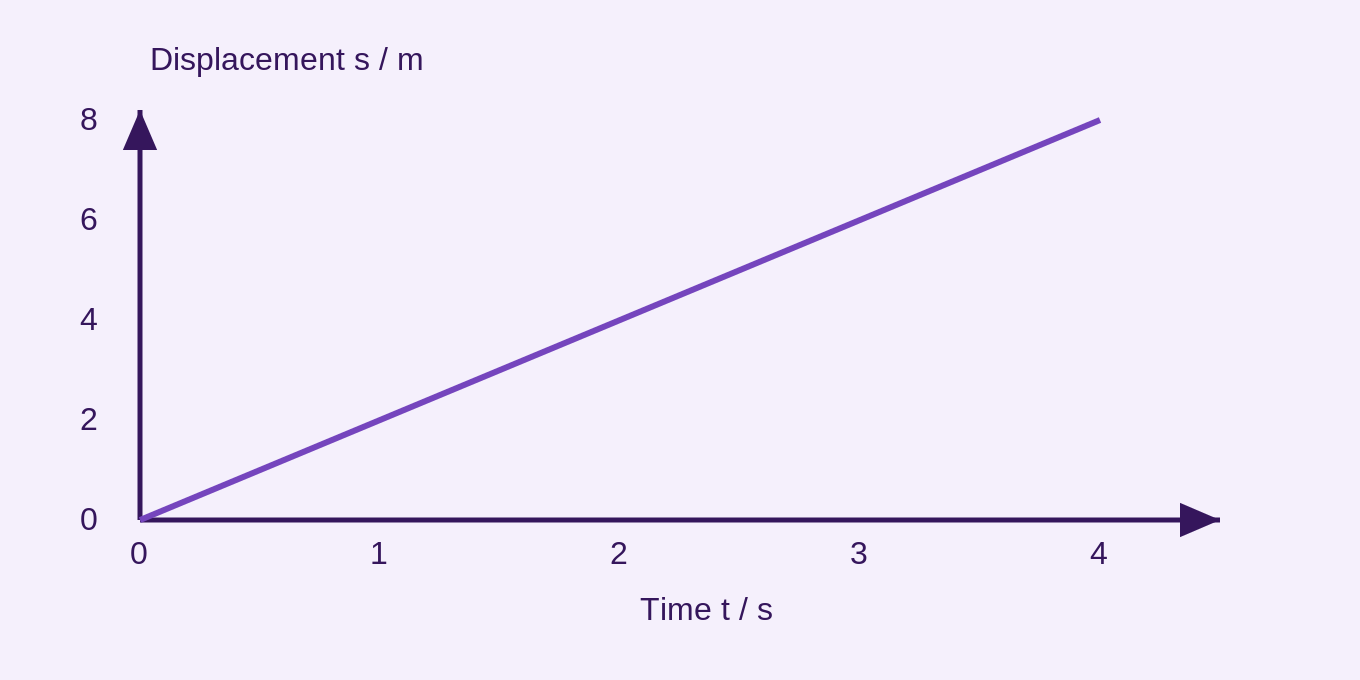
Equations and relationships
v = Δs/Δt (gradient)
Worked examples and applications
Straight-segment velocity
Displacement changes from 4.0 m at 1.0 s to 16 m at 5.0 s. v = (16 − 4.0)/(5.0 − 1.0) = 3.0 m s⁻¹.
Tangent estimate
A tangent passes through (2.0 s, 5.0 m) and (6.0 s, 17 m). Its slope is 12/4.0 = 3.0 m s⁻¹. Use the tangent points even if the curve itself does not pass through them.
Common misconceptions
The displacement value is not the velocity; velocity comes from slope.
Examination technique
Draw a large gradient triangle and include units on both changes.
For an explanation, connect the physical cause to its effect. For a calculation, state the model, rearrange before substitution, retain intermediate digits, and finish with units. For a data question, refer to the actual readings and distinguish a trend from proof of a cause.
Check your understanding
Five questions. Choose an option, then Check Answer. Read the feedback and use Try Again to reset. Use Tab between controls, arrow keys within radio groups, and Enter or Space on buttons. These local practice answers are not saved.

FREE RESOURCES
Physics revision
Explore the available lessons, diagrams and questions in your subject hub.
Free No payment
Explore Physics Browse exam resources