FREE PHYSICS REVISION · UNIT 3 · B1.4
Pearson BTEC Level 3 AAQ Applied Science · Issue 7 (May 2026)
What you will learn
Applications in fitness trackers, phones and blood-pressure monitoring systems.
Specification mapping: B1.4
Prerequisites: B1.3.6
Physical principles
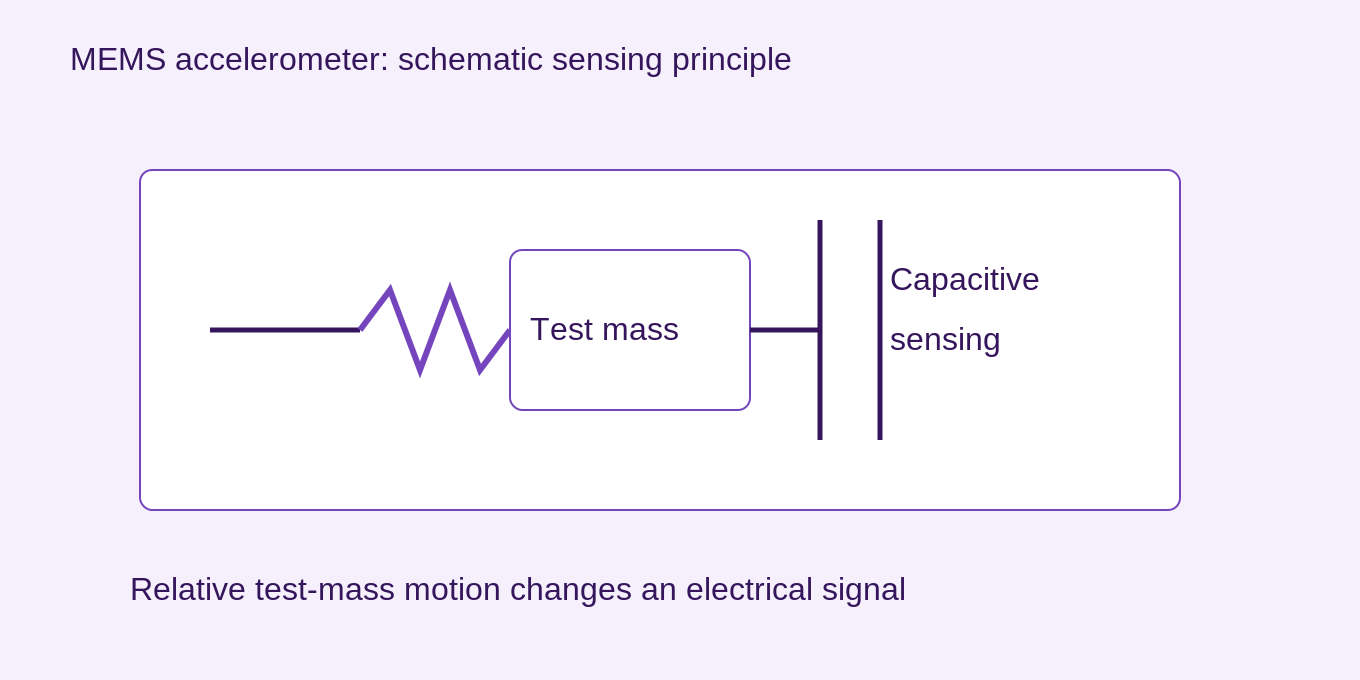
An accelerometer measures acceleration-related effects through a sensing element, often a tiny suspended mass in a microelectromechanical device. Displacement or force on that element changes an electrical property such as capacitance. Multiple axes allow movement and orientation-related effects to be detected.
Phones use accelerometer data for screen orientation, motion control and activity detection. Fitness trackers infer steps and movement patterns, but steps are an algorithmic estimate rather than a direct count of physical distance. A stationary supported sensor can register the support-related response associated with gravity; a freely falling sensor ideally reads near zero specific force. Raw sensor data therefore need careful interpretation.
In blood-pressure monitoring systems, accelerometers can identify movement, posture or vibration and help reject motion-contaminated readings. They do not directly replace a cuff pressure transducer. Common oscillometric blood-pressure measurement uses cuff-pressure pulsations; not every monitor includes an accelerometer. Keep this distinction when explaining the specification’s application.
Calibration, sensor orientation, sampling rate and filtering affect measurements. Integrating acceleration to estimate velocity or position accumulates small offsets over time, so additional reference information may be needed. An acceleration trace can show events without proving their cause.
Scientific diagram and interpretation
Worked examples and applications
Sensor offset
An illustrative acceleration offset of 0.020 m s⁻² maintained for 10 s produces a velocity error Δv = at = 0.20 m s⁻¹ on integration. Small offsets accumulate.
Interpret monitoring data
A blood-pressure device flags large motion during cuff inflation. Rejecting and repeating the reading can improve confidence; claiming the accelerometer directly measured arterial pressure would confuse two sensors.
Common misconceptions
Accelerometers do not directly measure speed, distance or blood pressure.
Examination technique
Name the sensed quantity, then explain how processing supports the specific application.
For an explanation, connect the physical cause to its effect. For a calculation, state the model, rearrange before substitution, retain intermediate digits, and finish with units. For a data question, refer to the actual readings and distinguish a trend from proof of a cause.
Check your understanding
Five questions. Choose an option, then Check Answer. Read the feedback and use Try Again to reset. Use Tab between controls, arrow keys within radio groups, and Enter or Space on buttons. These local practice answers are not saved.
Take Your Learning Further
Practise
Build Your Confidence
Reinforce what you’ve learned with our topic-based workbook. Every workbook page links back to its matching online lesson, so help is always at hand.
Explore Workbooks – PhysicsMaster
Get Exam Ready
Challenge yourself with exam-style practice papers and detailed mark schemes. Apply your knowledge, identify areas to improve and build exam confidence.
Practice Papers – PhysicsEXAM RESOURCES
Physics exam resources
Apply your knowledge with written practice.
Browse exam resources