FREE PHYSICS REVISION · UNIT 3 · B2.7
Pearson BTEC Level 3 AAQ Applied Science · Issue 7 (May 2026)
What you will learn
Air resistance, road vehicles, parachutes and objects falling in liquids.
Specification mapping: B2.7, B2.7.1
Prerequisites: B2.5, B2.6
Physical principles
If the resultant force is zero, acceleration is zero and velocity is constant, including the possibility of rest. A non-zero resultant changes velocity. Resistive drag commonly increases with speed, although its exact dependence varies with flow regime, object shape and fluid properties.
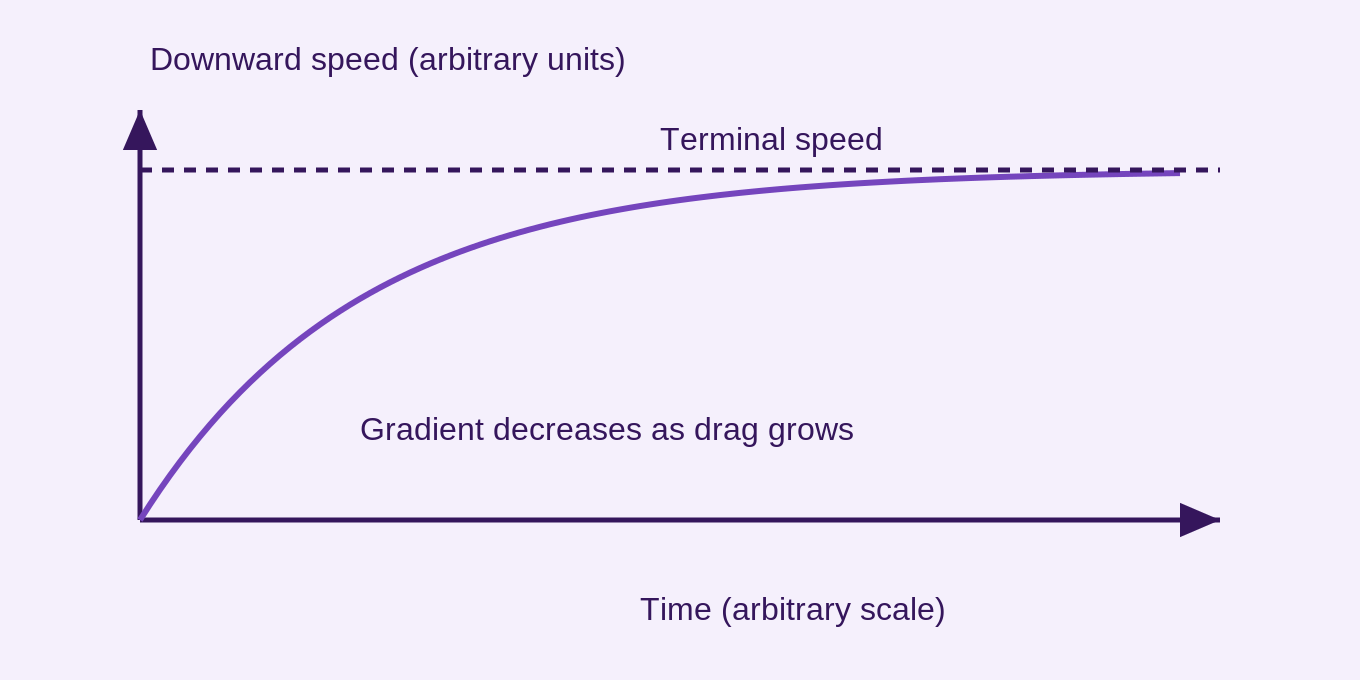
A falling object initially has a downward resultant because weight exceeds upward drag and buoyancy. As speed increases, drag grows and acceleration decreases. Terminal velocity occurs when upward forces balance weight. It is a non-zero steady velocity, not zero motion. In a liquid, upthrust can be substantial and must not be omitted when relevant.
Opening a parachute greatly increases effective drag area. Just after opening at the previous high speed, drag can exceed weight, giving upward acceleration while the person is still moving downwards. Speed decreases until a new lower terminal speed is reached. Eventually drag plus upthrust balances weight again.
A road vehicle reaches steady speed when drive balances rolling and aerodynamic resistance on a level road. Greater speed usually requires greater power to overcome drag. Do not assume a universal drag law or terminal speed without the necessary data. A velocity–time curve approaching a horizontal line has a gradient tending to zero.
Scientific diagram and interpretation
Worked examples and applications
Terminal force balance
A falling object weighs 10 N and experiences 2 N upthrust. At terminal velocity drag must be 8 N upward so total upward force is 10 N.
After parachute opening
A 70.0 kg person has weight 686.7 N before rounding. If upward drag is briefly 1.40 × 10³ N and upthrust is negligible, Fnet = 686.7−1400 = −713.3 N taking down as positive. a = −713.3/70 = −10.2 m s⁻²: downward speed decreases.
Common misconceptions
Terminal velocity means zero acceleration, not zero velocity. Deceleration after parachute opening can occur while motion is still downwards.
Examination technique
Describe how forces change during each stage and mention upthrust in fluid problems when significant.
For an explanation, connect the physical cause to its effect. For a calculation, state the model, rearrange before substitution, retain intermediate digits, and finish with units. For a data question, refer to the actual readings and distinguish a trend from proof of a cause.
Check your understanding
Five questions. Choose an option, then Check Answer. Read the feedback and use Try Again to reset. Use Tab between controls, arrow keys within radio groups, and Enter or Space on buttons. These local practice answers are not saved.

FREE RESOURCES
Physics revision
Explore the available lessons, diagrams and questions in your subject hub.
Free No payment
Explore Physics Browse exam resources