FREE PHYSICS REVISION · UNIT 3 · C2.1.3
Pearson BTEC Level 3 AAQ Applied Science · Issue 7 (May 2026)
What you will learn
P = E/t; work, energy and durations with SI conversions.
Specification mapping: C2.1.3
Prerequisites: C1.2
Physical principles
Power is the rate at which energy is transferred or work is done: P = E/t for average power over an interval. Here E is the energy transferred during that same interval, measured in joules, and t is in seconds. The unit watt is J s⁻¹. Rearranging gives E = Pt or t = E/P.
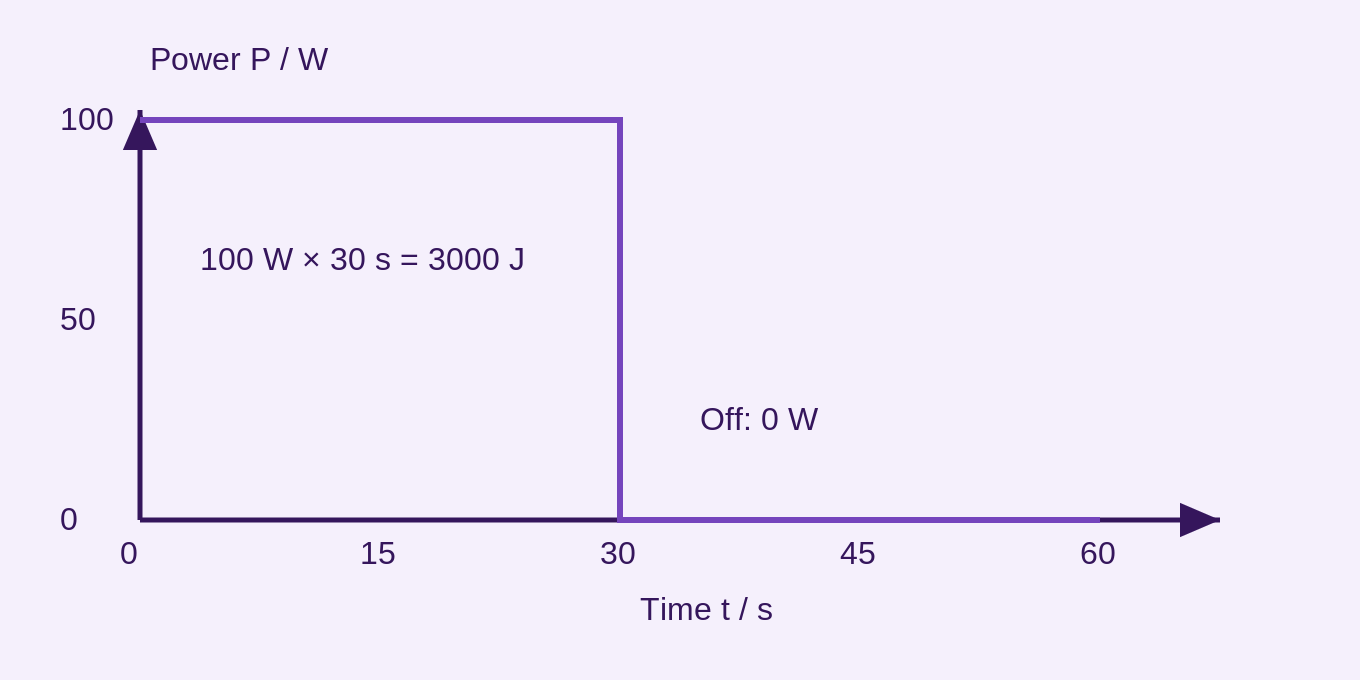
When power varies, E = Pt remains valid if P is the appropriate time-average power. Multiplying peak power by total duration overestimates energy when a device cycles or pulses. Energy is the area under a power–time graph: a rectangle for constant power, a sum of rectangles for simple intervals.
Mechanical work and electrical heating are different energy-transfer processes, but their power is measured in the same unit. An efficient device may transfer only part of input power to the desired outcome; account for the stated system boundary. Do not equate input and useful output without evidence.
Scientific diagram and interpretation
Equations and relationships
P = E/t
Worked examples and applications
Energy from power
A 40 W device operates for 3.0 min = 180 s. E = Pt = 40 × 180 = 7200 J = 7.2 kJ.
Time from energy
A constant 250 W heater must transfer 150 kJ. t = E/P = 150000/250 = 600 s = 10 min, assuming all the stated energy reaches the target.
Cycling device
A 100 W device runs for 30 s and then is off for 30 s. Energy = 3000 J over 60 s; average power = 50 W, although on-state power is 100 W.
Common misconceptions
A device rated at 100 W does not necessarily draw that power every second of a long controlled operating cycle.
Examination technique
Convert minutes to seconds for watts and joules, or explicitly use kW and hours for kWh.
For an explanation, connect the physical cause to its effect. For a calculation, state the model, rearrange before substitution, retain intermediate digits, and finish with units. For a data question, refer to the actual readings and distinguish a trend from proof of a cause.
Check your understanding
Five questions. Choose an option, then Check Answer. Read the feedback and use Try Again to reset. Use Tab between controls, arrow keys within radio groups, and Enter or Space on buttons. These local practice answers are not saved.
Take Your Learning Further
Practise
Build Your Confidence
Reinforce what you’ve learned with our topic-based workbook. Every workbook page links back to its matching online lesson, so help is always at hand.
Explore Workbooks – PhysicsMaster
Get Exam Ready
Challenge yourself with exam-style practice papers and detailed mark schemes. Apply your knowledge, identify areas to improve and build exam confidence.
Practice Papers – PhysicsEXAM RESOURCES
Physics exam resources
Apply your knowledge with written practice.
Browse exam resources