FREE PHYSICS REVISION · UNIT 3 · C5.1
Pearson BTEC Level 3 AAQ Applied Science · Issue 7 (May 2026)
What you will learn
Fusion and vaporisation measurements; sample mass changing phase and corrections.
Specification mapping: C5.1
Prerequisites: C4.3, C2.1.4
Physical principles
Specific latent heat is energy transferred per kilogram during a specified phase change without temperature change under the chosen pressure conditions. Fusion describes solid–liquid change; vaporisation describes liquid–gas change. They are different quantities for the same substance and depend on conditions.
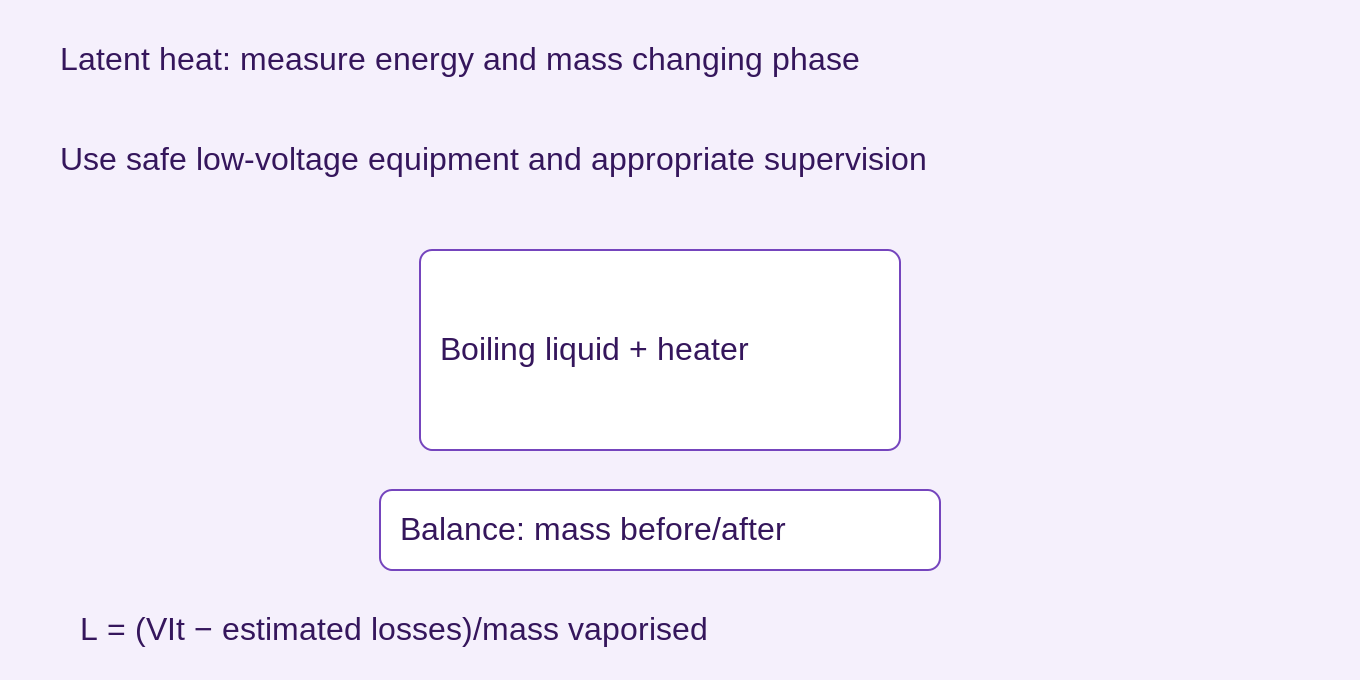
For vaporisation, bring a liquid to steady boiling with a controlled heater, then measure V, I and the time while measuring the mass lost. The simple estimate Lv = VIt/Δm uses only the mass vaporised in that interval, not the initial liquid mass. Correct for heat losses and unwanted evaporation or splashing; do not heat to dryness. A balance must be protected from heat and steam.
For fusion, one approach melts ice initially near its melting point using a heater and measures the meltwater mass. Run a comparable unheated control to estimate melting caused by surroundings. Subtract that background melt mass from the heated run under matched conditions, then Lf ≈ VIt/mheater. Alternatively use a calibrated mixing calorimeter and include water, container and any ice-warming terms.
Control initial phase temperature. Ice below its melting point first needs energy to warm; liquid initially below boiling needs sensible heating before vaporisation. These contributions cannot all be called latent energy. Use safe low-voltage apparatus, eye protection where appropriate, supervised hot-liquid handling and suitable collection arrangements.
Scientific diagram and interpretation
Equations and relationships
L ≈ VIt/mphase, after appropriate corrections
Worked examples and applications
Vaporisation estimate
At steady boiling, 12 V and 3.0 A run for 600 s while 0.010 kg is vaporised. Input = 21600 J. Uncorrected Lv = 21600/0.010 = 2.16 × 10⁶ J kg⁻¹ ≈ 2.2 × 10⁶ J kg⁻¹ to two significant figures. Neglected heat loss tends to make this input-based estimate too high.
Fusion control
A heated melting run collects 0.040 kg and a matched unheated control collects 0.010 kg. Heater-attributable melt = 0.030 kg. If input energy is 9900 J, Lf ≈ 9900/0.030 = 3.3 × 10⁵ J kg⁻¹, subject to matched background conditions.
Common misconceptions
Use mass that actually changes phase during the measured energy interval. Fusion is melting, not nuclear fusion in this context.
Examination technique
Separate warming to the transition temperature, phase change, and losses.
For an explanation, connect the physical cause to its effect. For a calculation, state the model, rearrange before substitution, retain intermediate digits, and finish with units. For a data question, refer to the actual readings and distinguish a trend from proof of a cause.
Check your understanding
Five questions. Choose an option, then Check Answer. Read the feedback and use Try Again to reset. Use Tab between controls, arrow keys within radio groups, and Enter or Space on buttons. These local practice answers are not saved.
Take Your Learning Further
Practise
Build Your Confidence
Reinforce what you’ve learned with our topic-based workbook. Every workbook page links back to its matching online lesson, so help is always at hand.
Explore Workbooks – PhysicsMaster
Get Exam Ready
Challenge yourself with exam-style practice papers and detailed mark schemes. Apply your knowledge, identify areas to improve and build exam confidence.
Practice Papers – PhysicsEXAM RESOURCES
Physics exam resources
Apply your knowledge with written practice.
Browse exam resources